
Hackers target temperature controls at French blood banks; alarms avert damage amid wider European freezer attacks
Narrative Snapshot
Across outlets, there is broad agreement that attackers manipulated temperature controls at three French blood storage sites and that on-site alarm systems enabled a rapid response before products were lost. The Guardian reports thresholds were raised to “very high levels” and credits alarms and technicians with preventing compromise, while France24 similarly describes the incident as unsuccessful and notes authorities’ confirmation.
Coverage diverges on how far the attackers pushed the systems. Several outlets specify an attempted spike from roughly -30°C to 110°C: ANSA cites a jump “from less than 30 to 110 degrees,” Deutsche Welle says temperatures were pushed “past the boiling point,” and RT attributes the 110°C figure to Le Canard Enchaîné. By contrast, Le Monde avoids quantification and stresses that any link to prior incidents remains unknown, and The Guardian confines itself to “very high levels.”
Most sources contextualize the event within a broader European pattern of attacks on refrigerators and freezers. The Guardian and France24 reference the supermarket incidents, while Le Monde underscores uncertainty about any connection. Italian and Argentine outlets characterize the episode as part of a “hybrid” campaign, whereas the BBC notes theories about culprits without endorsing any particular explanation. France24 adds that the French cooperative bank Crédit Mutuel Arkéa was also affected the same day, extending the story’s cross-sector resonance beyond the cold chain.
What Happened
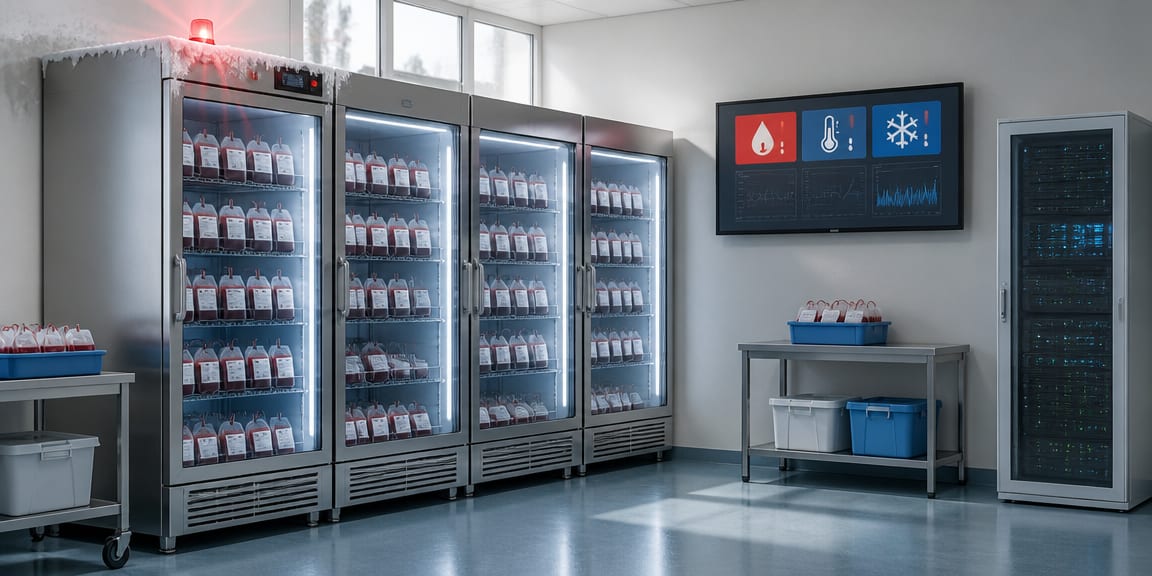
France’s national blood service (Etablissement français du sang, EFS) said that hackers accessed control systems at three cold storage facilities holding blood products and raised temperature and defrost thresholds to very high levels. Alarms triggered in time for technicians to intervene, and the health minister later said there was no health impact. Multiple outlets frame the incident as part of a recent wave targeting fridges and freezers across Europe, including supermarket cold storage in mid-October in France and early November in other countries. Some reports add technical detail and severity: ANSA, Deutsche Welle, and RT, citing Le Canard Enchaîné, say the attackers attempted to drive temperatures from around -30°C to as high as 110°C, and RT reports that equipment from an external refrigeration supplier was compromised. France24 notes the attack coincided with a cyber incident at Crédit Mutuel Arkéa.
Why It Matters
Coverage situates the incident at the intersection of healthcare resilience and a wider pattern of operational technology targeting. The move from supermarket cold chains to blood plasma storage suggests risk migration from retail to critical health services, with the public health stakes emphasized by The Guardian’s focus on “vital blood products” and France24’s description of donated blood and plasma in the affected facilities. The episode also highlights dependence on automated safeguards: alarms and human intervention prevented loss this time, per The Guardian and France24, but outlets citing extreme temperature manipulation point to the potential for catastrophic spoilage if defenses fail. Several sources frame the event within a broader, Europe-wide campaign against refrigeration systems; others, notably Le Monde, stress the absence of confirmed links. With attribution unsettled and “theories” circulating, as the BBC puts it, decision-makers face a cross-sector exposure that includes finance, given France24’s note on Crédit Mutuel Arkéa’s same-day disruption.
Diverging Narratives
Accounts split most clearly on severity and framing. The Guardian reports “very high” thresholds and successful intervention without numerical claims, while Le Monde emphasizes uncertainty about whether this incident is related to earlier refrigerator attacks. In contrast, ANSA and Deutsche Welle assert that temperatures were driven toward or beyond 100°C, and RT specifies a jump from -30°C to 110°C, attributing the detail to Le Canard Enchaîné and adding that an external refrigeration supplier’s equipment was the entry point. On impact, La Repubblica foregrounds the health minister’s assurance of “no health impact,” whereas Sky News and Deutsche Welle stress the gravity of the attempt to destroy blood plasma, and Clarin frames the episode as a near-disaster and part of an expanding “hybrid” conflict. Most outlets situate the event within Europe’s broader freezer hacks; Le Monde cautions that any linkage remains unproven, and the BBC underscores that attribution remains unsettled even as “theories” proliferate. France24’s inclusion of the Crédit Mutuel Arkéa incident broadens the aperture to concurrent, cross-sector disruptions.
What Happens Next
Two decision points are central. First, whether French authorities and EFS can establish any link between the blood bank incident and the refrigerator attacks in supermarkets reported across Europe. Le Monde highlights that this remains unknown; movement here would come through official statements tying campaigns together or distinguishing them. Second, whether EFS and its vendors change access controls and monitoring on refrigeration equipment. RT reports the compromise of an external supplier’s systems, which, if confirmed, would imply third‑party remediation and tighter remote access policies; confirmations of such steps by EFS or the ministry would signal the path chosen.
Analysts should also watch whether outlets converge on the reported 110°C attempt or revert to more cautious descriptions; that will reflect investigative clarity on the attack’s mechanics. Finally, France24’s note on Crédit Mutuel Arkéa invites attention to any coordinated responses across sectors if concurrent incidents persist, or, alternatively, to sector‑specific mitigations if the events remain discrete.