
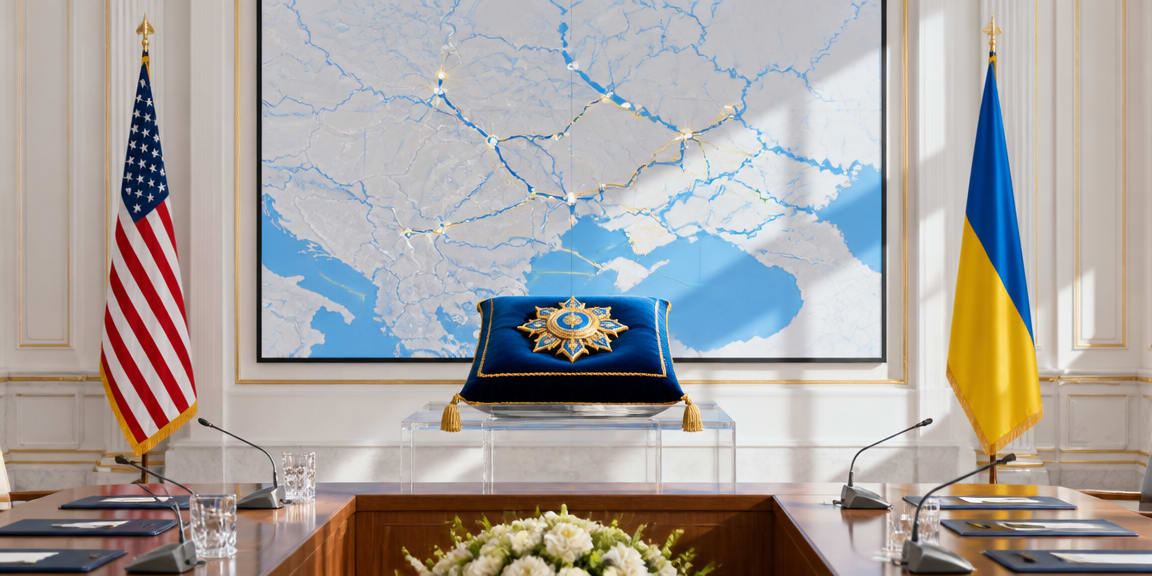
Zelensky awards Melania Trump Ukraine’s Order of Princess Olga as she hosts Russian and Ukrainian delegations before Abu Dhabi talks
Narrative Snapshot
Ukrainian and international outlets broadly agree that Kyiv’s move is formal recognition of Melania Trump’s role in humanitarian facilitation linked to the Oleshky truce, though they differ on how directly they tie the honor to ceasefire brokering. Ukrainian sources emphasize the state decoration and its stated rationale of “humanitarian support,” while several foreign outlets foreground her convening role in upcoming contacts among Kyiv, Moscow, and Washington. Russian and Latin American reporting centers on process and protocol—who will attend, where talks will occur, and what contacts are ruled out—rather than on the award itself. What is at stake across the coverage is whether a humanitarian foothold—the Oleshky evacuation corridor—can structure a next phase of contacts, with the White House meeting shaping Abu Dhabi discussions that some outlets describe as aimed at ending the war.
What Happened
President Volodymyr Zelensky awarded U.S. First Lady Melania Trump the Order of Princess Olga, 1st Class, citing her “significant personal contribution to humanitarian support for Ukraine,” according to Ukrainian outlets and the presidential decree. International reporting links the recognition to her role in facilitating a partial ceasefire that enabled evacuations from Russian‑occupied Oleshky. Multiple outlets report that Russian and Ukrainian delegations will meet the U.S. first lady at the White House on Thursday, ahead of trilateral talks in Abu Dhabi. The Kremlin said Dmitriev and Lantratova will represent Russia and that the full delegation will be announced later. Argentine reporting adds that Russia’s ombudsman will meet the first lady at an event tied to the Oleshky truce, anticipates visa issues being addressed, and notes the Kremlin has ruled out leader‑level phone contacts and separated the process from recent elections.
Why It Matters
This sequence spotlights an atypical, humanitarian‑led diplomatic channel: a first lady convening adversary delegations after helping secure a localized truce that enabled civilian evacuations. France24 reports that human rights chiefs from both countries are involved, suggesting a near‑term focus on practical measures that can build confidence for subsequent political talks. The Ukrainian state honor signals Kyiv’s endorsement of U.S. facilitation in this humanitarian space and may aim to consolidate momentum from the Oleshky precedent. Moscow’s controlled messaging on delegation makeup and its distancing from leader‑level contact or electoral timing indicate a preference for lower‑visibility tracks. With Abu Dhabi as venue, the process sits within a non‑Western third‑country facilitation pattern. For governments and multilateral actors, the configuration suggests opportunities—and limits—for humanitarian mechanisms to scaffold broader negotiations described by some outlets as aimed at ending the war.
Diverging Narratives
Ukrainian outlets present the award as recognition for humanitarian support, specifying the Order of Princess Olga, 1st Class. The Hindu adds institutional context on the order’s criteria across science, education, culture, and charitable work. By contrast, BBC and the South China Morning Post explicitly tie the honor to brokering the Oleshky ceasefire and the evacuation it enabled, with BBC characterizing it as Ukraine’s highest award. Russian state media does not engage that framing, focusing instead on delegation representation and deferring full details. Clarin emphasizes procedural elements, including expected resolution of visa issues, and underscores the Kremlin’s denial of leader‑level phone contacts and its effort to separate the talks from recent elections. Western and Asian outlets frame the White House meeting as a prelude to Abu Dhabi discussions “aimed at ending the Ukraine war,” while Ukrainian sources do not connect the award to that stated aim. Uncertainties remain over full delegation composition and how centrally the Oleshky template will figure in the agenda.
What Happens Next
Analysts should watch whether the White House meeting produces concrete humanitarian steps or agenda parameters for Abu Dhabi; France24’s note that human rights chiefs will attend points toward evacuation‑related or similar measures as early test cases. The Kremlin’s pending announcement of its full delegation, referenced by TASS, will signal mandate and scope, as will any parallel disclosures from Kyiv. Clarin’s mention of visa issues introduces a practical gating factor for participation that could affect timing. Coverage from Bangkok Post and France24 that frames Abu Dhabi talks as aimed at ending the war raises the question of whether discussions remain confined to humanitarian confidence‑building or broaden toward political issues; official readouts and participant lineups will indicate direction. Finally, whether future communications link progress to the Oleshky truce, as in BBC and SCMP reporting, or maintain a procedural posture, as in TASS, will shape expectations for incremental outcomes.