
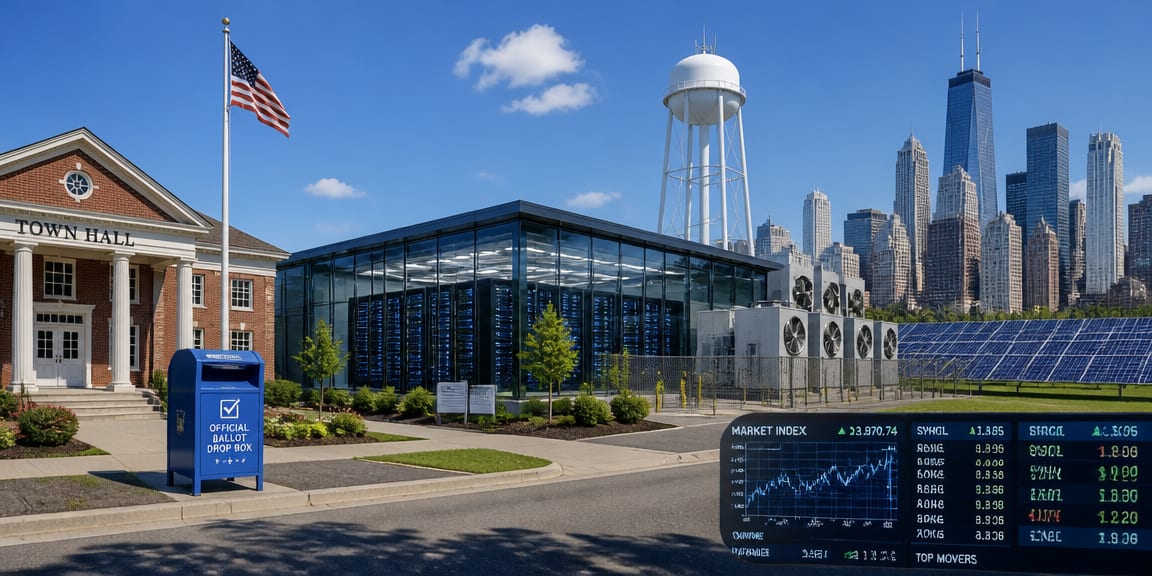
US midterms trigger local data center curbs and Democratic gains, prompting warnings of an AI buildout slowdown
Narrative Snapshot
Across the international press, there is broad agreement that local ballot measures in the United States delivered meaningful constraints on new data center projects. Japan Times and Folha de S.Paulo report that voters in dozens of cities approved restrictions or outright bans, with Folha highlighting that discontent tied to the artificial intelligence surge cut across party lines. Clarín places the emphasis on public distrust of the installations and cites El Dorado and Edgewater as cases where bans or restrictions passed, framing the outcome as a rejection of development policies associated with Donald Trump.
Business-focused coverage centers the financial and regulatory implications. The South China Morning Post reports that analysts see a Democratic midterm sweep ushering in a potential clampdown that could stall up to 30 percent of planned facilities, prompting Wall Street downgrades of Big Tech infrastructure spending. The Toronto Star, carrying an AP report, underscores a slate of Democrats pledging to tighten oversight, while BBC Verify scrutinizes whether a “data centre revolt” materially affected electoral outcomes and what rising anti-AI sentiment could mean for the sector.
Industry response narratives diverge between persuasion and standards-setting. Folha de S.Paulo reports that OpenAI launched an offensive to shift public opinion following the votes. Clarín details negotiations between major technology firms and environmental groups—backed by the Rockefeller Foundation—to define safeguards on energy, water, and community impacts, an attempt to channel local discontent into enforceable sustainability guidelines.
What Happened
Local ballots in the United States produced a wave of restrictions and bans on data centers, with Japan Times and Folha de S.Paulo both reporting approvals in dozens of cities. Clarín cites El Dorado and Edgewater among places that passed measures to prohibit or limit construction, interpreting the votes as a sign of mounting distrust and, in its framing, a rebuke of development policies linked to Donald Trump. In parallel, Democrats posted significant midterm gains, which the South China Morning Post says triggered analyst warnings of a regulatory clampdown that could derail a multi-trillion-dollar AI data center buildout. The paper reports Wall Street forecasters cut infrastructure-spending projections after the vote, cautioning that moratoria and tighter oversight could stall up to 30 percent of planned US facilities. The Toronto Star notes Democrats have pledged to clamp down, while Folha de S.Paulo reports OpenAI is moving to change public opinion. Clarín additionally describes talks between tech firms and environmental groups, backed by the Rockefeller Foundation, to craft sustainability safeguards.
Why It Matters
The results test the capacity of US infrastructure expansion to proceed amid assertive local veto points and shifting national political signals. The South China Morning Post’s account of reduced Wall Street spending projections and possible moratoria indicates capital allocation for AI infrastructure is now more exposed to political and regulatory risk. The Toronto Star’s reporting on Democratic pledges suggests a policy agenda aimed at tougher oversight, intersecting with local ballots that already restrict siting. Clarín’s coverage of industry–environmental group negotiations, supported by the Rockefeller Foundation, points to an emerging governance track focused on energy, water, and community safeguards. Folha de S.Paulo’s description of cross-partisan discontent underscores that this is not a single-party issue, complicating standard coalition-building. For decision-makers, the episode spotlights the importance of harmonizing permitting, sustainability standards, and community benefits frameworks with industry outreach efforts, including the public opinion campaign Folha reports OpenAI has initiated.
Diverging Narratives
Outlets differ on whether to read the votes primarily as a referendum on AI, a partisan inflection point, or a site-specific reaction to siting and resource concerns. Folha de S.Paulo characterizes the outcome as a broad rejection of data center expansion plans by the tech industry, and Japan Times similarly emphasizes the breadth of local restrictions. Clarín stresses public distrust and explicitly links the measures to repudiation of Trump-era development priorities, a political framing absent from other sources. The Toronto Star highlights a cohort of Democrats vowing to clamp down, aligning with the South China Morning Post’s account of analysts bracing for regulatory tightening and projecting up to 30 percent of planned facilities could be stalled or downscaled. In contrast, BBC Verify poses the open question of whether a “data centre revolt” measurably influenced the election results, signaling uncertainty about causality. On the corporate side, Folha reports a persuasion strategy by OpenAI, while Clarín describes a negotiated safeguards track with environmental groups, indicating competing pathways—regulation, standards-setting, and public persuasion—now coexist.
What Happens Next
Key decision points will revolve around how far policymakers translate electoral signals into formal constraints. The South China Morning Post reports forecasters are bracing for proposed moratoria and tighter oversight; analysts should watch which jurisdictions move from ballot restrictions to codified pauses and permitting rules, and whether Democrats’ pledges reported by the Toronto Star crystallize into legislative or administrative action. Investment guidance from major technology firms will be an indicator of whether the spending downgrades SCMP describes persist or stabilize. On the mitigation front, progress in the Rockefeller Foundation–backed talks noted by Clarín will show whether enforceable standards on energy, water, and community impacts emerge. Folha de S.Paulo’s report on OpenAI’s public outreach suggests a parallel track; how communities respond will shape siting prospects. Finally, BBC Verify’s examination of electoral effects will clarify whether data center politics are a durable driver of voting behavior or a contingent local issue.