
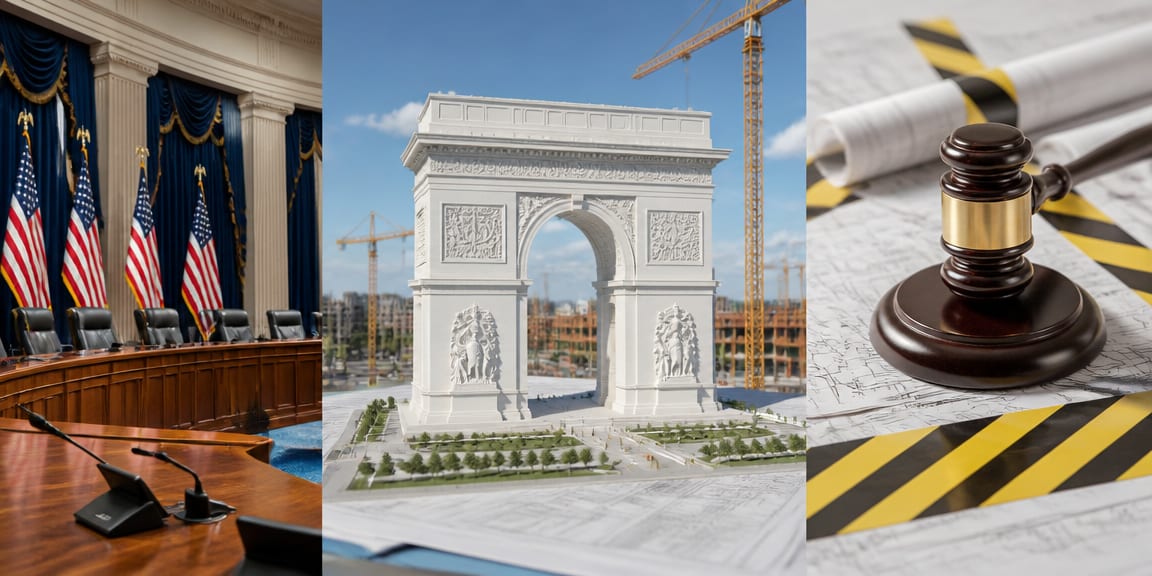
Judge pauses construction after federal panel approves Trump’s 250‑foot arch in Washington
Narrative Snapshot
Across outlets, there is broad agreement that the National Capital Planning Commission’s approval was a significant procedural milestone—and that the judicial response arrived quickly and decisively. Le Monde characterizes the commission’s nod as a “decisive step,” while Deutsche Welle and The Guardian focus on the immediate, time‑bound halt imposed by a federal judge. The Hindu underscores the volume of litigation—three lawsuits—and the expectation of prompt judicial action.
Where accounts diverge is in emphasis and framing. Fox News highlights momentum and administration backing, noting an 8–4 vote, supportive remarks from the commission’s Trump‑appointed chair, and suggestions that construction could begin “as soon as this week.” France24 situates the arch within a broader effort by President Trump to leave an imprint on Washington, provoking backlash. The Bangkok Post and The Guardian stress the intensity of public opposition during a lengthy hearing, while Clarin foregrounds legal risk and the reported absence of congressional funding, even as the administration signaled an intent to proceed.
A second axis of difference concerns political constraints. The New York Times points to looming congressional dynamics—Democrats’ upcoming control as a potential brake—whereas several international outlets concentrate on the court‑ordered freeze. What is most at stake, taken together, is not only the fate of a single monument but the interplay of planning authority, appropriations power, and judicial review over high‑visibility federal projects in symbolic locations near Arlington National Cemetery.
What Happened
After signaling that approval was imminent, a key federal planning body—the National Capital Planning Commission—voted 8–4 to authorize President Donald Trump’s proposed triumphal arch near downtown Washington, a 250‑foot (approximately 76‑meter) structure inspired by Paris’s Arc de Triomphe and situated to attract visitors crossing Memorial Bridge from Arlington National Cemetery. Fox News reported supportive comments from Mark Paoletta, the Trump‑appointed commission chair who also serves as general counsel at the Office of Management and Budget, and administration suggestions that construction could start quickly. The Guardian described a nine‑hour hearing with dozens of opponents before the vote. Multiple outlets noted active litigation; The Hindu cited three lawsuits and an expected ruling on whether to block work. Within hours of approval, a federal judge—identified by The Guardian as U.S. District Judge Tanya Chutkan—issued a 14‑day restraining order halting construction, as also reported by Deutsche Welle, ANSA, Al Jazeera English, and Clarin.
Why It Matters
The episode spotlights the checks that govern major federal memorial projects: planning consent, budget control, and judicial oversight. The New York Times noted that Democrats are poised to control Congress, introducing appropriations and oversight levers that could constrain or halt the project—especially salient given Clarin’s reporting that it lacks congressional funding. The swift restraining order underscores courts’ capacity to pause executive‑driven construction pending legal review, a point emphasized by Deutsche Welle, ANSA, and The Guardian.
Institutionally, the NCPC’s approval after an extensive public hearing, reported by The Guardian and the Bangkok Post, affirms that federal design governance can advance contentious projects, but not insulate them from litigation risk. Substantively, the proposed siting near Arlington National Cemetery elevates sensitivity around commemoration, access, and civic symbolism, as noted by Fox News and Clarin. International coverage (France24) also frames the arch within a larger push to reshape Washington’s monumental core, highlighting how legacy‑making ambitions can trigger procedural and political friction at multiple nodes of U.S. governance.
Diverging Narratives
Supporters cast the arch as a statement of national identity and civic ambition. Fox News quotes the NCPC’s chair praising “grand monuments” and cites an aim to draw visitors entering the capital from Arlington. France24 reports the administration’s claim that the project would honor the United States’ 250th anniversary, placing it in a lineage of high‑profile interventions in the capital’s cultural infrastructure.
Opponents emphasize legal and normative objections. The Bangkok Post describes “furious opponents” who questioned the project’s legality and purpose during the public hearing The Guardian said lasted nine hours. Clarin points to controversy over the location near Arlington Cemetery and stresses the lack of congressional funding alongside the administration’s intent to begin work without delay. The Hindu notes three lawsuits challenging the project, and multiple outlets report that a federal judge imposed a 14‑day construction freeze immediately after approval.
Coverage also splits on reading the inflection point. Le Monde highlights the commission’s green light as a decisive stride, whereas Deutsche Welle and The Guardian foreground the court order as a major setback. The New York Times layers in the prospect that a shift in congressional control could arrest or reshape the project, adding a political pathway to the legal and administrative ones already in motion.
What Happens Next
Two decision tracks will determine near‑term outcomes. First is the judiciary: The Guardian reports a 14‑day restraining order by Judge Tanya Chutkan; The Hindu had anticipated a ruling on whether to block construction. Analysts should watch whether the court converts the temporary pause into a preliminary injunction, narrows it, or allows work to proceed. Each outcome would signal the court’s view of the plaintiffs’ likelihood of success and the balance of harms.
Second is Congress. The New York Times underscores that Democrats’ incoming control could halt the project, and Clarin reports the absence of congressional funding. Signals to monitor include appropriations language, oversight letters, or riders that restrict project spending or implementation. If the restraining order lapses without an injunction and appropriations remain unavailable, the administration’s previously indicated desire to “start the work without delay” will collide with funding constraints, clarifying the practical limits of executive momentum after NCPC approval.