
Ueno Bank collapse triggers mass protests, criminal probes, and President Peña’s resignation in Paraguay
Narrative Snapshot
Across outlets, there is broad agreement on the shock’s scale and immediacy. Russian and international reports put Ueno’s client base at roughly 3 million in a country of about 7 million, translating into widespread account freezes and disrupted payments. Italian coverage underscores the lived impact of blocked cards and withdrawals, while Argentine reporting zeroes in on mechanics for savers to get reimbursed through the Deposit Guarantee Fund, including an online tool and extended wait times at designated banks.
Where outlets diverge is on causality, scale, and political framing. The Guardian emphasizes that Ueno’s rapid rise occurred under an administration that greenlit its expansion and characterizes the crisis as collapsing the banking system, while Russian state media accentuate Peña’s political isolation, street clashes, and his alignment with Donald Trump and Benjamin Netanyahu. Italian coverage highlights potential conflicts of interest, noting Peña was a Ueno shareholder until last year, and Russian reports say the opposition has accused him of illicit enrichment.
The legal narrative is sharpened by Brazilian and Venezuelan outlets detailing prosecutorial theories and measures: Folha reports the Paraguayan Public Ministry’s allegation that Ueno simulated a US$74.4 million portfolio sale using its own funds, and Telesur notes a judge ordered pretrial detention for six Ueno directors over alleged irregular lending and related-party transfers. Regional angles emerge as Folha identifies two detained executives with prior roles in Brazil, and Argentine and Venezuelan reports describe impeachment proceedings moving in tandem with the criminal probe.
What Happened
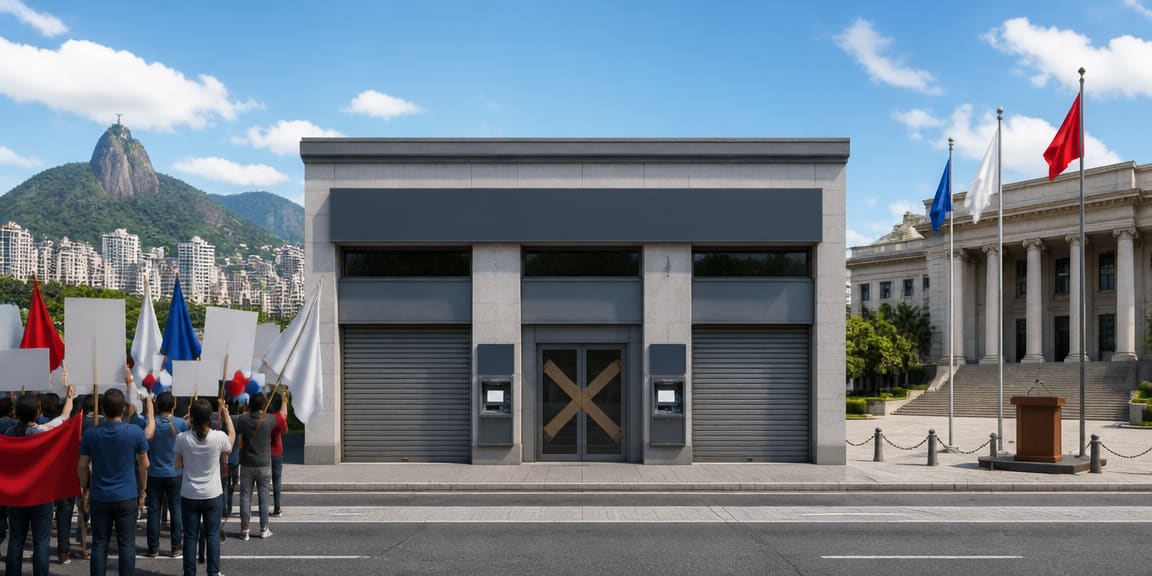
Paraguay’s central bank placed Ueno Bank under external administration after finding its capital ratio had fallen to less than half the legal minimum, a step the regulator said aimed to protect depositors and financial stability. With roughly 3 million clients, Ueno’s freeze on accounts and cards sparked mass demonstrations that escalated into clashes in Asunción. Clarin explains how savers can verify which bank will pay out via the Deposit Guarantee Fund and warns of long queues. Prosecutors intensified investigations: Folha reports an alleged simulated US$74.4 million loan-portfolio sale financed with the bank’s own money, and Telesur details pretrial detention orders for six executives over irregular lending and transfers among linked firms, with two others under house arrest. Politically, the Chamber of Deputies approved an impeachment process and the Senate opened a trial, as multiple outlets report President Santiago Peña resigned; Folha separately notes the central bank chief also stepped down.
Why It Matters
The episode tests Paraguay’s institutional capacity to supervise fast-growing digital lenders and to manage resolution and depositor protection at systemic scale. The Guardian reports Ueno’s ascent coincided with Peña-era authorizations that allowed drastic expansion, while Brazilian coverage explicitly compares the case to past bank scandals in the region, highlighting recurring risks around related-party transactions and political ties. Public exposure compounds the stakes: RT, citing the Associated Press, reports Ueno held an estimated US$800–850 million in public funds, including about US$380 million linked to pension and health systems, elevating fiscal, social, and political risk.
Beyond domestic oversight, the Japan Times frames the turmoil as a break from Paraguay’s cultivated image of stability to investors and world leaders. Cross-border professional linkages noted by Folha, combined with region-wide debates over fintech and prudential regulation, suggest spillover into regulatory coordination and due-diligence expectations for financial institutions across the Southern Cone.
Diverging Narratives
Competing frames center on scope and culpability. The Guardian contends the crisis “collapsed” Paraguay’s banking system and ties Ueno’s expansion to decisions under Peña; most other outlets confine the immediate shock to Ueno while noting severe depositor disruption and street unrest. On causation, prosecutorial accounts reported by Folha and Telesur foreground alleged fraud mechanics—simulated asset sales, loans lacking sufficient guarantees, and transfers among related companies—while Russian coverage emphasizes political responsibility, with RT asserting Ueno was propped up by Peña’s government and TASS highlighting opposition claims of illicit enrichment.
The personal-political angle is developed unevenly: Corriere reports Peña was a Ueno shareholder until last year, a point not universally featured elsewhere, and RT and the Japan Times emphasize his alignment with Donald Trump and Israel’s prime minister. On remedies, Clarin provides concrete paths for depositor compensation via the guarantee fund, a practical dimension largely absent from political narratives. All sides register the scale of depositor harm, but they vary in whether they present the event as a single-bank failure with legal repercussions or a broader systemic and governance breakdown.
What Happens Next
Two tracks will shape outcomes. On the political-legal side, impeachment proceedings authorized by the lower house and opened in the Senate continue alongside the president’s resignation, per Telesur and Clarin; analysts should watch whether the Senate advances judgment and how prosecutorial actions evolve, including potential indictments linked to the alleged simulated asset sale and irregular lending described by Folha and Telesur. Reports by TASS and Clarin on accusations against Peña create a second legal front; signals to watch include formal charging decisions and court rulings on any post-resignation immunities.
On the financial-administrative side, the pace and breadth of Deposit Guarantee Fund payouts, outlined by Clarin, and steps to stabilize supervision after the central bank chief’s resignation, noted by Folha, will be key indicators. RT’s reference to substantial public funds at Ueno raises the importance of transparent recovery plans for pension and health assets to gauge fiscal risk and restore confidence highlighted by the Japan Times.