
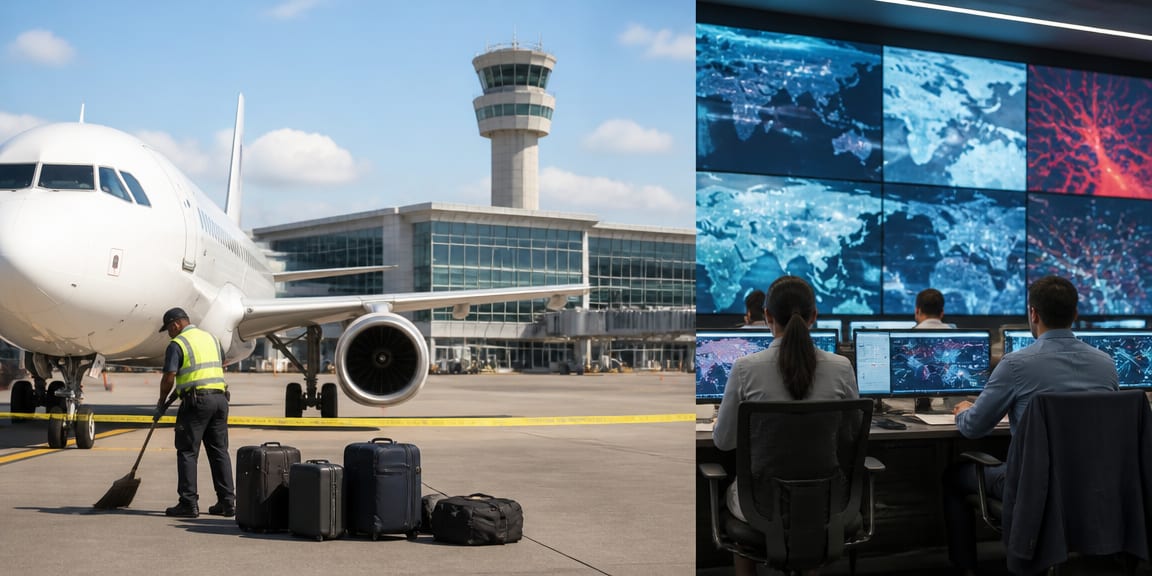
Europe confronts a coordinated wave of hoax bomb threats disrupting flights and media outlets
Narrative Snapshot
Across outlets, there is broad agreement that numerous bomb threats targeting European commercial flights were hoaxes, with no explosives found and all affected aircraft landing safely. Coverage consistently notes significant operational disruption: fighter jet escorts, diversions, emergency landings, and ground searches, along with a parallel spate of threats aimed at broadcasters that forced evacuations and programming suspensions. That consensus sits alongside a conspicuous spread in reported scope and tallies, reflecting fast-moving information and varied national reporting.
Publications diverge on scale and emphasis. Counts range from at least 15 flights (TASS) to at least 18 (the Guardian), approximately two dozen (Le Monde), 27 (Telesur), and 28 (RT). The United Kingdom’s BBC focuses on how air traffic control relayed the threats, while France24 characterizes “chaos within [the] aviation industry” and reports French prosecutors probing possible foreign links. The New York Times foregrounds passenger frustration rather than fear. The South China Morning Post and Folha de S.Paulo extend the aperture to television newsrooms, underscoring cross-sector vulnerability. RT highlights incident detail in France involving an Aer Lingus flight and official criticism of a pilot’s response. In sum, aviation security performance is not in dispute; attribution, scale, and operational lessons are.
What Happened
Multiple European flights received bomb threats over the course of the week, triggering interceptions by national air forces, diversions, and precautionary searches that uncovered no explosives. Le Monde reports air forces were mobilized in several countries, with approximately two dozen flights affected; the Guardian tallied at least 18 flights across Bulgaria, Czechia, France, Italy, Hungary, Cyprus, Romania, the UK, and Portugal, all landing safely after searches. RT details an Aer Lingus flight from Dublin to Rome diverted to France’s Evreux military base, citing the French prime minister’s office that the pilot “didn’t cooperate as expected,” and notes threats to two Finnair flights. BBC Verify analyzed messages showing threats were passed via air traffic control and called it the week’s second such incident. Beyond aviation, SCMP and Folha report coordinated hoax threats to TV broadcasters that prompted evacuations and temporary programming suspensions.
Why It Matters
The episode tests Europe’s ability to manage cross-border aviation security incidents that blend criminal hoaxes with real-time operational risk. Several outlets document rapid civil–military coordination—fighter escorts, diversions, and ground sweeps—while BBC reporting on air traffic control messaging highlights the dependence on interoperable communications during pan-European disruptions. The expansion from airlines to broadcasters, reported by SCMP, Folha, France24, and CBC, shows how multi-domain hoax campaigns can strain essential services and emergency protocols simultaneously. France24’s account that prosecutors in France are examining possible links to foreign powers underscores the potential for these incidents to intersect with state or state-adjacent influence operations, even as responsibility remains unidentified. For decision-makers, the spread of alerts across jurisdictions, sectors, and languages magnifies the need for harmonized threat assessment, clear public communication, and calibrated response thresholds that preserve safety without amplifying disruption.
Diverging Narratives
Outlets quantify the disruption differently, a function of evolving case counts and varied national disclosures: TASS reports 15 planes receiving threats; the Guardian cites at least 18; Le Monde references roughly two dozen; Telesur aggregates to 27 across at least 10 countries; and RT lists 28 with 19 on a single day. Despite the divergence, all agree no explosives were found and flights landed safely. On framing, several publications emphasize apparent coordination: Le Monde points to a coordinated attack, while the Guardian attributes an “apparently continued and coordinated effort” to sow chaos. Others concentrate on process or impact: BBC focuses on how threats were transmitted through air traffic control; France24 stresses industry-level disruption; the New York Times centers traveler frustration rather than fear. Attribution is the most open question: France24 reports French prosecutors are testing a hypothesis about foreign involvement without naming actors, whereas most outlets refrain from causal claims. RT singularly highlights an official critique of an Aer Lingus pilot’s cooperation, a detail not echoed elsewhere, illustrating how outlet selection can shape operational takeaways.
What Happens Next
Three decision points emerge from the reporting. First, investigations: France24 notes prosecutors in France are probing whether foreign powers were involved; confirmation would shift the response toward counter–influence operations and diplomatic channels, while an absence of such findings would keep the focus on criminal attribution and deterrence. Second, aviation protocols: BBC’s analysis of air traffic control messaging and Le Monde’s account of fighter escorts indicate authorities may review thresholds for diversions, interception procedures, and communication flows; tighter protocols could reduce ambiguity but risk added disruption. Third, cross-sector resilience: SCMP and Folha document broadcaster evacuations and service interruptions; whether similar hoaxes persist beyond aviation will influence how security postures are adjusted across media and other essential services. Analysts should watch for consolidated incident tallies, prosecutorial disclosures, and any public guidance changes by airlines, airports, or broadcasters on handling threat communications.