
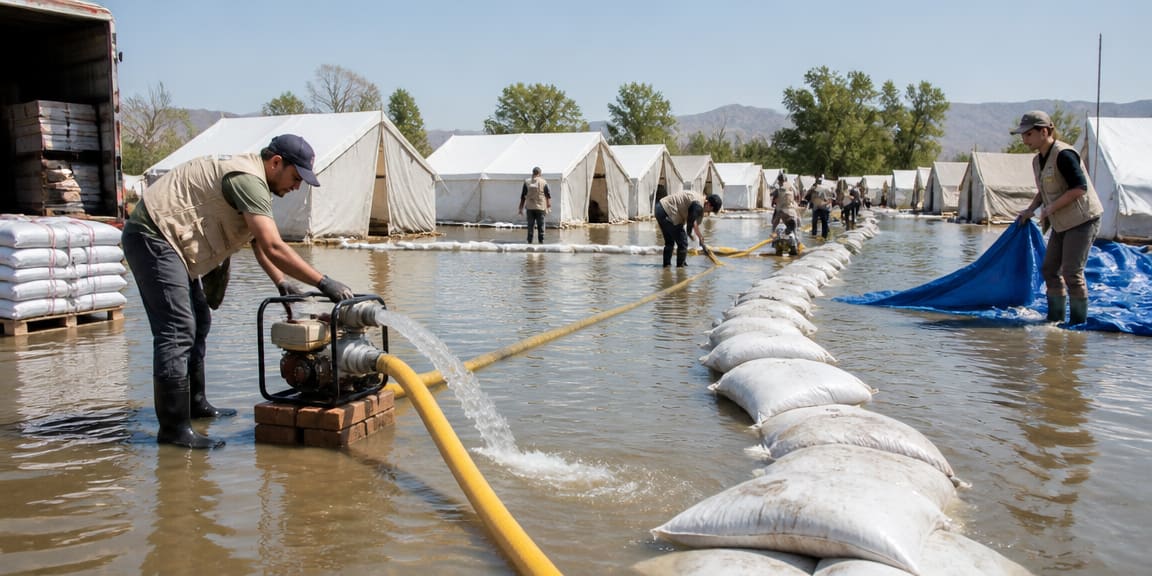
Heavy rains inundate Gaza displacement camps, overwhelming responders and flooding tens of thousands of tents
Narrative Snapshot
Across outlets, reporting converges on the same immediate picture: heavy rain has inundated Gaza’s displacement sites, collapsing or saturating makeshift shelters. Al Jazeera notes shelters giving way under rainwater, while Deutsche Welle situates the flooding in a landscape where homes have already been damaged or destroyed by war, compounding an existing humanitarian emergency. Middle East Eye adds granular detail through family accounts of tarpaulins failing and unsafe structures under strain.
Quantification varies by source and dataset. TASS and La Repubblica both cite roughly 70,000 flooded tents, with La Repubblica adding an estimate that about 700,000 people were affected. Telesur, drawing on the United Nations and local authorities, reports nearly 950,000 displaced people at moderate to high flood risk and more than 400,000 in especially vulnerable conditions, according to OCHA. On operational load, Al-Quds reports over 1,000 distress calls to civil defense, while Telesur cites about 1,500 in 10 hours, with capacity too limited to meet most requests.
Causal framing also diverges. Telesur explicitly links current exposure to years of destruction during Israeli military operations, using charged terminology, and highlights hospital disruptions and shortages hampering protection efforts. Deutsche Welle emphasizes war-damaged housing without adversarial framing. TASS underscores that enclave authorities reported casualties but offers no figures. Al-Quds stresses the lack of rescue equipment and the flooding of sewage centers, pointing to systems under strain, while European coverage balances scale with human impact.
What Happened
A winter storm on 7 November brought heavy rain that flooded displacement sites across the Gaza Strip. Al Jazeera reported makeshift shelters collapsing under accumulated rainwater. Local civil defense lines were inundated: Al-Quds said more than 1,000 calls for help came in, and Telesur cited roughly 1,500 calls within ten hours, with responders unable to meet most requests due to shortages of capabilities and equipment. TASS and La Repubblica reported that over 70,000 tents were affected, with La Repubblica estimating about 700,000 people impacted. TASS added that a spokesperson for Gaza’s authorities reported casualties, without details. Telesur, citing the UN and local authorities, said nearly 950,000 displaced persons face moderate to high flood risk, with more than 400,000 in particularly vulnerable conditions per OCHA. Deutsche Welle described the rains as worsening an already dire situation amid war-damaged or destroyed housing.
Why It Matters
The flooding intersects with multi-year displacement and infrastructure damage, amplifying humanitarian needs as winter begins. Deutsche Welle’s emphasis on destroyed housing and Telesur’s account of hospital disruptions and supply shortages indicate multiple systems stressed at once. OCHA’s risk categorization, reported by Telesur, offers a baseline for prioritizing assistance toward more than 400,000 people in especially vulnerable settings, while reports from Al-Quds about civil defense shortfalls and flooded sewage centers underscore constrained emergency response and service continuity. European and Russian outlets’ tent and population figures provide additional scale markers that humanitarian actors can use to align shelter, drainage, and winterization efforts. For policy makers and multilateral agencies, the convergence of weather shocks with limited rescue capacity and damaged health and sanitation infrastructure frames the operational envelope for assistance, situational awareness, and potential resource mobilization.
Diverging Narratives
Discrepancies center on scale, sourcing, and emphasis. TASS and La Repubblica align on a tent-focused metric—about 70,000 tents flooded—while La Repubblica adds an estimate of 700,000 people affected. Telesur, citing UN and local authorities, frames the issue in risk terms: nearly 950,000 displaced people at moderate to high risk and over 400,000 in particularly vulnerable conditions per OCHA. Emergency-call volumes also vary: Al-Quds reports more than 1,000 calls to civil defense, whereas Telesur specifies about 1,500 within ten hours; both agree responders could not answer most calls due to limited equipment and capabilities. On outcomes, TASS notes casualties reported by enclave authorities without providing numbers, a claim not quantified elsewhere in the provided reporting. Causality and language diverge too: Telesur links exposure to years of destruction in explicitly adversarial terms, Deutsche Welle highlights the war-damaged housing context in neutral phrasing, and Al Jazeera and Middle East Eye foreground immediate on-the-ground impacts and household-level coping.
What Happens Next
Two decision points emerge from the reporting. First is how authorities and aid agencies reconcile and update the scale: whether OCHA’s risk estimates and local counts of flooded tents and affected people converge through new assessments will determine targeting. Analysts should watch for updated OCHA figures and official statements clarifying the casualty reports noted by TASS. Second is response capacity under winter conditions. Al-Quds and Telesur both describe civil defense overwhelmed and short of equipment, alongside hospital disruptions and flooded sewage centers. Whether these capacity gaps are alleviated—or persist—will shape rescue coverage, shelter reinforcement, and service continuity for the more than 400,000 people OCHA classifies as particularly vulnerable. Household-level vulnerabilities highlighted by Middle East Eye and the shelter failures described by Al Jazeera provide practical indicators of whether protective measures are reaching those most exposed.