
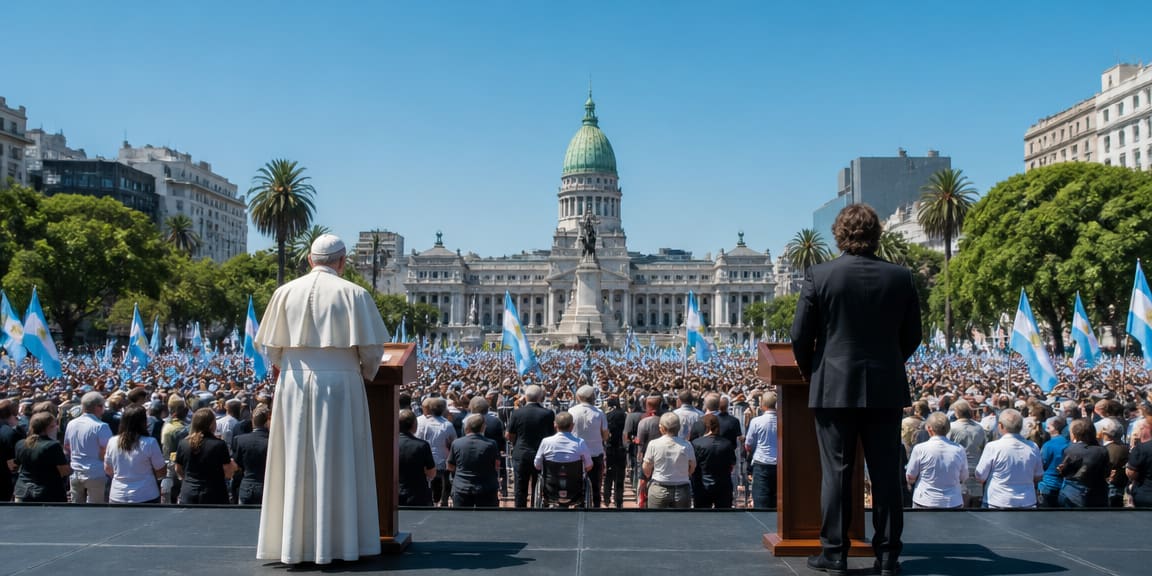
Pope Leo XIV’s Buenos Aires address presses people‑first economics and democratic safeguards alongside President Milei
Narrative Snapshot
Across major outlets, coverage converges on the clarity of Pope Leo XIV’s message in Buenos Aires: the economy should serve people, and Argentina must protect democracy. European and Anglophone reports consistently foreground his implicit challenge to austerity. Folha de S.Paulo highlighted the line delivered beside President Javier Milei that “the economy should be in service of the people, not the people in service of the economy.” The Guardian, BBC, Le Monde and Deutsche Welle similarly emphasized a pointed admonition that growth must benefit the poor.
Italian and French outlets stressed democratic guardrails and social protection. La Repubblica underscored the admonition to protect democracy and remember those with work or health problems, noting church criticism of government reforms; Corriere della Sera framed the intervention as a social‑justice appeal. Al Jazeera distilled the governance angle to leaders knowing the limits of power. The Hindu drew attention to the poor and pensioners and read concern for people with illness, dependency and disability as a veiled reference to cuts affecting disability assistance.
Other outlets widened the aperture. Telesur English centered institutional integrity, corruption, employment, education, sustainability, abortion and artificial intelligence as themes of the address, situating the speech within a broader governance agenda. Domestic coverage in Clarin registered immediate political contestation over interpretation, quoting Buenos Aires mayor Jorge Macri’s warning against partisan appropriation and his call for unity. France24 and BBC stressed scale and context: the first papal visit to Argentina in nearly four decades, part of a 12‑day Latin America tour with Uruguay behind and Peru ahead, drawing massive crowds despite the pontiff’s recent lung cancer surgery.
What Happened
Arriving in Buenos Aires from Uruguay on the second leg of a 12‑day Latin America tour, Pope Leo XIV shared a stage with President Javier Milei at the Palacio Libertad after a private meeting at the Casa Rosada and received the keys to the city from Buenos Aires mayor Jorge Macri. In his first public address of the visit, he urged that the economy be “at the service of the people,” called for guarding democracy and warned leaders to know the limits of power. He spoke in defense of the poor and pensioners and pressed particular concern for those facing illness, dependency and disability. Telesur English reported that he also addressed corruption, institutional trust, employment, education, sustainability, abortion and artificial intelligence. Massive crowds turned out in the capital, including for an outdoor Mass, in what France24 described as the first papal visit to Argentina in nearly four decades.
Why It Matters
The visit places Argentina’s domestic policy debate in an institutional frame that blends social doctrine and governance standards. Multiple outlets noted the church’s social‑justice commitments and prior criticism of reforms, setting the Pope’s call for a people‑first economy against a backdrop of contentious austerity measures. His focus on the poor, pensioners and persons with disabilities intersects directly with disputes over welfare and disability assistance, elevating constituencies identified by The Hindu and others. Appeals to “guard democracy” and recognize limits of executive power speak to rule‑of‑law norms in a polarized environment and to public trust concerns highlighted by Telesur’s focus on corruption and institutional integrity. Regionally, the Latin America tour channels these themes beyond Argentina, after Uruguay and ahead of Peru, with France24 and BBC noting unprecedented turnout and sustained attention despite health constraints—signals that enlarge the diplomatic and normative weight of the message for governments and multilateral partners attentive to inclusive growth, social protection and institutional resilience.
Diverging Narratives
Outlets differ mainly in emphasis, not in substance. The Guardian, BBC and Le Monde framed the Buenos Aires remarks as a “stinging” or “veiled” rebuke of Milei’s austerity and “ultra‑liberal” policy, while Italian wires and dailies cast them as a lesson or admonition to protect democracy and pursue social justice. Folha de S.Paulo focused on the signature economy‑serves‑people line delivered beside Milei, underscoring its immediacy. Al Jazeera distilled the speech to a caution that leaders should know the limits of power. Telesur English pivoted from austerity to a broader governance agenda—corruption, institutional trust and policy domains from labor and education to AI and abortion—placing the address within institutional integrity rather than economic policy alone. The Hindu singled out vulnerable groups, reading the passage on illness, dependency and disability as a discreet critique of cuts to disability assistance. Domestic reporting in Clarin captured political contestation over interpretation, with Jorge Macri urging against partisan uses of the speech and calling for unity. BBC and France24 foregrounded scale and context—millions in the streets, the rarity of a papal visit to Argentina, and the continuity of the tour—more than policy substance.
What Happens Next
Key inflection points center on how state and church actors operationalize the address. On the government side, analysts should watch whether the administration’s rhetoric shifts toward the Pope’s call for unity and institutional trust, as reflected in Clarin’s reporting on efforts to avoid partisan appropriation, and whether official communications explicitly engage the appeals to protect democracy and prioritize the poor and people with disabilities referenced by The Hindu, Al Jazeera and Deutsche Welle. Within the church, the New York Times’ description of tensions with a socially engaged hierarchy suggests monitoring statements from Argentine bishops for amplification of critiques of reforms noted by La Repubblica and Corriere. On governance, Telesur’s account of anti‑corruption and institutional integrity themes points to potential legislative or executive signals on transparency and public trust. Regionally, France24 and BBC indicate continuity of messaging as the tour proceeds to Peru; observers can track whether the people‑first economy and democracy safeguards recur and how local actors respond.