
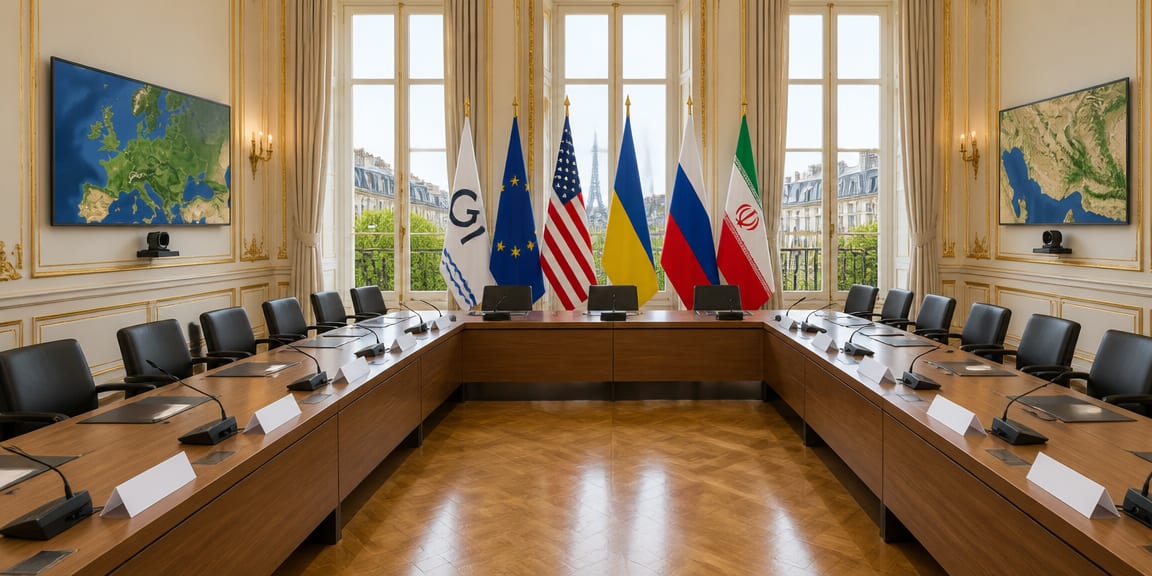
G7 ministers convene in Paris as US-brokered Russia–Ukraine talks open in Abu Dhabi, with Iran tensions on the table
Narrative Snapshot
European outlets emphasize process and leverage. Reports from Germany and France highlight concern in European capitals that Washington’s preparations for trilateral talks with Moscow and Kyiv could translate into pressure on Ukraine to accept unfavorable terms, even as EU states seek a larger role in shaping any settlement. They also place prospective US strikes on Iran alongside Ukraine on the Paris agenda, framing both as tests of alliance coordination under shifting US domestic politics.
US-linked and Russian state media foreground scope and authorship. Reporting centers the White House’s envoys and an expansive brief that extends beyond a ceasefire to postwar guarantees and broader European security, amplified by the US president’s own hints at a “very big” agreement. This contrasts with Europe’s process-oriented messaging and the Indian press’s portrayal of continuity with the G7’s March deliberations.
Coverage from Canada, Italy, Japan, and Argentina ties personnel and politics to policy trajectory. Marco Rubio’s full two-day participation is treated as a notable signal after his partial attendance in March, while diplomats caution that the US midterm setback narrows Washington’s room to maneuver without heralding a wholesale return to traditional multilateralism. Latin American reporting underscores uncertainty about US foreign policy after the election and Europe’s bid for a decisive role.
Iran is cast through dual lenses of capability and constraint. French and German reports say the option of further US strikes remains live and on the G7 agenda, while UK-based analysis relays Tehran’s reading of the US midterm results as a political setback for the Trump administration and poses whether the outcome will restrain or entrench confrontation.
What Happened
Foreign ministers from the Group of Seven gathered in Paris to revisit Russia’s war in Ukraine and address tensions with Iran, an agenda described as closely tracking their March meeting. European leaders, amid US preparations for negotiations with Moscow and Kyiv, want greater involvement and fear Ukraine could face pressure to accept a poor deal. In parallel, US-brokered Russia–Ukraine talks are set for November 10–11 in Abu Dhabi, the first in over nine months, led by presidential envoys Jared Kushner and Steve Witkoff. Kushner said the talks would focus on ending hostilities, credible postwar security guarantees, Ukraine’s economic recovery, humanitarian issues, and improving European security arrangements. Ahead of the talks, Moscow struck Kyiv, injuring at least five. The US president has hinted at a sweeping agreement extending beyond Ukraine. The Paris discussions also include Iran, with Washington keeping the option of new strikes open after Republicans’ midterm losses, as Marco Rubio attends both days.
Why It Matters
The alignment between a US-led, envoy-driven Abu Dhabi track and a ministerial G7 process will shape who sets terms for any Ukraine settlement and how allied cohesion is maintained. European outlets’ insistence on a larger say underscores intra-alliance dynamics over process legitimacy and end-state parameters, particularly if Washington seeks to fold “European security arrangements” into outcomes articulated by presidential envoys rather than through broader multilateral formats. The combination of active hostilities in Ukraine and parallel diplomacy increases the salience of security guarantees and reconstruction planning as part of a negotiated package, themes explicitly flagged by US mediators. On Iran, the G7’s handling of a still-open option for further US strikes intersects with a US domestic context that, according to diplomats and analysts, narrows Washington’s room for maneuver without restoring prior multilateral defaults. For decision-makers, these tracks test institutional capacity to coordinate across theaters under changing US political constraints.
Diverging Narratives
European reporting concentrates on agency and safeguards for Kyiv. German coverage warns that, with Washington organizing talks, Europe fears Ukraine could be pushed toward a “bad deal,” and French reporting frames the Paris meeting as an opportunity to press the US on both Ukraine and Iran. Argentine coverage similarly highlights Europe’s effort to secure a central role amid uncertainty over post-election US policy. By contrast, Russian state media and US presidential envoys emphasize substance and breadth: an end to hostilities, postwar guarantees, economic recovery, humanitarian issues, and even revisions to European security architecture, with the US president touting a “very big” agreement that might extend beyond Ukraine.
Assessments of US latitude also diverge. French reporting states Washington has kept the option of new strikes on Iran open since Republicans lost the midterms. Japanese and UK-based analysis, however, argue that while the electoral setback narrows the administration’s room for maneuver, it does not imply a return to traditional multilateralism; Tehran reportedly views the result as a political setback for Washington. Signals differ on process, too: several outlets stress Marco Rubio’s full participation in Paris as notable, while Indian coverage highlights continuity of agenda rather than a pivot in approach.
What Happens Next
Two decision points will define the near term. First, the Abu Dhabi track’s scope: US envoys have flagged not only ceasefire terms but security guarantees, reconstruction, humanitarian steps, and improvements to European security arrangements. Analysts should watch post-meeting readouts for concrete references to those pillars and any language suggesting expansion beyond Ukraine-specific measures. Second, Europe’s leverage in shaping talks: Paris discussions are positioned by European outlets as a bid for a greater say. Communiqué language and ministerial remarks will indicate whether G7 partners cohere around red lines to avoid a “bad deal” for Kyiv.
On Iran, attention turns to whether Washington operationalizes the “option of new strikes” discussed in Paris or signals restraint amid reduced political bandwidth after the midterms. Indicators include any G7 articulation of shared parameters on Iran and subsequent US statements. Finally, Rubio’s full engagement alongside White House envoys will signal whether State-led diplomacy gains weight relative to presidential emissaries in the weeks ahead.