
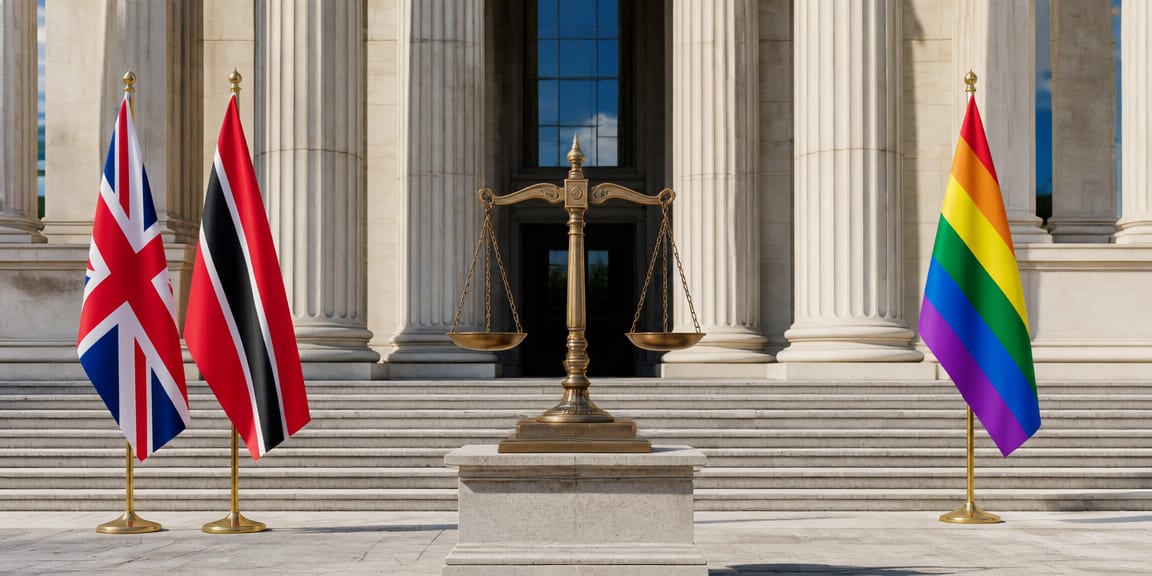
UK Privy Council overturns Trinidad and Tobago law criminalising consensual sex between male same-sex couples
Narrative Snapshot
Across outlets there is alignment on the venue, actor, and outcome: London’s Judicial Committee of the Privy Council, which serves as Trinidad and Tobago’s final court of appeal, struck down provisions criminalising consensual sexual relations between male same-sex partners. The litigation’s protagonist, Jason Jones, is foregrounded, with UK and international coverage emphasising the case as a rights-based constitutional challenge. Where coverage diverges is in framing and specificity. Several reports characterise the decision as a UK court action, while others stress the appellate relationship as a colonial legacy, underscoring the court’s institutional role rather than its geography.
Substantively, outlets vary in how they describe the prohibited conduct. Some reports focus on “anal sex,” others on “buggery” and “gross indecency,” and still others on “homosexuality” more generally, reflecting different statutory labels and editorial choices about scope. The periodisation of Jones’s effort is also inconsistent: one account calls it a decade-long fight, another puts it at 11 years. European and Asian outlets inject distinct emphases: a French report highlights the concrete prison terms attached to the offences, while a Hong Kong-based outlet anchors the story in constitutional rights language, and a German outlet centres the decision’s colonial-era judicial architecture. The stakes presented range from immediate decriminalisation effects at home to potential jurisprudential ripple effects across Caribbean jurisdictions that share similar laws and appellate pathways.
What Happened
London’s Privy Council, the final court of appeal for Trinidad and Tobago, overturned provisions of the country’s Sexual Offences Act that criminalised consensual sexual relations between male same-sex couples. The case was brought by Trinidadian activist and dual citizen Jason Jones, who argued that offences such as “buggery” and “gross indecency” breached fundamental constitutional rights. The ruling follows a complex domestic trajectory: after Jones earlier secured a High Court judgment declaring the colonial-era “buggery” laws unconstitutional, Trinidad and Tobago’s Court of Appeal subsequently issued a 2025 decision that recriminalised consensual anal sex; the Privy Council has now set aside that appellate ruling. Reports note that the offences carried significant penalties, with “sodomy” punishable by up to five years’ imprisonment and “grave indecency” by up to two years.
Why It Matters
The decision illustrates how post-colonial judicial arrangements continue to shape rights outcomes: for Trinidad and Tobago, the Privy Council remains the last resort in constitutional disputes, and its London-based ruling carries binding effect despite the country’s independence. That institutional fact, highlighted in coverage, situates the case within broader questions about external appellate oversight and domestic constitutionalism. The judgment also intersects with regional decriminalisation dynamics. One account frames it as a landmark that could help unsettle comparable anti-gay statutes elsewhere in the Caribbean, particularly in jurisdictions that retain the Privy Council or share similar constitutional protections. Other reporting spotlights the human rights basis of the challenge and the concrete criminal penalties it displaces, underlining a shift from punitive criminal law to constitutional rights enforcement. For policymakers and courts in the region, the ruling functions as both authoritative precedent within this appellate framework and a signal of how constitutional rights claims are being interpreted against colonial-era sexual offences.
Diverging Narratives
Coverage differs on how the case is temporally and substantively framed. The length of Jason Jones’s campaign is variously described as a 10-year fight and an 11-year legal battle, reflecting different starting points for measuring the litigation arc. Outlets also diverge on the scope of behaviour at issue: some specify consensual sex between male same-sex partners, others refer to anal sex, and still others to homosexuality more broadly. These distinctions track the statutory terms cited (“buggery,” “gross indecency,” “sodomy”) and editorial choices, and they matter for understanding how narrowly or broadly the decision may be read in public discourse.
There is also a contrast in institutional emphasis. UK and international wire-style reports sometimes present this as a UK court action, while other coverage explicitly emphasises the Privy Council’s status as Trinidad and Tobago’s final court of appeal as a legacy of colonial legal structures. Finally, while one outlet projects potential influence on similar laws in other Caribbean countries, the rest largely confine their reporting to the domestic decision, avoiding broader claims about regional cascade effects. These differences do not contradict the core outcome but shape readers’ sense of its legal scope and regional salience.
What Happens Next
Two decision points emerge from the reporting. First is domestic implementation. Because the Privy Council is Trinidad and Tobago’s final appellate court, its ruling governs the application of the Sexual Offences Act provisions on “buggery,” “sodomy,” and “gross indecency.” Analysts should watch for how courts and law enforcement operationalise the judgment, including any formal steps to align prosecutions and statutory text with the ruling’s constitutional analysis and the removal of exposure to the previously reported custodial penalties.
Second is regional jurisprudence. One report suggests the ruling could help overturn similar anti-gay laws in other Caribbean jurisdictions. For observers, the indicators are subsequent filings or judgments that cite this decision in countries sharing comparable offences and appellate arrangements, including reliance on constitutional rights arguments akin to those advanced by Jones. Given variations in how outlets described the prohibited conduct, another practical marker will be official clarifications that define the ruling’s precise scope within Trinidad and Tobago’s legal system, which would inform how far analogous claims might travel elsewhere.