
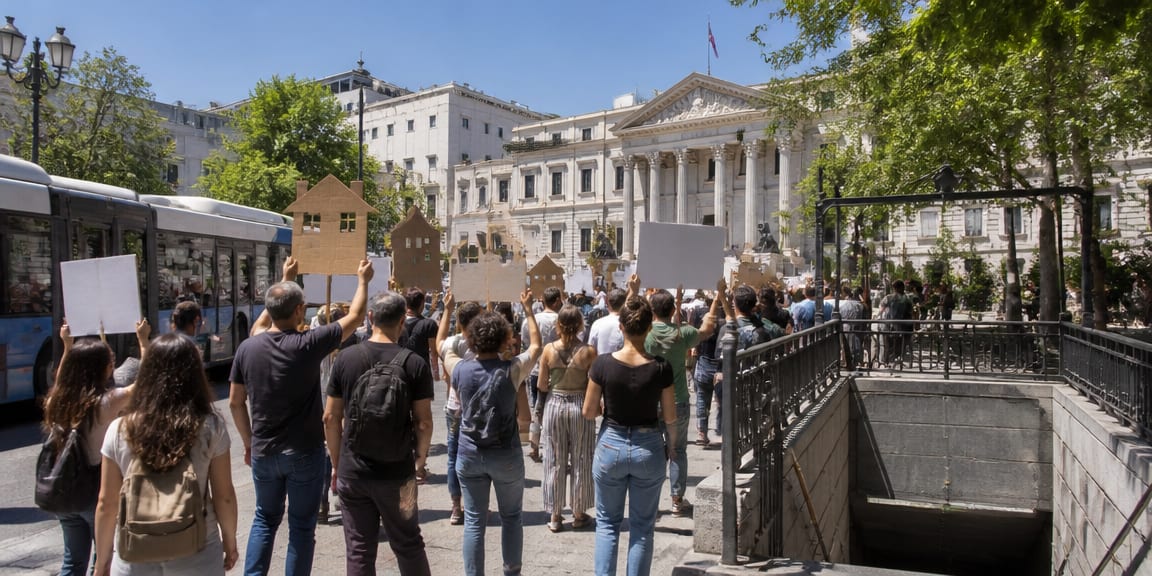
Spain holds first general strike in 14 years over housing and living costs ahead of Nov. 29 election
Narrative Snapshot
Across outlets, coverage converges on the scale and timing of an unprecedented national work stoppage, but diverges on why it matters most. Labor- and movement-oriented reporting foregrounds housing as the central grievance and situates union action alongside tenant mobilization. Analysts amplify that frame by pointing to rent regulation and social housing as emblematic demands. International wires and regional press, by contrast, elevate the electoral calendar and the potential for the strike to shape late-campaign dynamics.
Security and disruption receive sharper emphasis in travel-oriented reporting, which keys off U.S. Embassy guidance warning of nationwide demonstrations and possible volatility. Regional context further broadens the lens: one outlet juxtaposes Spain’s strike with large-scale French unrest over inequality and living costs, underscoring that grievances over affordability are animating protests beyond a single national case. Domestic Spanish press also highlights a more somber overlap, noting that the week of labor actions coincides with a funeral in Toledo for victims of a recent train accident.
What Happened
Spain’s two largest unions, UGT and CCOO, called a 24-hour nationwide walkout for Wednesday, November 11, marking the country’s first general strike in 14 years. Tenants’ organizations joined the action, with organizers centering demands for affordable housing, rent regulation, expanded social housing, defense of pensions, and a higher minimum wage. Reporting from Spain and international outlets described a politically charged context less than three weeks before national elections on November 29, with millions of workers participating on the day of the strike, according to the Associated Press account carried by the Toronto Star. Authorities and foreign missions warned travelers to expect disruptions across flights, trains, local transit, and urban services, and the U.S. Embassy advised that otherwise peaceful demonstrations could escalate. The strike unfolded within a broader week of rail stoppages and mobilizations flagged by Spanish and regional media, coinciding with a funeral in Toledo for victims of a recent train accident.
Why It Matters
The walkout tests Spain’s institutional capacity to absorb social pressure on housing while legislating under electoral deadlines. Organizers positioned the strike to influence a legislative juncture, with Congress scheduled to ratify government housing decrees, and to push rent regulation and social housing expansion from movement slogans into statutory commitments. Analytical commentary traces the action’s lineage to earlier Spanish mobilizations that extracted policy concessions through sustained street pressure, suggesting a potential replay of movement-to-policy dynamics.
Internationally, the strike highlights how affordability disputes can strain critical services, trigger diplomatic advisories, and complicate tourism-dependent urban economies. It also unfolds amid reporting of parallel cost-of-living protests elsewhere in Europe, indicating that social protection and wage-price tensions are not confined to one polity. For decision-makers, the episode underscores the need to sequence housing measures, labor-market responses, and public-order planning in a compressed pre-election window, with clear implications for coalition-building and policy credibility.
Diverging Narratives
Housing-centric sources tie the strike’s legitimacy to concrete programmatic aims. Telesur English attributes a leading role to the Confederation of Tenants’ Unions and cites its “Homes for living” platform, which argues the real estate sector should be reoriented from private profitability to social need; Le Monde’s analysis similarly spotlights rent regulation and social housing as core demands shaped by earlier protest cycles. Al Jazeera’s reporting from the streets amplifies lived precarity—young adults confined to family homes or paying high rents for extremely small spaces—making the housing crisis the proximate driver rather than a broader cost-of-living basket.
Other outlets frame the event through risk and politics. Fox News, relaying a U.S. Embassy alert, prioritizes operational disruption and warns that protests could turn violent, emphasizing closures, picket lines, and heightened police presence. The Toronto Star (AP) foregrounds electoral stakes, noting the proximity to a national vote that could alter Spain’s political balance. Spanish and regional press add distinct context: Clarin notes the week-long sequence of rail strikes and the coincidence with a Toledo funeral for train accident victims, while RT’s France-focused piece situates Spain’s turmoil alongside contemporaneous French unrest over inequality and living costs. Together, the coverage places the same facts within policy, security, and electoral frames, with unresolved questions around the content and fate of the housing decrees and how authorities manage protest-related disruptions.
What Happens Next
Two decision points dominate. First, Congress’s scheduled ratification of the government’s housing decrees will test whether legislative text aligns with movement priorities reported across outlets—rent regulation, social housing expansion, and relief from rising costs—and whether unions and tenant groups regard those provisions as sufficient after calling for a “root-and-branch overhaul.” Analysts should watch bill language, amendment activity, and public positions from UGT, CCOO, and the Confederation of Tenants’ Unions in response.
Second, the November 29 election will translate strike salience into political incentives. Coverage ties the walkout to late-campaign dynamics, with the Toronto Star (AP) flagging potential gains for the far right; monitoring party platforms on housing, turnout signals from the strike, and any post-strike concessions will indicate how parties calibrate. In the near term, Clarin’s note of a broader week of rail stoppages and Fox News’s reporting on embassy alerts point to continued transport and city-center disruptions; watch policing posture and municipal notices to gauge escalation risks and service continuity.