
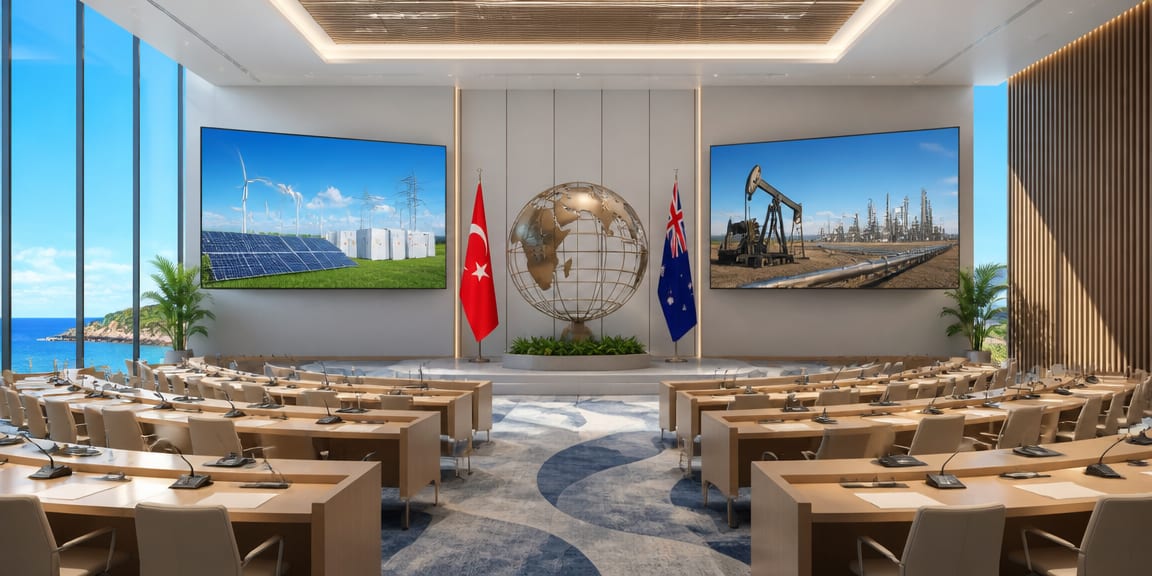
COP31 opens in Turkey with UN call to phase out fossil fuels as hosts push global electrification
Narrative Snapshot
Across outlets, António Guterres’ warning defined the opening frame. Middle East Eye, Le Monde, ANSA, Al Jazeera English, CGTN and AllAfrica (RFI) repeatedly quoted his assessment that the “climate crisis is outrunning us” and his line that fossil fuels “must go the way of the dinosaurs,” paired with criticism of oil and gas lobbying. Coverage also highlighted prescriptive elements — a Climate Justice Pact, windfall taxes on oil profits, and tripling renewables by 2035 — reported by Telesur English, Corriere della Sera and Folha de S.Paulo. In parallel, The Guardian foregrounded UNFCCC chief Simon Stiell’s linkage of fossil price shocks to inflation, reinforcing an economic-policy throughline.
Attention to the hosts’ program converged on an “electrification” push championed by Turkey and Australia, with Le Monde detailing an emerging target for electricity to supply 35% of global energy by 2035 and France24 describing the initiative as a response to an energy and cost-of-living squeeze. Yet other reporting stressed dissonance: Bangkok Post and Folha noted Ankara touting a new oil find even as it promotes electrification and zero-waste (also reported by the Toronto Star), while Le Monde underscored Turkey’s domestic coal legacy and observed that both co-chairs had until now skirted a direct fossil-fuels reckoning.
Coverage of political positioning diverged most around leadership signals. Deutsche Welle emphasized pressure on Australia to push a fossil exit and protect Pacific states, while The Guardian reported Prime Minister Anthony Albanese’s keynote touting renewables without mentioning coal or gas. Le Monde traced assertive engagement by Pacific island states, contrasted with a European posture complicated by key absences; Le Monde and Corriere della Sera listed no-shows including France’s president, China’s Xi and India’s Modi, with Ursula von der Leyen speaking for the EU.
A final strand contrasted expanding stakeholder presence with legitimacy critiques. Folha reported record private-sector participation via an SB COP platform representing 55 million firms across 123 countries; South China Morning Post and Folha amplified Greta Thunberg’s charge that UN climate conferences have become “greenwash circuses.” Geopolitics seeped into the forum as well: Middle East Eye covered Turkish President Recep Tayyip Erdogan’s denunciation of “ecocide” in Gaza, while France24 linked price shocks to war in the Middle East.
What Happened
The UN’s annual climate talks opened in Antalya with an unusual shared presidency by Turkey and Australia and a headline bid to elevate “electrification” as a global mitigation pivot. Le Monde reported a proposed target for electricity to supply 35% of global energy by 2035, while France24 and Corriere della Sera framed electrification as a response to record heat, high emissions and energy-driven cost pressures. In opening interventions, UNFCCC head Simon Stiell warned that fossil price spikes are “spreading inflation like a cancer,” per The Guardian. UN Secretary-General António Guterres told leaders the crisis is “outrunning” humanity, urged a fossil phase-out, attacked industry lobbying, and called for a Climate Justice Pact, oil windfall taxes, and tripling renewables by 2035, according to Middle East Eye, ANSA, Telesur and Al Jazeera. Reporting also noted Turkey’s zero-waste pitch (Toronto Star) alongside celebration of new oil reserves (Bangkok Post), and Australia’s prime minister omitting fossil fuels in his speech (The Guardian). Participation featured many absences (Corriere della Sera; Bangkok Post), robust private-sector engagement (Folha), and visible activist presence (South China Morning Post; Folha).
Why It Matters
The co-stewardship of COP31 by two fossil-reliant economies tests whether procedural innovation can shift outcomes in a process Le Monde and Folha described as oversized and slow. If an electrification target — such as electricity reaching 35% of global energy by 2035 — is adopted (Le Monde), it would crystallize a systems-level benchmark that can cascade into power-sector planning, grid investment and industrial policy across multilateral development banks and export-credit regimes. Guterres’ calls for a Climate Justice Pact and windfall taxes (Telesur; Corriere della Sera; Folha) sharpen the collision between climate finance needs and current fiscal architectures, intersecting with Brazil’s proposals to mobilize on the order of $1.3 trillion and tap super-rich contributions (Folha). Pressure on Australia from Pacific states (DW; Le Monde) and an EU constrained by leadership absences (Le Monde; Corriere della Sera) spotlight regional coalition dynamics that often set the language on phase-out versus phase-down. Framing climate as macroeconomic risk and public health emergency (The Guardian; Folha) signals growing linkage to G20 finance tracks and health-security agendas.
Diverging Narratives
The most consistent split is between a technology-forward electrification frame and an explicit fossil-fuel phase-out. Turkey and Australia are rallying around electrification (Le Monde; France24; Corriere della Sera), but Le Monde reported both have historically avoided directly addressing fossil fuels, a gap Guterres tried to close with categorical language and fiscal proposals (Middle East Eye; Telesur; ANSA). That tension is visible in-stage: The Guardian reported Albanese lauded renewables without mentioning coal or gas, while DW questioned whether Canberra would press a fossil exit given Pacific exposure to sea-level rise.
Host-country signals drew contrasting portrayals. Bangkok Post and Folha highlighted Ankara announcing an oil discovery during a summit urging fossil exits; Le Monde chronicled long-running coal impacts at Afsin-Elbistan. Simultaneously, Toronto Star reported Turkey’s zero-waste initiative, illustrating mixed messages rather than a single policy vector.
Stakeholder legitimacy is another divide. Folha described unprecedented business mobilization through SB COP, even as South China Morning Post and Folha quoted Greta Thunberg calling the process a “greenwash circus.” On energy choices for developing regions, AllAfrica (IPS) relayed anti-nuclear protests urging renewables in Africa, underscoring unresolved pathways for baseload and industrialization. Finally, geopolitical overlays complicated the forum’s focus: Middle East Eye covered Erdogan’s “ecocide” charge regarding Gaza, and France24 situated energy prices within regional conflict. Reporting also varied on leadership presence, with Corriere della Sera and Bangkok Post noting notable absences; one Bangkok Post piece asserted the United States had quit global climate talks even as it noted representation from 197 nations.
What Happens Next
Negotiators will determine whether COP31 codifies an electrification goal — specifically, electricity supplying 35% of global energy by 2035 (Le Monde). Watch draft decision text from the Turkish-Australian presidency and whether references to fossil fuels accompany the target or remain technology-only. A second hinge is mitigation language: Guterres urged a fossil phase-out (Middle East Eye; Al Jazeera), while Australia’s public line has been less explicit (The Guardian; DW). Monitor whether “phase-out,” “phase-down,” or “unabated” qualifiers appear, and how Pacific island states and the EU, represented by Ursula von der Leyen (Le Monde), shape the verbs.
Finance is a third axis. Signals to track include any uptake of windfall taxes and a Climate Justice Pact (Telesur; Corriere della Sera), and whether Brazil’s financing blueprint and transition maps, which won an early award (Folha), are referenced in outcomes. Finally, host-country cues matter: movement on Turkey’s zero-waste initiative (Toronto Star) relative to its oil announcement (Bangkok Post) will indicate the tenor of implementation language, while debates highlighted by AllAfrica (IPS) over Africa’s energy mix will shape how the final text treats nuclear and renewables in development pathways.