
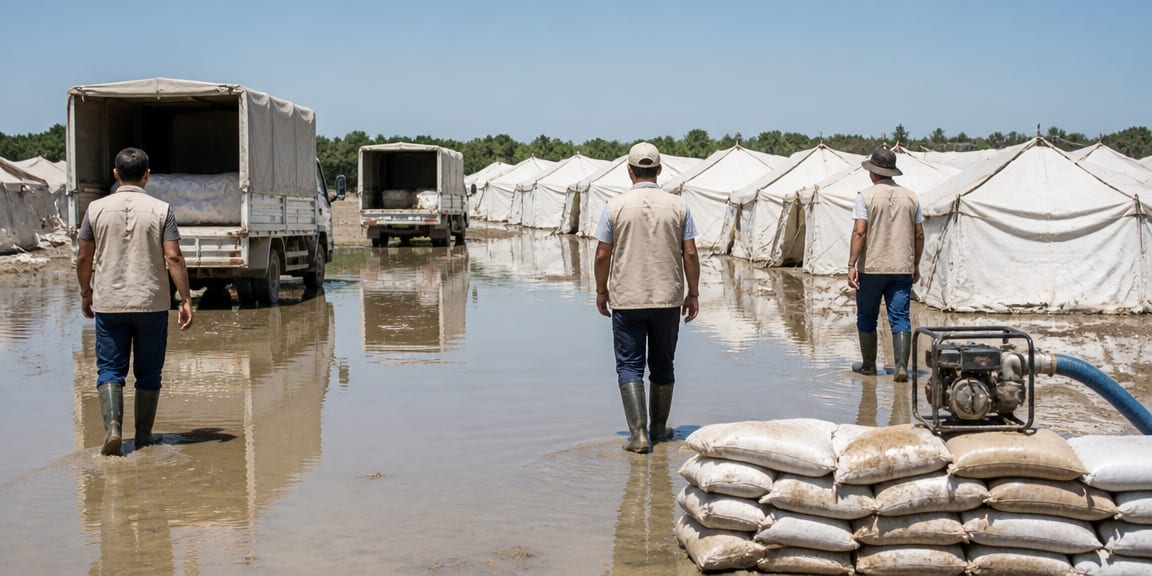
Heavy rains swamp Gaza’s displacement camps, with deaths reported and access restrictions under scrutiny
Narrative Snapshot
Across outlets, the scale of flooding in Gaza’s tented camps and the vulnerability of displaced families are uncontested. Reporting converges on tents being inundated within hours, shelters collapsing, and children among the dead. Where accounts diverge is less about whether there is a crisis than about attribution and remedies. Israeli and international angles foreground institutional constraints: Haaretz cites a UN report accusing Israel of blocking equipment needed for infrastructure rehabilitation, while the New York Times highlights Israel’s position that rebuilding will not proceed until Hamas disarms. European and Qatari coverage stresses the material collapse of basic systems and ongoing aid restrictions, with Le Monde asserting that Israel continues to limit deliveries needed for reconstruction. Advocacy-oriented pieces push further: Middle East Eye publishes a call for sanctions, Tehran Times frames international inaction as refusal to confront the problem, and La Repubblica features testimony from a priest describing despair and “putrid sludge.” Telesur and Al Jazeera provide granular accounts from Deir al-Balah of a sand embankment collapse that buried families, centering the immediate human toll.
What Happened
Winter storms swept Gaza, flooding sprawling encampments of displaced people and collapsing fragile shelters. France24 reports tents “entirely submerged,” while a Haaretz summary of a UN report says heavy rain flooded 40,000 tents and affected 200,000 residents. Casualty figures vary: the New York Times cites at least four deaths from one family, and Le Monde reports five fatalities, including three children. Telesur names those killed when a sand embankment collapsed onto tents in Deir al-Balah, an incident Al Jazeera also describes as burying families alive and triggering desperate rescues. Middle East Eye documents families waking “soaking wet” as shelters failed overnight. Le Monde says the floods expose the extent of war damage and alleges ongoing Israeli restrictions on deliveries needed for reconstruction; Haaretz relays a UN accusation that Israel is preventing essential infrastructure equipment from entering. The New York Times notes Israel’s stance that Gaza will not be rebuilt until Hamas disarms.
Why It Matters
The flooding turns a chronic displacement crisis into an acute disaster-risk failure. Multiple sources tie the damage to degraded infrastructure and access constraints: Al Jazeera highlights systemic collapse, while Le Monde and Haaretz cite continuing Israeli limits on reconstruction inputs and a UN allegation that essential equipment is being blocked. Israel’s position, reported by the New York Times, links rebuilding to Hamas disarmament, effectively conditioning large-scale recovery on a political-security outcome. For donors and humanitarian agencies, this alignment of winter hazards, destroyed utilities, and movement restrictions narrows the operational space for disaster preparedness. Advocacy calls in Middle East Eye for sanctions, and Tehran Times’ emphasis on international inaction, signal mounting pressure on multilateral bodies to reassess leverage and monitoring of access. Three years on, as France24 notes, protracted displacement persists, underscoring the limits of existing aid arrangements absent structural reconstruction and governance decisions.
Diverging Narratives
The fault lines in coverage center on causes and remedies. Haaretz, citing a UN report, and Le Monde both attribute Gaza’s exposure to flood damage partly to Israeli restrictions on bringing in materials critical for infrastructure repair and reconstruction. The New York Times, while noting the storm’s toll, foregrounds Israel’s declared condition that Gaza’s rebuilding will not begin until Hamas disarms, emphasizing a security-linked policy framework. Middle East Eye’s opinion piece goes further, arguing that withholding vital supplies constitutes mass collective punishment and calling for sanctions, a step not echoed in the straight news reporting. Tehran Times characterizes global passivity in confrontational terms, while La Repubblica and the Middle East Eye news feature highlight residents’ lived hardship without prescribing policy. Quantitatively, estimates of the scale differ: Haaretz reports 40,000 tents flooded and 200,000 people affected per a UN report, whereas the Middle East Eye opinion column asserts roughly 70,000 tents. Fatality figures also vary between four (New York Times, Telesur’s named family) and five (Le Monde).
What Happens Next
Several decision points will shape immediate conditions. First, access for infrastructure rehabilitation: Haaretz’s account of a UN accusation and Le Monde’s reporting on continued restrictions set up a test of whether Israel permits entry of essential equipment; expanded access would enable stormwater and shelter fortification ahead of further winter weather noted by Al Jazeera and France24, while continued limits would leave camps exposed. Second, the political precondition for reconstruction: the New York Times reports Israel will not rebuild until Hamas disarms; unless that stance changes or is offset by alternative arrangements, large-scale recovery remains stalled. Third, external pressure and advocacy: Middle East Eye’s call for sanctions and Tehran Times’ framing of international inaction indicate a push for stronger measures; watch for UN reporting updates, donor statements, or policy shifts that reference access and reconstruction conditions. Finally, casualty and displacement assessments may be revised as Al Jazeera documents post-flood damage reviews and rescue outcomes.