
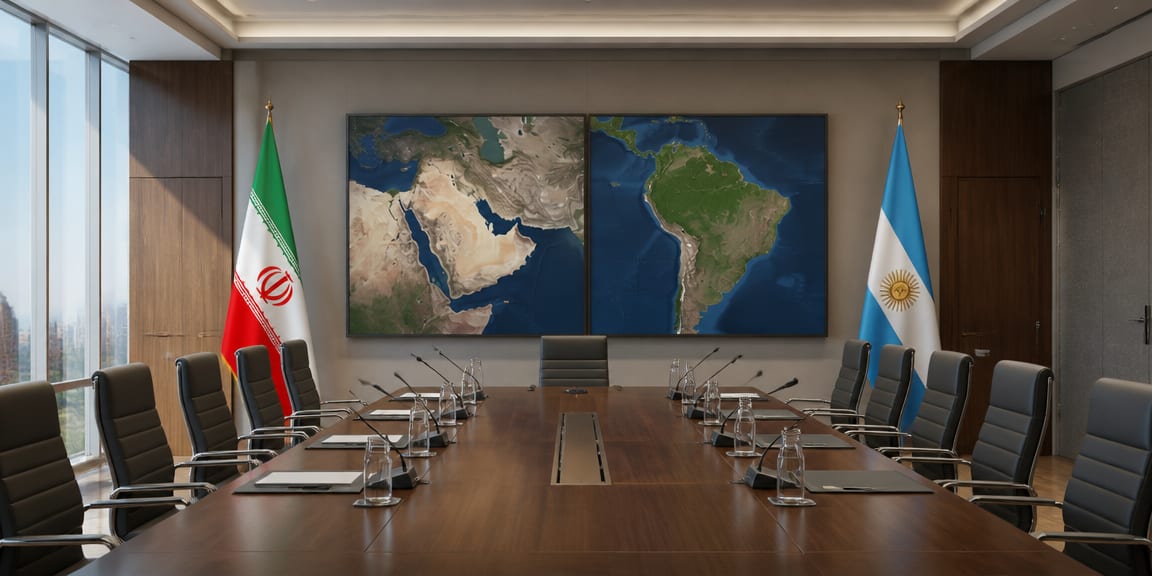
Iran labels Argentina’s Navy and Air Force ‘terrorist organizations’ in reciprocal move
Narrative Snapshot
Across outlets, the event is framed as a retaliatory designation anchored in reciprocity, with agreement that Tehran’s step follows Buenos Aires’ earlier listing of Iran’s Islamic Revolutionary Guard Corps. Iranian and Chinese state-aligned coverage emphasizes the response logic without elaborating on consequences, presenting a concise official narrative from Tehran’s Foreign Ministry (Tehran Times; CGTN). European and Israeli reporting adopts a tit-for-tat framing and adds political context: Deutsche Welle highlights Tehran’s warning that Buenos Aires would bear responsibility for “further consequences,” while Haaretz attributes Argentina’s original IRGC listing to pressure from the Trump administration, a claim not echoed elsewhere.
Latin American coverage foregrounds Argentine domestic ramifications. Folha de S.Paulo links the Iranian move to President Javier Milei’s April decision, while Clarín details both the Foreign Ministry’s categorical rejection and internal concern within the Defense establishment, alongside political messaging from Senator Patricia Bullrich asserting this “marks which side we are on” and invoking prior terrorist attacks in Argentina attributed to Iran in Argentine political discourse. Russian state media notes the earlier Argentine listing occurred in March, underscoring minor timeline discrepancies across outlets (TASS versus Folha, CGTN). The stakes identified in this mix are diplomatic and institutional: whether reciprocal terrorism designations between states become normalized tools of statecraft and how Argentina calibrates its response amid its current foreign policy alignment.
What Happened
Iran’s Foreign Ministry announced on November 11 that it had designated Argentina’s Navy and Air Force as terrorist organizations, explicitly linking the action to Buenos Aires’ earlier decision to designate Iran’s Islamic Revolutionary Guard Corps (Tehran Times; CGTN; Al Jazeera English). Outlets differ on the timing of Argentina’s move—TASS cites March, while Folha de S.Paulo and CGTN refer to April—but all tie the Iranian step to that precedent. Argentine daily Clarín reports that Tehran justified its action on a “principle of reciprocity” and notes Iran has a law enabling retaliation against any state that designates its military forces as terrorist organizations. Deutsche Welle adds that Tehran said Buenos Aires would be responsible for any “further consequences.” In Argentina, the Foreign Ministry issued a categorical rejection, and Clarín describes “extreme concern” within the Defense establishment and ongoing evaluation of potential measures in response.
Why It Matters
The episode underscores the growing use of terrorism designations against state military institutions, not only non-state actors. Multiple outlets describe Iran’s move as a reciprocal response to Buenos Aires’ listing of the IRGC, signaling the potential institutionalization of mirrored designations between states (Tehran Times; Folha de S.Paulo; CGTN; Clarín). Clarín’s reference to an Iranian legal basis for retaliation indicates an embedded framework that could facilitate further escalatory steps when Iran’s forces are targeted by foreign governments. For Argentina, Clarín’s reporting on internal deliberations and categorical diplomatic rejection suggests immediate policy choices on crisis management and alliance signaling under President Javier Milei. Haaretz’s portrayal of U.S. influence on Argentina’s original decision highlights the broader geopolitical framing within which these steps are interpreted, while Deutsche Welle’s citation of Tehran’s warning points to possible downstream ramifications that Buenos Aires is now weighing.
Diverging Narratives
Iranian and several international outlets frame the designation as a direct, rules-based reciprocity to Argentina’s IRGC listing, keeping the focus on sequence and state prerogative (Tehran Times; CGTN; Al Jazeera English). European coverage characterizes the interaction as tit-for-tat and introduces the possibility of additional fallout, with Deutsche Welle reporting Tehran’s assertion that Argentina would bear responsibility for any “further consequences.” Israeli coverage injects a U.S. angle, with Haaretz stating Argentina acted under Trump-era pressure, a claim not corroborated across the other sources. Latin American reporting centers Argentine agency and domestic politics: Folha de S.Paulo emphasizes the Milei government’s April step as the proximate cause, while Clarín provides Argentina’s official rejection, notes Defense-sector concern, and quotes Senator Patricia Bullrich arguing the episode affirms Argentina’s chosen alignment and referencing two terrorist attacks in the country as part of the domestic justification narrative. Outlets also diverge modestly on the month of Argentina’s IRGC listing, with TASS citing March and others April, without affecting the agreed causal link.
What Happens Next
Argentina’s government is “evaluating measures,” according to Clarín, creating an immediate decision point between a largely declaratory response and more substantive diplomatic or policy steps. A firmer posture could reinforce the Milei administration’s alignment signaled domestically by figures like Bullrich, while a calibrated approach would aim to contain escalation; analysts should watch for formal communiqués from the Foreign Ministry and any Defense-related directives reported by Argentine outlets. On the Iranian side, Clarín’s note about a legal framework for retaliation and Deutsche Welle’s report of Tehran warning of “further consequences” establish a second decision point: whether Iran operationalizes additional measures beyond designation. Indicators include follow-on statements from Iran’s Foreign Ministry specifying scope and application, and any expansion of listings. Across both capitals, the persistence or adjustment of the original Argentine IRGC designation remains a baseline indicator, with Clarín’s categorical rejection suggesting no near-term reversal.