
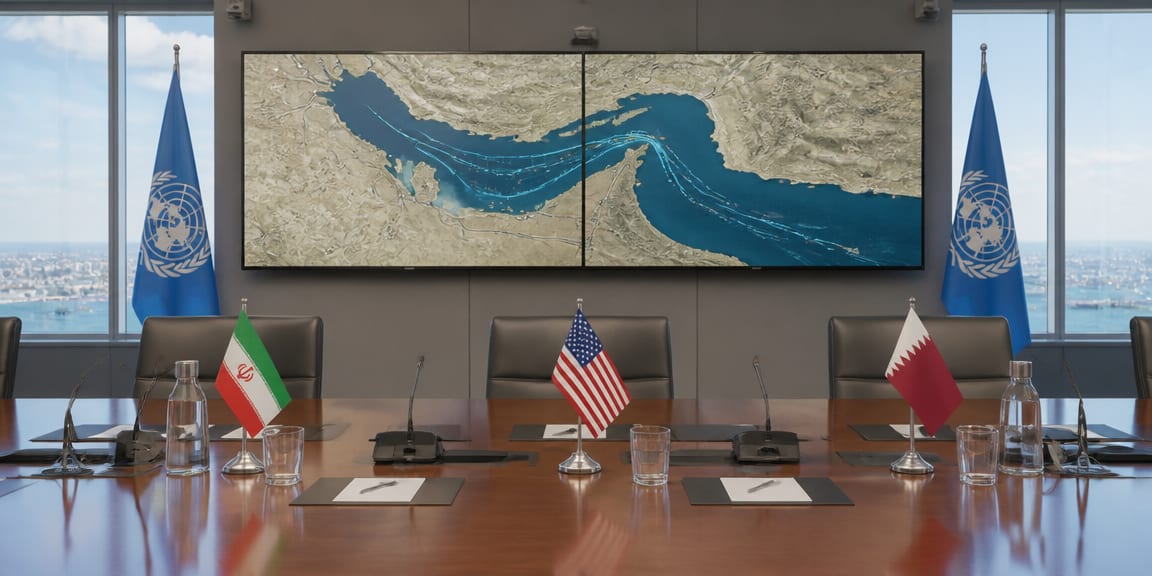
Iran moves to end ‘no war, no peace’ amid Qatari mediation; US downplays renewed war as Hormuz stays restricted
Narrative Snapshot
Across outlets, there is broad acknowledgment that the diplomatic track is active and regionally anchored. Qatari officials say both Washington and Tehran have responded positively to mediation and that Doha is working “to end the uncertainty” of the crisis, with Saudi and Qatari foreign ministers coordinating on de-escalation and emphasizing a “good agreement” over a perfect one. A senior UAE figure describes cautious optimism tied to Qatari efforts. At the same time, Tehran’s leadership signals a shift, with President Masoud Pezeshkian stating the Leader has ordered an end to the “neither war nor peace” state and that Iran is ready for talks but not coercion. Iranian negotiators add that the “ball is in Washington’s court.”
What divides the coverage is how preconditions and pressure are framed. Iranian and aligned outlets stress that Tehran demands complete sanctions removal before entering peace talks, labels its military posture legal self-defense, and rejects US ultimatums as counterproductive. Western and Israeli coverage emphasizes pressure levers and partial openings: the Times of Israel reports Iran says the IAEA has inspected a nuclear site and ties the reopening of Hormuz to US acceptance of its demands, alongside reports of a possible US offer to ease restrictions. The New York Times details Washington’s bid to tighten a blockade by closing Iran’s land borders—an effort neighboring states resist.
Economic stakes are consistently foregrounded. The Hindu notes Iran’s continued partial blockage of the Strait of Hormuz has dented Gulf oil supplies; Qatar warns that a prolonged closure and the onset of winter are doubling the crisis’s costs; and Al Jazeera assesses whether Tehran can sustain a “zero oil” budget under a US siege that would leave most Iranians poorer. Telesur underscores the chokepoint’s centrality, with roughly 20 percent of global petroleum flowing through Hormuz.
Domestic US politics surface as a separate lens on the same crisis. President Donald Trump describes a renewed war as “highly unlikely” and claims “considerable progress,” even as he acknowledged limited strikes earlier. In parallel, Fox News details Republican divisions after midterm losses, with Secretary of State Marco Rubio defending the administration’s approach and Vice President JD Vance blaming the war for electoral setbacks. An opinion essay in Middle East Eye depicts the elections as a “blue tsunami” and a setback for Trump, a view it says is echoed in Tehran.
What Happened
After large-scale US and Israeli operations began on 28 February 2026, Iran restricted traffic through the Strait of Hormuz, a partial closure that The Hindu says continues to dent oil supplies. In early November, President Trump said a renewed war was “highly unlikely,” while Middle East Eye reported he acknowledged “limited strikes” and “considerable progress.” Iran’s Parliament Speaker and lead negotiator Mohammad Bagher Ghalibaf told Al Jazeera that Tehran seeks to end the “no war, no peace” condition, has provided clear demands, and awaits a formal US reply; he added Hormuz would not revert to pre-war status and referenced a seven-point framework. Tehran Times reported President Masoud Pezeshkian saying the Leader ordered an end to the limbo, with readiness for talks without coercion. Qatar publicly said both sides responded positively to mediation and warned the closure’s costs are rising. The Times of Israel reported Iran said the IAEA inspected a nuclear site and tied reopening Hormuz to US acceptance of Tehran’s demands, amid reports of an American offer to ease restrictions. The New York Times said Washington seeks to tighten its blockade by closing land borders, but neighbors are pushing back.
Why It Matters
The confrontation is reshaping the rules around a critical maritime chokepoint. By explicitly linking Hormuz access to sanctions relief and US policy shifts, Tehran is testing the interplay between freedom of navigation and economic coercion at a corridor that Telesur notes carries about one-fifth of global petroleum, with The Hindu and Qatar highlighting mounting supply and cost impacts. Washington’s effort to extend a blockade onto land routes, described by the New York Times and resisted by neighbors, spotlights the limits of extraterritorial enforcement and the importance of regional consent for sanctions architectures.
Institutionally, the IAEA’s inspection, as reported by the Times of Israel, offers a narrow technical foothold for confidence-building amid military deterrence signaling. Diplomatically, Qatar’s shuttle efforts—coordinated with Saudi Arabia and watched by the UAE—illustrate Gulf actors’ central brokerage role. For decision-makers, Al Jazeera’s “zero oil” budget question underscores the domestic resilience calculus in Tehran, while Fox News’ reporting on US political divisions and Middle East Eye’s emphasis on the midterm shock suggest shifting incentives in Washington that could affect the durability of pressure-only approaches.
Diverging Narratives
Tehran’s public line, reflected in IRNA and Middle East Eye, holds that Iran has no desire for war, has delivered a reasonable response, and awaits a formal US answer; it pairs this with an insistence that Hormuz will not return to the pre-war status quo and that any reopening hinges on a seven-point Iranian framework. Telesur extends this by stating Tehran demands complete sanctions removal before talks and frames Iran’s actions as lawful self-defense. A TASS-cited Iranian diplomat argues US ultimatums will fail and aggravate the crisis.
US- and Israel-focused coverage highlights pressure, conditional openings, and partial steps. The Times of Israel reports Iran’s claim of an IAEA inspection and Tehran’s call for Washington to heed public sentiment and end the war, while noting reports of a US offer to ease restrictions. The New York Times describes Washington’s push to close Iran’s land borders, even as neighbors resist. Domestically, Fox News captures a split: Secretary of State Rubio defends the war’s rationale; Vice President Vance blames it for Republican midterm losses, aligning with Middle East Eye’s portrayal of a “blue tsunami” and perceived setback in Tehran. Trump’s statements, reported by The Hindu and Middle East Eye, oscillate between downplaying the likelihood of renewed large-scale fighting and acknowledging limited strikes, while Fox News notes he has not categorically ruled out further operations. These strands converge on a central friction: Iran conditions de-escalation on sanctions relief and altered US posture, while Washington seeks leverage through multi-domain pressure amid mixed political signals at home.
What Happens Next
Several decision points emerge from the record. First, whether Washington issues the formal, specific reply that Ghalibaf says is still pending; movement here would show up in public acknowledgment of a US response and any reference to easing restrictions, which the Times of Israel reports has already been floated. Second, the linkage between Hormuz access and Iranian conditions will be tested; indicators include statements about Tehran’s seven-point framework and “seven conditions” cited by Fox News, any mention of complete sanctions removal (Telesur), and observable easing of Strait restrictions noted by outlets tracking closure impacts. Third, the scope of the US blockade is in flux; watch for neighboring states’ positions as Washington tries to close land borders, a step the New York Times says they currently resist. Fourth, Gulf mediation dynamics matter; continued Saudi-Qatari coordination, Qatari briefings on “positive signals,” and the UAE’s tone will signal trajectory, as will any G7 diplomatic messaging referenced by the Times of Israel. Finally, technical steps on the nuclear file—such as follow-on IAEA activity and the reported Iranian proposal transmitted via Qatar—will indicate whether a narrow nuclear channel can anchor broader de-escalation.