
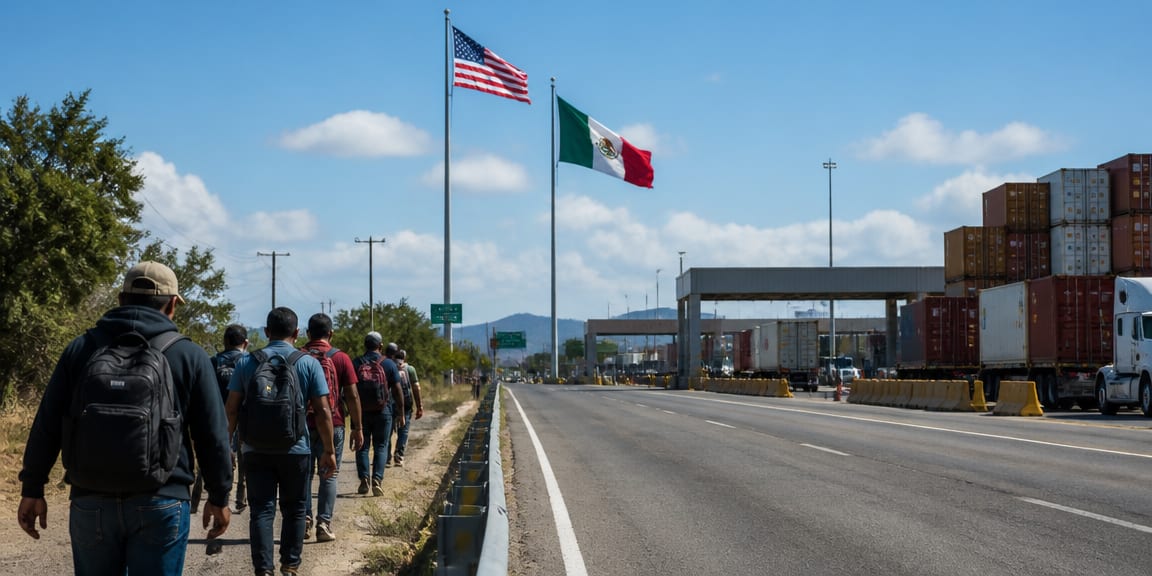
Trump threatens to double Mexico tariffs as new migrant caravan leaves southern Mexico
Narrative Snapshot
Across outlets there is agreement that a new caravan of roughly 1,500–2,000 Central Americans has set out from southern Mexico and that President Donald Trump has threatened to immediately double tariffs on Mexican goods unless the migrants are stopped. Reports converge on the caravan’s origins in Honduras and its movement through Chiapas, while varying slightly on size and emphasis.
The framing diverges sharply. Telesur English and Al Jazeera spotlight migrants’ hopes tied to Democrats’ midterm gains in Congress and include first‑person accounts of economic motivations. Fox News and the South China Morning Post foreground Trump’s warning and his characterization of the caravans as an imminent security challenge. Le Monde adds on‑the‑ground detail about the caravan’s ease of entry into Mexico and situates it against Republican midterm losses. The Toronto Star (AP) centers Mexico’s rebuttal—President Claudia Sheinbaum said no caravans have reached the U.S. border since Trump returned to office in 2025—while Clarín underscores border tensions, diplomatic frictions, and migrants’ criticism of U.S. troop deployments.
What is most at stake is the explicit linkage of migration control to trade penalties, the credibility of Mexico’s containment claims as the group moves north, and how domestic U.S. political narratives shape both migrant expectations and executive threats.
What Happened
A caravan of nearly 2,000 people from Honduras, El Salvador, Guatemala, and Nicaragua left San Pedro Sula and resumed travel from Tapachula, Chiapas, heading north through Mexico (Telesur English; Le Monde). Estimates in other coverage put the group at about 1,500 (Fox News; South China Morning Post). Migrants interviewed said they were motivated by work opportunities and by a belief that Democrats’ congressional gains could lead to U.S. policy changes; some planned to work temporarily in Mexico while they wait (Telesur English; Al Jazeera).
In a Truth Social post, President Trump warned that “tariffs on Mexico will be immediately doubled” unless Mexico halts the caravans and said relevant U.S. and Mexican officials were informed (Fox News; SCMP). Telesur noted the post did not specify which duties would double or how (Telesur English). Responding, President Claudia Sheinbaum said no migrant caravans have reached the U.S. border since Trump returned to office in 2025 (Toronto Star/AP). Clarín reported migrants criticized Trump’s decision to send troops.
Why It Matters
The threat to double tariffs ties migration enforcement directly to trade penalties, raising the cost of noncompliance for Mexico and signaling a readiness to use economic leverage to influence a partner’s border actions (Fox News; SCMP; Telesur English). Clarín highlights that continued caravans under restrictive policies exacerbate border tensions and diplomatic strains, underscoring how migration can destabilize broader bilateral agendas.
Mexico’s assertion that no caravans have reached the U.S. border since 2025 projects enforcement capacity and aims to counter the premise of Washington’s ultimatum (Toronto Star/AP). Telesur’s observation that the White House offered no specifics on tariff scope or implementation introduces uncertainty for markets and policy planners, even as the threat itself may pressure Mexican authorities. Meanwhile, migrant accounts linking their decisions to perceived shifts in U.S. politics indicate how electoral narratives can reverberate through regional mobility patterns (Telesur English; Al Jazeera), complicating deterrence strategies and cross‑border coordination.
Diverging Narratives
Trump’s portrayal is categorical: large caravans are “beginning their illegal march” and “will not be accepted,” with an immediate doubling of tariffs threatened if Mexico does not stop them (Fox News; SCMP). Telesur adds that the post offered no detail on which duties would double, leaving the mechanics unspecified. Mexico counters that caravans have not reached the U.S. border since 2025, presenting a record of containment that challenges the urgency and premise of the tariff warning (Toronto Star/AP).
Migrant perspectives differ again: Telesur quotes participants expecting U.S. policy to shift after Democrats’ congressional wins and describing labor demand as a pull factor; Al Jazeera reports similar hopes among those stranded in southern Mexico. On‑the‑ground reporting from Le Monde notes the caravan crossed into Mexico “easily” and is transiting Chiapas, suggesting current movement is unimpeded at Mexico’s southern frontier even as Mexico claims success at preventing arrival to the U.S. border. Clarín introduces a military dimension by relaying migrants’ criticism of Trump’s troop deployment decision, indicating resentment toward securitized responses. Even basic metrics vary slightly, with outlets citing 1,500 to nearly 2,000 people, reflecting fluid counts and differing vantage points.
What Happens Next
Three decision points emerge. First, whether the United States operationalizes the tariff threat: Telesur reports no details on which duties would double, so analysts should watch for formal designations or implementing guidance that would translate rhetoric into policy. Second, how Mexico manages the caravan as it advances through Chiapas and beyond: Le Monde places the group in southern Mexico, while Sheinbaum asserts caravans have not reached the U.S. border since 2025; the test will be whether authorities intercept, disperse, or channel the group to keep it from the frontier (Le Monde; Toronto Star/AP). Third, the caravan’s trajectory and composition: Telesur notes some intend to work in Mexico pending U.S. policy shifts, so indicators include reports of partial settlement or slowing movement. Clarín’s reference to troop deployments suggests watching for U.S. border posture changes and whether such measures influence migrant decisions or Mexico’s response.