
Europe names joint team to represent it in Ukraine peace talks, with UK alongside EU powers
Narrative Snapshot
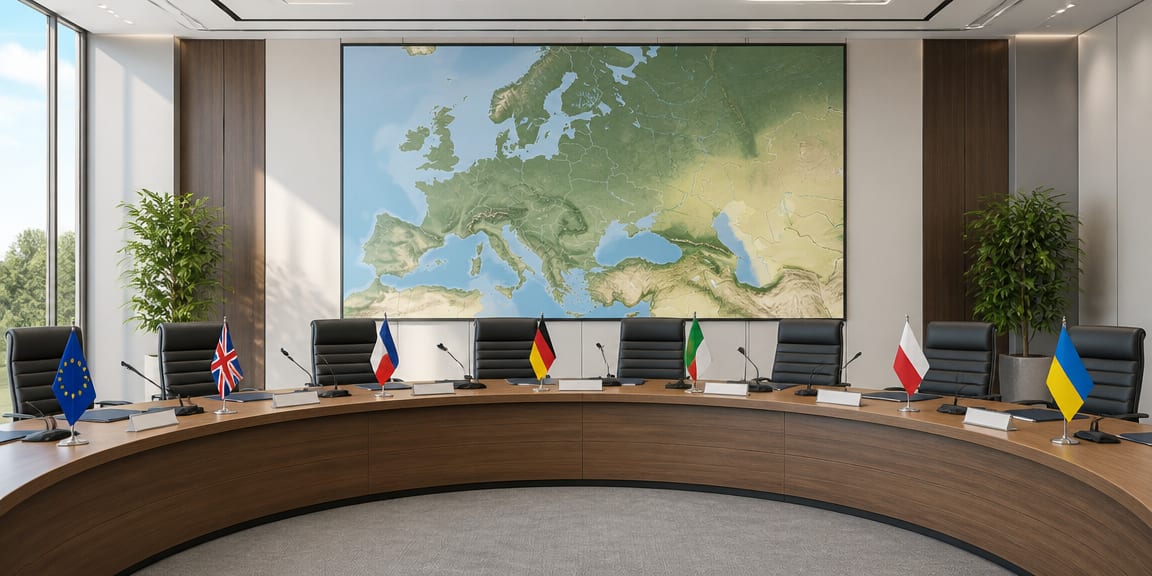
Across European, North American, and Ukrainian outlets, the center of gravity shifts from whether Europe will be present to how it will speak. Several European and U.S. reports describe an agreement to field a joint team that includes EU institutions and five major European military powers, with the United Kingdom participating alongside France, Germany, Italy, and Poland (Folha de S.Paulo; Deutsche Welle; New York Times; Sky News). Ukrainian outlets echo that consensus and underline both timetables and principles, citing expectations of concrete talks within weeks and emphasizing that only Ukraine can decide on sovereignty-related questions (Ukrinform; Kyiv Independent).
Other reporting foregrounds the still-present anxieties about process control. Coverage from AP carried by the Toronto Star and by Al Jazeera highlights concern that a U.S.-backed channel could leave Europe on the margins while Moscow and Washington set the terms. The Hindu frames Kyiv’s own balancing act, noting Ukraine’s desire for European reinforcement and its reluctance to leave talks to a U.S. administration perceived as sympathetic to Moscow’s views.
Russian state media contest the premise and optics of European inclusion. TASS quotes a Russian official claiming the EU has not been invited and delivers a pointed personal attack on EU foreign policy chief Kaja Kallas, while a separate TASS item details Rome’s move to designate the Italian prime minister’s diplomatic adviser for the talks and cites European Council President Antonio Costa on an EU institutions–plus–“coalition of the willing” format. RT’s analysis attributes Europe’s prospective seat to recent U.S. envoy contacts with President Vladimir Putin and stresses European divisions.
Kallas’ own positioning sets a boundary for the agenda. Outlets in India and Thailand report her warnings against Russian “traps” and her argument to prioritize a ceasefire over broader security negotiations, signaling how Europe may try to narrow the scope even as it expands its representation (The Hindu; Bangkok Post).
What Happened
European leaders agreed in Dublin on a joint team to represent Europe in negotiations aimed at ending Russia’s war against Ukraine, according to Ukrainian and European reports (Ukrinform; Deutsche Welle). The composition, described by Folha de S.Paulo and echoed by Deutsche Welle and Sky News, includes the EU institutions alongside the United Kingdom, France, Germany, Italy, and Poland; the New York Times likewise reports a six-member European team. Kyiv-based outlets add timing signals: Friedrich Merz said Europe will be represented for the first time at concrete talks expected in the coming weeks (Ukrinform). European Council President Antonio Costa underscored that only Ukraine has legitimacy over decisions on its territory and sovereignty (Kyiv Independent). On the process, Deutsche Welle notes a U.S. envoy’s comments after talks with Vladimir Putin suggested Europe’s seat was likely, while RT identifies the envoys as Steve Witkoff and Jared Kushner. TASS reports Italy has tapped the prime minister’s diplomatic adviser and also quotes a Russian security official claiming the EU has not yet been invited.
Why It Matters
Coalescing around a joint representation including EU institutions and the non‑EU UK signals a flexible “coalition of the willing” approach that bridges EU and NATO power centers and could mitigate fears—flagged by AP reporting and Al Jazeera—of a U.S.–Russia duopoly over outcomes. It also tests Europe’s institutional capacity to centralize diplomacy after months of hesitation noted by Deutsche Welle and Folha de S.Paulo. For Kyiv, Europe’s presence is both support and a guardrail: Costa’s assertion that sovereignty decisions rest with Ukraine codifies a principle that counterbalances pressure for expediency (Kyiv Independent). Kaja Kallas’ warnings about Russian “traps” and her prioritization of a ceasefire over broader security negotiations preview Europe’s attempt to shape scope and sequencing (The Hindu; Bangkok Post). Russian state media pushback on Europe’s role foreshadows procedural contention (TASS), making mandate clarity and internal coordination mission‑critical for governments planning sanctions relief, security guarantees, and reconstruction linkages.
Diverging Narratives
European and U.S. outlets largely converge on the fact of an agreed European team and portray it as a long-sought coordinated stance, with explicit membership reported by Folha de S.Paulo and Deutsche Welle and the United Kingdom’s participation highlighted by Sky News; the New York Times frames this as Europe filling a newly available seat. Yet AP reporting in the Toronto Star and coverage by Al Jazeera stress that Europe remains anxious about being sidelined by a U.S.-backed track, indicating that unity of voice is not assumed simply by naming a team.
Ukrainian and Indian outlets elevate agency and agenda. Ukrinform quotes Kaja Kallas saying Europe must help shape the outcome, while The Hindu reports her view that Moscow does not choose Europe’s representatives; the Kyiv Independent emphasizes Costa’s line that only Ukraine decides sovereignty issues.
Russian state media challenge both inclusion and coherence. TASS quotes Dmitry Medvedev claiming the EU has not been invited and attacking Kallas personally, while another TASS piece cites Costa on a delegation drawn from EU institutions and a “coalition of the willing” and reports Italy’s choice of a prime ministerial adviser. RT situates Europe’s place as a product of U.S. envoy engagement with Putin and frames European politics as fractious. Across these accounts, questions remain about operational leadership within the European team and the precise breadth of its mandate.
What Happens Next
The immediate determinant is format recognition. If Moscow formally acknowledges Europe’s inclusion, the six-member construct reported by European and U.S. outlets can be tested in practice; if Russia maintains that no invitation has been issued, as TASS reports, timing for the “coming weeks” described by Ukrinform could slip. Implementation choices now loom: capitals and EU institutions must name specific delegates and define coordination, with Italy’s reported selection of a prime ministerial adviser indicating national-level moves are underway (TASS). Agenda definition will shape leverage and duration. Kallas’ call to prioritize a ceasefire over expansive security talks points to one pathway; pressure to fold broader European security issues into the process would mark another (Bangkok Post). Analysts should watch for scheduling announcements from European Council President Costa, any confirmation from Moscow or Washington of the next round, and signs that UK participation alongside EU institutions functions smoothly (Kyiv Independent; Sky News; Folha de S.Paulo).