
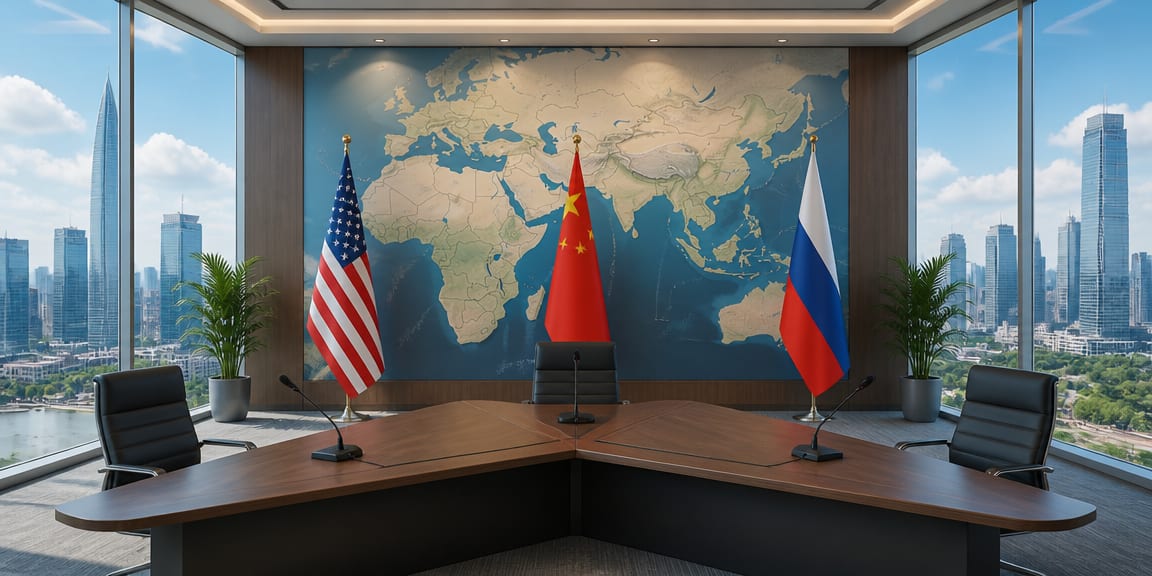
White House confirms first Trump–Xi–Putin three-way meeting in China to focus on nuclear arms and the Iran war
Narrative Snapshot
Across outlets, there is broad agreement that Washington has confirmed an unprecedented three-leader meeting in Shenzhen next week on the sidelines of APEC, with nuclear arms and the war in Iran flagged as headline topics. Several reports characterize the encounter as historic but likely to be heavy on symbolism. Latin American coverage underscores this point most explicitly, emphasizing low expectations for concrete progress.
The sharpest divergence is whether Ukraine will be on the table. One account includes Ukraine alongside Iran under a wider international security brief, while multiple others say it is not expected to be discussed. Coverage also splits on who benefits from the optics: Indian reporting frames this as a coveted opportunity for the Kremlin to project parity with Washington and Beijing, whereas German reporting highlights Beijing’s own calculus and the reputational risks of hosting a format that could be seen as advantaging Moscow.
What Happened
The White House has confirmed that U.S. President Donald Trump, Chinese President Xi Jinping, and Russian President Vladimir Putin plan to hold an unprecedented trilateral meeting in Shenzhen, China, next week on the sidelines of the APEC summit. Reports place the APEC gathering on November 18–19, with several outlets specifying the trilateral meeting as taking place on Thursday, November 19. Multiple accounts state the talks will focus on nuclear arms control or the reduction of nuclear weapons, and on international security issues that include the ongoing war in Iran. One report says Ukraine will also be on the agenda, while others say it is not expected to be raised. Coverage consistently describes the session as the first such three-way meeting among current U.S., Chinese, and Russian leaders.
Why It Matters
This gathering sets a rare three-leader format that several outlets call historic, establishing a precedent for direct engagement among Washington, Beijing, and Moscow on nuclear arms and acute security crises. The subject matter—nuclear arsenals and the war in Iran—touches core questions of strategic stability, and the inclusion or exclusion of Ukraine would signal how each participant prioritizes concurrent conflicts. Reporting from India emphasizes that the Kremlin views the format as a chance to project parity with the United States and China, underscoring the symbolic leverage Russia seeks from the event. German coverage stresses Beijing’s hosting dilemma and the risk that the optics could favor Moscow, potentially affecting China’s broader global image. Argentine reporting points to limited expectations for tangible outcomes, suggesting that how the meeting is framed—and by whom—may matter as much as any substantive deliverables.
Diverging Narratives
The agenda is the main point of contention. One account says Ukraine is among the security issues to be discussed, but multiple outlets report that Ukraine is not expected to come up. By contrast, there is consistent emphasis that Trump intends to discuss nuclear arms and the war in Iran, though the level of detail varies: some stories cite a spokeswoman’s reference to “reduction of nuclear weapons,” while others frame it as broader arms control. The New York Times adds that Trump is not expected to address the scandal involving Jensen Huang.
On strategic framing, Indian reporting highlights the Kremlin’s desire to use the format to posture as a superpower on par with Washington and Beijing. German coverage centers on Beijing’s reputational calculus, warning that hosting could tilt the optics toward Moscow and complicate China’s global positioning. Argentine coverage stresses the primacy of symbolism over substance, setting a low bar for outcomes. Russian state media, citing the White House confirmation, presents the meeting as unprecedented and wide-ranging on international security.
What Happens Next
Key indicators will come from final agenda signals and readouts. Analysts should watch whether official briefings align with the report that Ukraine will be discussed or with multiple outlets stating it will not be raised; that divergence will shape interpretations of each leader’s priorities. Given the emphasis on nuclear arms, any specificity in language—whether about “reduction” or broader “arms control”—will indicate the scope of potential follow-on engagement. The degree to which participants reference the Iran war will show how centrally it figures in the trilateral. With Indian and German coverage highlighting, respectively, Russian parity-seeking and China’s image risk, the optics of protocol, sequencing, and public messaging in Shenzhen will be consequential. Argentine reporting’s low expectations suggest that the presence or absence of concrete announcements will itself be a key outcome to monitor.