
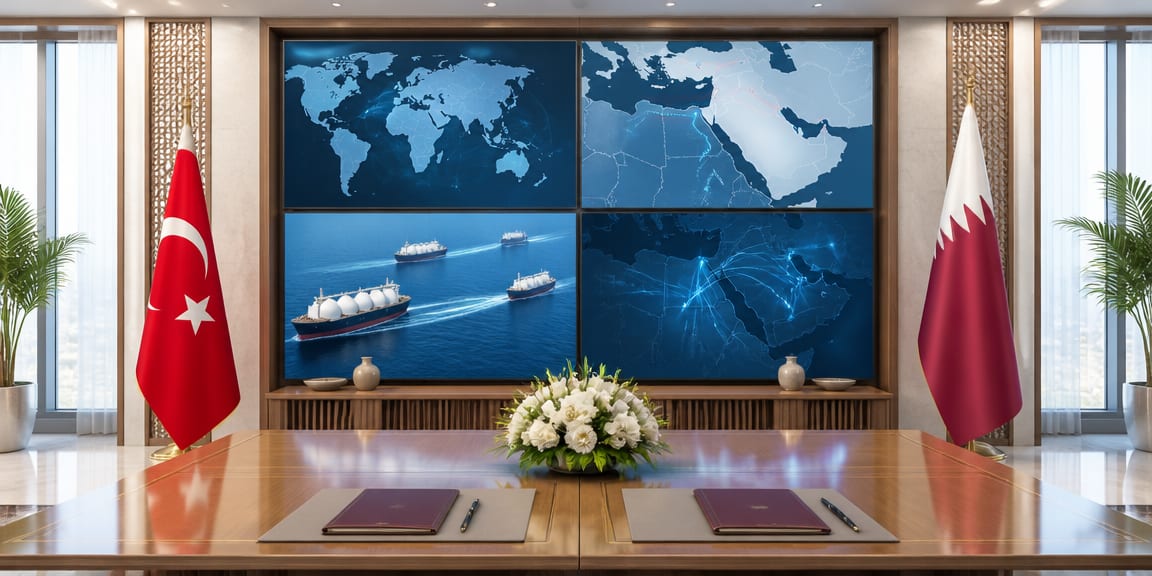
Turkey and Qatar sign mutual defence pact pledging unified response and broader security cooperation
Narrative Snapshot
Across outlets, the core point is consistent: Ankara and Doha have formalized a commitment to act in concert if either faces an external armed attack, while building out practical cooperation. Middle East Eye foregrounds the joint statement’s operational content—consultations on threats and defence policy, expanded joint exercises, defence industry projects, and personnel training—alongside an explicit energy dimension focused on liquefied natural gas. The Bangkok Post and France24 emphasize the “unified position” or “unified response” language, keeping the spotlight on collective defence.
Other coverage widens the frame. The Hindu highlights Turkish presidential messaging on diversifying the energy partnership and growing defence-industry collaboration, underscoring a dual-track agenda that links security and energy. Al Jazeera characterizes the accord as a message of deterrence amid regional instability. The Times of Israel anchors the agreement in contemporaneous issues, noting that President Erdogan and Emir Al Thani also discussed Iran and Gaza, and quotes Erdogan’s description of the pact as adding “a new dimension” to their ties.
What is most at stake varies with these emphases: the legal-political signal of mutual defence, the institutionalization of joint military and industrial activity, and the coupling of security with energy trade. None of the outlets publish the full text, so beyond the shared commitment to a unified stance, details on scope or enforcement mechanisms are limited to consultative and cooperative provisions cited by Middle East Eye.
What Happened
Turkey and Qatar signed a mutual defence agreement on 13 November 2026, with the leaders’ joint statement pledging a unified position or response to any external armed attack on either country, according to France24, Middle East Eye, and the Bangkok Post. Middle East Eye reports that the pact sets out consultations on threats to their security, regional and global security issues, and defence policy, and expands cooperation via joint military exercises, defence industry projects, and personnel training exchanges. The Hindu cites the Turkish presidency saying defence-industry cooperation will grow and that the two are working to develop and diversify their energy partnership. Middle East Eye places the leaders’ meeting in Istanbul on 13 November, while the Times of Israel notes they discussed Iran and Gaza and quotes President Erdogan calling the pact a new dimension to “brotherly” ties. Al Jazeera frames the agreement as deepening the partnership amid regional instability.
Why It Matters
The pact formalizes bilateral collective defence signaling while institutionalizing pragmatic channels—consultations, exercises, industrial projects, and training—described by Middle East Eye. This blends political commitment with mechanisms that can shape force readiness and interoperability. The Hindu’s emphasis on defence-industry growth and energy cooperation, and Middle East Eye’s specific reference to LNG, link security policy to supply and industrial strategies, suggesting a deepening Turkey–Qatar nexus that spans hard security and energy trade. France24 notes the agreement follows the Mecca Joint Defence Agreement reported as signed by Turkey, Pakistan, and Saudi Arabia in August, positioning Ankara’s move within a broader pattern of regional defence alignment. For governments and multilateral bodies, the immediate implications are in coordination dynamics around crisis response, procurement and joint production pathways, exercise planning, and potential energy tie-ins that can affect market exposure and leverage.
Diverging Narratives
Outlets converge on the core mutual-defence message but diverge in framing and granularity. Middle East Eye provides the clearest operational detail, depicting a framework that couples a collective stance with standing consultations and practical military cooperation. The Bangkok Post and France24 keep to the headline commitment of a unified position or response, offering minimal additional specifics. The Hindu elevates the energy and defence-industrial vectors via a statement from the Turkish presidency, shading the pact as part of a broader economic-security partnership.
Al Jazeera’s deterrence framing puts the agreement in the context of regional instability without elaborating the mechanisms. The Times of Israel situates the accord alongside discussions on Iran and Gaza and quotes Erdogan’s “new dimension” language, emphasizing political affinity and topical security concerns. Across these accounts, the binding nature of obligations is not spelled out; the shared phrasing on a unified stance or response is clear, while the instruments identified—consultations, exercises, and projects—point to implementation pathways rather than detailed treaty enforcement provisions.
What Happens Next
Implementation will turn on choices the parties signal in three areas identified across the coverage. First, defence cooperation: Middle East Eye’s account implies near-term decisions on scheduling joint exercises, launching defence-industry projects, and scaling training exchanges; concrete announcements on timelines, unit participation, or co-production would indicate depth. Second, energy linkage: Middle East Eye and The Hindu point to LNG and broader energy cooperation; watch for supply agreements or frameworks that tie energy flows to the partnership. Third, strategic coordination: The Times of Israel notes discussions on Iran and Gaza; subsequent joint statements or aligned diplomatic moves would show how the consultative provisions translate into regional positioning. France24’s note that this follows the Mecca Joint Defence Agreement suggests a potential interface between bilateral and wider formats; references to, or deconfliction with, that arrangement would signal how Ankara and Doha nest this pact within evolving regional architectures.