
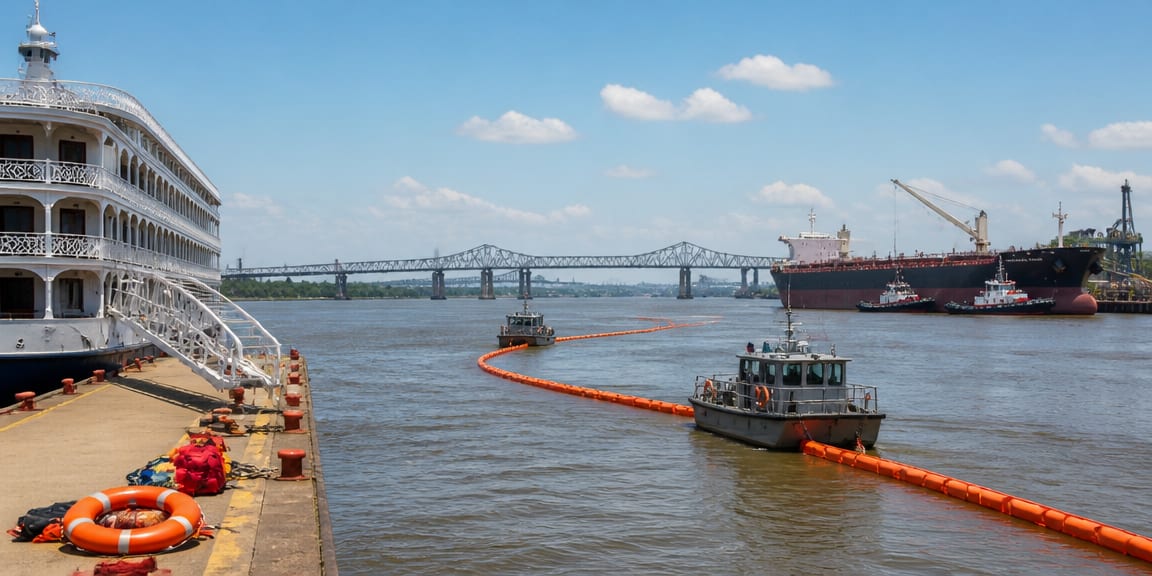
Tanker strikes docked Mississippi river cruise ship in New Orleans; all rescued as port moves to seize vessel
Narrative Snapshot
Across outlets, the rescue outcome anchors the coverage while emphasis diverges on injuries, legal fallout, and operational risk. Fox News and the BBC amplify officials’ “miracle on the Mississippi” framing and detail ongoing salvage and fuel-removal plans, while France24 highlights a partial river closure and the scale of the riverine rescue. Injury tallies and passenger counts vary: Telesur English reports about a dozen injured and roughly 129 passengers aboard, Fox News cites 191 total passengers and crew with eight hospitalized, and the Times of Israel notes 32 treated for non-critical injuries. Legal accountability and jurisdiction receive the sharpest cross-border framing: CBC News foregrounds the port’s rapid lawsuit to control a tanker owned by a subsidiary of a Chinese company, echoed by the BBC’s report that New Orleans seeks to seize and sell the vessel to cover damages. Clarin stresses the capsizing, critical injuries, and weeks-long cleanup trajectory.
What Happened
A tanker identified as the Atlantic Asphalt collided with the docked river cruise ship American Heritage near the Port of New Orleans as passengers were disembarking. CBC News reports the tanker lost steering before striking the vessel. Images and video cited by Telesur English show the riverboat listing and partially submerged, with tugboats holding position near a Mississippi River bridge and people in the water moving toward safety. Fox News reports roughly 100 people were pulled from the river, all aboard survived, and eight remained hospitalized, including two in serious condition; the Times of Israel notes 32 treated for non-critical injuries. France24 reports a portion of the river remains closed. The U.S. Coast Guard is leading an investigation and response, with plans cited by Fox News to remove approximately 16,000 gallons of fuel before salvage, an effort officials and Clarin indicate could take weeks.
Why It Matters
The case tests how quickly U.S. port authorities can assert control over a foreign-linked vessel after a high-risk casualty on a critical inland waterway. CBC News reports the Port of New Orleans sued within hours to ensure federal investigators can seize the China-linked tanker; the BBC adds the filing seeks permission to seize and sell the ship to pay damages. That move, alongside a Coast Guard-led investigation and partial river closure reported by France24, reflects the interplay of admiralty law, evidence preservation, and continuity of commerce on the Mississippi. Operationally, Fox News details the pre-salvage removal of 16,000 gallons of fuel and pollution monitoring—an environmental risk-management baseline under stress when a vessel capsizes in a constrained channel. The episode underscores response capacity and liability pathways on a river system central to U.S. grain, energy, and industrial flows.
Diverging Narratives
Accounts differ on the scale of casualties and who exactly was aboard. Telesur English cites about a dozen injuries and about 129 passengers, while Fox News reports 191 passengers and crew with eight hospitalized, and the Times of Israel cites 32 treated for non-critical injuries. Clarin reports eight hospitalized, two in critical condition, consistent with Fox News, but describes the counterpart as a barge, whereas multiple outlets identify a tanker, specifically the Atlantic Asphalt. Descriptions of the vessel’s condition vary in emphasis—Telesur English highlights a list and partial submergence; Fox News and Clarin characterize a capsizing; the Times of Israel reports the boat flipped while evacuations were underway. Causal framing remains preliminary: only CBC News attributes the collision to the tanker losing steering, while others center on rescue operations and aftermath. Legal framing splits focus as well, with CBC News and the BBC prioritizing the port’s lawsuit and seizure bid, while France24 foregrounds navigation impacts and Fox News details salvage timelines and pollution precautions.
What Happens Next
Two process tracks will drive outcomes. First, the legal and custody track: New Orleans has asked a court to let authorities seize—and per the BBC, potentially sell—the tanker to cover damages; CBC News stresses this is to secure the vessel for federal investigators. Analysts should watch for court rulings on arrest and sale, ownership disclosures, and any challenges from the China-linked subsidiary. Second, the safety and salvage track: the Coast Guard’s plan to remove about 16,000 gallons of fuel before raising the American Heritage, with pollution teams on standby, will determine the pace of reopening the closed river segment reported by France24. Indicators include whether divers’ assessments alter the fuel-removal sequence, any observed leaks noted by Fox News, and Coast Guard updates on river restrictions. Investigation findings on steering loss reported by CBC News will shape liability determinations and potential claims the port seeks to recover.