
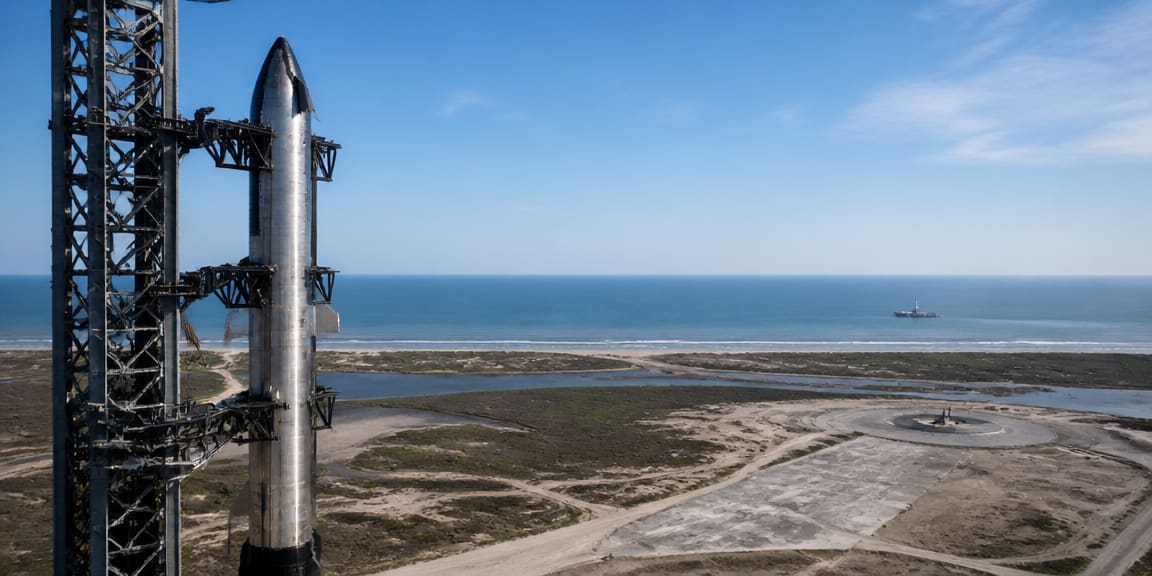
SpaceX executes first mid-air recovery of Starship upper stage; booster catch aborted
Narrative Snapshot
Across outlets, there is broad agreement that SpaceX achieved a first-of-its-kind capture of Starship’s upper stage using the launch tower’s mechanical arms in Texas after a roughly 22-hour, 14-orbit mission. Coverage consistently frames the maneuver as a milestone for reusability: from BBC’s emphasis on the “chopsticks” arms to the New York Times’ and South China Morning Post’s portrayal of a key step toward fully reusable rocketry. Italian and Japanese outlets similarly present the feat as historic precision recovery, with ANSA stressing the accuracy of the insertion between the arms and Japan Times placing it within the industry’s decadeslong push for reusability.
Where reports diverge, they do so chiefly on the fate of the Super Heavy booster and the pre- versus post-event timing of publication. The Guardian and France24 note the failed booster recovery, with the former saying it exploded, while RT’s coverage references both a fiery crash and a soft water landing. CBC and France24 framed the story in anticipatory terms before the catch, while most other outlets reported the successful upper-stage capture after the fact. Brazilian coverage from Folha de S.Paulo described the recovery as occurring on a platform, in contrast to multiple sources specifying the launch tower arms.
Strategic framing also varies. Le Monde and La Repubblica tie the achievement to ambitions for Moon/Mars missions and even space-based infrastructure like data centers. Al Jazeera English and Clarín emphasize cost and operational cadence gains from rapid reuse, and the Times of Israel adds institutional endorsement by citing NASA’s reaction as “almost magic.” The Hindu looks ahead operationally, noting SpaceX’s expectations to begin launching from Florida’s Kennedy Space Center within months, while SCMP situates the catch within a decade-long effort to close the loop on full-system reusability.
What Happened
SpaceX launched its two-stage Starship system from Starbase, Texas, and, after roughly 22 hours and 14 orbits, the upper stage returned to the launch site and was captured by the tower’s mechanical arms. Multiple outlets describe the maneuver as a first for recovering an orbital spacecraft via a launch tower, framing it as a pivotal step toward making Starship fully and rapidly reusable. The planned “double catch” did not occur: coverage from France24 and others notes that the booster’s recovery attempt was aborted, and outlets including the Guardian report the booster subsequently exploded. NASA publicly welcomed the result, with the Times of Israel reporting the agency called the achievement “almost magic.” Several outlets underscore the operational focus on reusability and precision landing as SpaceX advances its test campaign from Texas.
Why It Matters
The mid-air capture is being read as a structural marker in the longstanding pursuit of fully reusable launch systems, which Japan Times characterizes as a decadeslong industry objective. If repeated reliably, the technique points to lower costs and faster turnaround, priorities highlighted by Al Jazeera English and Clarín and central to how private launch capacity influences public and commercial space agendas. Le Monde and La Repubblica link the technology path to deep-space ambitions, including Moon and Mars missions and potential orbital infrastructure such as data centers, suggesting wider industrial and policy implications beyond launch economics. NASA’s welcoming tone, as reported by the Times of Israel, signals institutional receptivity to the capability, while The Hindu’s note on forthcoming operations at Kennedy Space Center indicates a potential broadening of the test and launch footprint that could shape scheduling, coordination, and risk management for U.S.-based space activities.
Diverging Narratives
The principal uncertainty concerns the booster’s end state and recovery profile. France24 and the Guardian foreground the failed attempt and booster explosion, while RT’s accounts reference both a fiery crash and a soft water landing, reflecting inconsistent descriptions of the same episode. There is also timing-induced divergence: CBC and France24 published as the catch was still pending, framing a planned recovery, whereas most later reports confirmed the successful capture. On the recovery mechanism itself, Folha de S.Paulo’s description of a platform contrasts with multiple outlets’ explicit references to the tower’s mechanical arms. Payload reporting is uneven: RT alone specifies that the upper stage deployed 26 Starlink satellites, a detail absent from other coverage. Finally, outlets situate the achievement within different strategic horizons—cost and cadence (Al Jazeera English, Clarín), deep-space and orbital infrastructure ambitions (Le Monde, La Repubblica), institutional validation (Times of Israel), and the programmatic arc of achieving full-system reusability (SCMP, New York Times).
What Happens Next
Two decision points emerge from the reporting. First is whether SpaceX can translate this one-off upper-stage catch into repeatable operations and advance toward the original “double catch” objective. Folha de S.Paulo previewed the plan to recover both stages in a single test, and France24 noted the booster catch was aborted this time; watch for test objectives explicitly restating a two-stage recovery and any adjustments to booster return profiles. Second is the shift to Florida operations: The Hindu reports SpaceX expects to begin launching from Kennedy Space Center within months, so scheduling disclosures, pad readiness, and the sequencing of Texas versus Florida flights will be key indicators of cadence. Additional signals to track include whether future flights carry operational payloads, as referenced by RT, and the tone of subsequent NASA statements, which the Times of Israel reported as strongly supportive after this flight.