
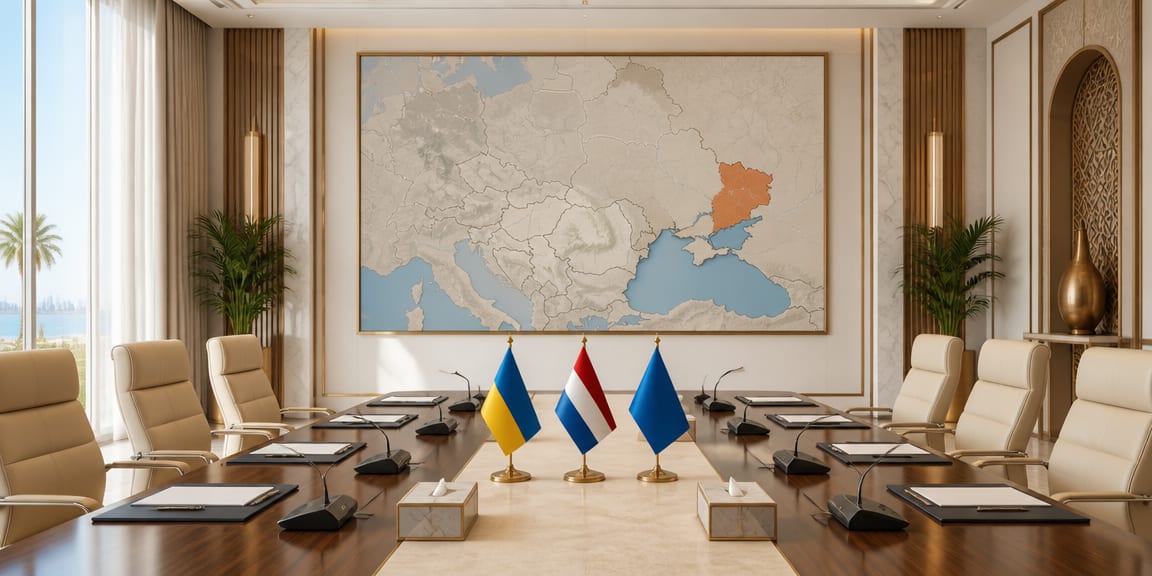
Zelensky says U.S. envoys floated Donbas withdrawal in exchange for NATO membership during Abu Dhabi talks
Narrative Snapshot
Across outlets, there is broad alignment that Volodymyr Zelensky reported a new line of inquiry from U.S. negotiators: whether Ukraine would withdraw from parts of Donbas if it could join NATO, something he said had not been raised before in the talks. European and Anglo-American coverage emphasizes the novelty and sensitivity of linking alliance membership to territorial concessions, with BBC, France24, and the Japan Times underscoring that it was the first time this question surfaced. Ukrainian and several European outlets pair that point with Kyiv’s refusal to concede territory; the Kyiv Independent quotes Zelensky’s formulation of the U.S. question, while Al Jazeera reiterates his rejection of both neutrality and ceding land.
Russian and Chinese state-backed outlets concentrate on process and architecture rather than the linkage. RT highlights “progress” in Abu Dhabi on a prisoner exchange and warns, via Russian officials and analysts, that bringing Europe into the format could derail momentum, while CGTN reports Europe is nonetheless seeking a role. That contrasts with Western reporting that puts the proposed trade-off at the center of coverage and frames the talks as shifting toward a “long-term security architecture,” as the Guardian and BBC put it.
Regional outlets surface distinct stakes. Bangkok Post adds that Russia rejected a ceasefire limited to energy targets. Italian and French papers situate the episode within harder end-state positions: ANSA cites Moscow’s demand for NATO’s return to 1997 borders, and Le Monde notes Ukraine is not taking the Donbas-for-NATO idea seriously while Putin “insists on his territorial demands.” Latin American coverage (Clarín) personalizes U.S. diplomacy through “Trump’s envoys,” reflecting the prominence of Jared Kushner and Steve Witkoff in the shuttle.
What Happened
U.S.-mediated trilateral talks among Russia, Ukraine, and the United States resumed in Abu Dhabi after a nine-month pause, focusing on European security arrangements and humanitarian issues. The Guardian and RT report agreement in principle on the largest prisoner exchange of the war, but no breakthrough on a wider settlement. Following the session, U.S. envoys Jared Kushner and Steve Witkoff met Vladimir Putin in Moscow and were due to meet Zelensky in Dublin, according to France24 and the Guardian. Multiple outlets report Zelensky’s account that U.S. negotiators asked, for the first time, whether Ukraine would withdraw from parts of Donbas if it could join NATO; he rejected ceding territory (BBC, Kyiv Independent, Al Jazeera). Deutsche Welle notes Zelensky said any security deal could go to a referendum. Putin reiterated opposition to any foreign troops in Ukraine (CGTN), and Bangkok Post reports Russia rejected an energy-target ceasefire proposal.
Why It Matters
Raising a Donbas-for-NATO linkage places core international norms and alliance practice in direct tension: the prohibition on acquiring territory by force versus the promise of collective defense. Embedding Ukraine’s security within NATO—or even via “Article Four and an Article Five-like” guarantees, as Fox News reported U.S. officials exploring—would reframe European security beyond ad hoc bilateral support. Moscow’s stated red lines, including opposition to foreign troops in Ukraine (CGTN) and a demand for NATO’s return to 1997 borders (ANSA), highlight how far apart the parties remain on the region’s security order. The process questions are also structural: RT warns that premature European participation could stall talks, while CGTN and Clarín indicate Europe seeks involvement, and France24 notes active U.S. shuttle diplomacy. For policymakers, the episode spotlights the feasibility and legitimacy tests of any settlement: acceptability to Russia, as even U.S. Senator Rubio flagged (Kyiv Independent), and domestic endorsement in Ukraine, potentially via referendum (DW).
Diverging Narratives
Outlets differ on characterization and salience of the U.S. idea. Several frame it as a question or “float” raised by negotiators (BBC, Sky News, RFE/RL, Japan Times), while Le Monde and France24 summarize it as a proposal conveyed by Trump’s envoys. Ukrainian and Arab coverage center Kyiv’s refusal to concede territory or accept neutrality (Kyiv Independent, Al Jazeera). European reporting layers in skepticism about Russian acceptance of any arrangement that admits Ukraine to NATO; La Repubblica cites analyst Volodymyr Fesenko arguing Putin would “never accept” Kyiv in NATO, while ANSA notes Moscow’s 1997-borders demand. Process narratives also diverge: Western outlets stress a shift toward designing a “long-term security architecture” and the scale of the prisoner exchange (Guardian, BBC), whereas Russian and Chinese coverage foreground “progress” on humanitarian issues and warn against expanding the negotiating table to include Europe (RT, CGTN). Additional frictions reported include Russia’s rejection of a ceasefire limited to energy infrastructure (Bangkok Post) and Putin’s reiteration that any foreign troops in Ukraine would be “legitimate targets” (CGTN), which sits uneasily alongside U.S. exploration of NATO-like guarantees (Fox News).
What Happens Next
Several decision points emerge from reported positions. First, whether the U.S. shuttle can broaden into a format that includes European actors: RT relays Russian warnings that European involvement could derail progress, while CGTN and Clarín report Europe is seeking a role. Signals to watch include joint readouts hinting at a follow-on multilateral round and any Russian conditionality tied to EU participation. Second, the content and form of security guarantees: Fox News reports U.S. exploration of NATO-like assurances, and CGTN quotes Putin rejecting foreign troops and threatening to target them; concrete indicators would be U.S. proposals that avoid troop deployments versus any move toward stationing forces. Third, the domestic legitimacy pathway in Ukraine: DW reports Zelensky said a security deal could go to a referendum; watch for Kyiv’s steps toward legal frameworks for such a vote. Finally, implementation of the prisoner exchange flagged by the Guardian and RT will test whether channels remain functional amid unresolved disputes over territory and ceasefire parameters (Bangkok Post).