
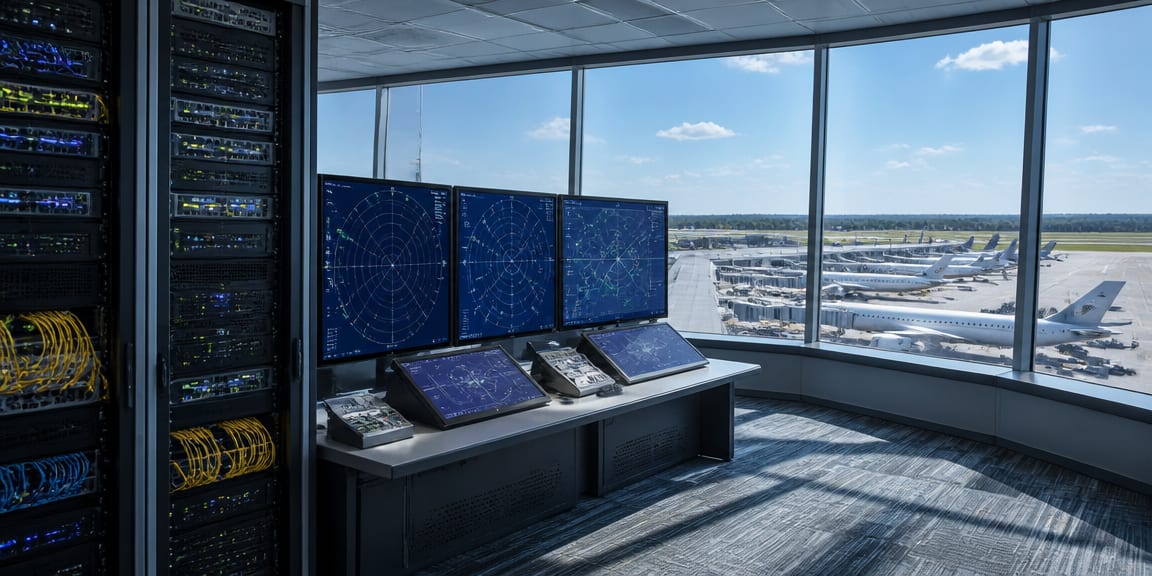
US grounds flights nationwide after air traffic control communications failure; officials reject cyberattack, cite aging systems and maintenance-linked router fault
Narrative Snapshot
Across outlets, the throughline is infrastructure fragility: reporting from Al Jazeera English, Deutsche Welle, and Le Monde centers on outdated technology as the proximate explanation, echoing the US transport secretary’s attribution to “old equipment.” Coverage then bifurcates between political framing and technical forensics. Le Monde emphasizes that the Trump administration used the disruption to argue for a $50 billion upgrade package, while The Times of Israel and Ukrinform focus on a specific fault: an L3 Harris-installed router undergoing maintenance during a copper-to-fiber transition that overloaded communications links.
Initial uncertainty over intent versus error is treated unevenly. TASS first notes that authorities were looking into a possible AI role and that equipment problems hit 22 air route control centers, but its subsequent piece cites President Trump ruling out both cyberattack and AI, aligning with Deutsche Welle and Telesur English, which say officials pointed to incompetence or faulty technology rather than malfeasance. France24 widens the aperture to public fear, situating the outage amid broader anxieties over cybersecurity and AI after unrelated technology disruptions.
Outlets also differ on scale and ripple effects. The Guardian, Deutsche Welle, and Telesur English cite large but varying cancellation and delay totals, while the Toronto Star documents cross-border knock-on impacts with Toronto Pearson halting US-bound flights. Clarin highlights operational causes and consequences—stressing newly implemented tech overloading legacy systems, five hours of disruption, mass diversions, and over a million travelers affected—while Bangkok Post and Clarin underscore the administration’s messaging challenge after its own press conference was marred by technical glitches.
What Happened
The Federal Aviation Administration ordered a nationwide ground stop on Friday after a communications failure at regional air traffic control centers, halting departures at all US airports and disrupting international connections, according to Telesur English and The Guardian. The transport secretary said the outage reflected “old equipment,” a point carried by Le Monde and Al Jazeera English. TASS reported equipment problems at 22 Air Route Traffic Control Centers, and the Toronto Star noted Toronto Pearson halted US flights in response. The FAA lifted the ground stop later the same day, with US airspace reopening at 8:15 pm ET, The Guardian reported, while authorities warned recovery would take time, as Bangkok Post and Telesur English also noted. Officials ruled out a cyberattack or AI involvement, per TASS and Telesur English. Subsequent reporting by The Times of Israel and Ukrinform attributed the collapse to a router malfunction during fiber-optic upgrade work that overloaded the communications network.
Why It Matters
The shutdown exposed structural risk in a critical node of US and North American aviation, where legacy communications hardware—routers that The Times of Israel said should have been replaced in 2006—interacts with ongoing modernization. Le Monde reports the administration used the episode to press for $50 billion in upgrades, signaling an imminent funding and procurement debate that will set timelines and risk tolerance for future transitions. Deutsche Welle and The Guardian framed the scale as the largest grounding since 9/11, underscoring the systemic nature of the vulnerability rather than a single-airline failure.
For decision-makers, two domains converge: safeguarding continuous operations during infrastructure changeovers, as highlighted by Ukrinform’s account of a copper-to-fiber upgrade precipitating overload, and managing public confidence in an environment of cybersecurity and AI anxiety flagged by France24. Cross-border responses like Toronto Pearson’s halt show the externalities for allies and partners tied into US-controlled airspace flows and contingency protocols.
Diverging Narratives
Outlets align that malice was not the driver, but they differ on emphasis and sequencing. TASS first referenced an inquiry into possible AI involvement, later carrying the president’s statement ruling out both cyberattack and AI. Deutsche Welle similarly reported officials hinting at incompetence or faulty equipment rather than malfeasance, while France24 emphasized how concurrent tech disruptions fed broader cyber- and AI-related fears among the public, regardless of attribution.
On causality detail, Le Monde and Al Jazeera English stay at the infrastructure level—“old equipment”—while The Times of Israel and Ukrinform provide vendor- and process-specific accounts, citing an L3 Harris router failure during routine maintenance tied to a fiber upgrade that overloaded communications channels. Impact metrics also diverge: The Guardian reported 6,600 cancellations and 8,600 delays, Deutsche Welle cited some 16,000 cancellations over 24 hours, and Telesur English noted over 10,000 delays and at least 4,700 cancellations. Clarin underscores operational overload from integrating new technology with legacy systems and estimates over a million affected travelers. Meanwhile, Le Monde frames the administration’s response as politicizing the outage to support a $50 billion funding push, a lens not present in the technical-focused accounts.
What Happens Next
Several decision points emerge from the reporting. First is funding: Le Monde’s reference to a $50 billion request suggests an impending contest over scope, pace, and oversight of modernization. Signals to watch include formal budget proposals, legislative hearings, and timelines for replacing hardware that The Times of Israel said was overdue since 2006. Second is remediation and sequencing: Ukrinform’s description of a router failure during a fiber upgrade points to the need for maintenance-window safeguards and redundancy. Indicators would be FAA guidance on upgrade protocols, outage containment measures, and vendor requirements.
Third is attribution finalization and accountability. Although officials ruled out cyberattack and AI per TASS and Telesur English, a definitive technical report could shape contractor performance assessments and procurement choices, particularly if L3 Harris equipment and maintenance processes are confirmed as central, as reported by The Times of Israel. Finally, cross-border coordination bears watching: the Toronto Star’s account of Pearson’s response implies renewed emphasis on binational contingency planning and notification standards during US airspace disruptions.