
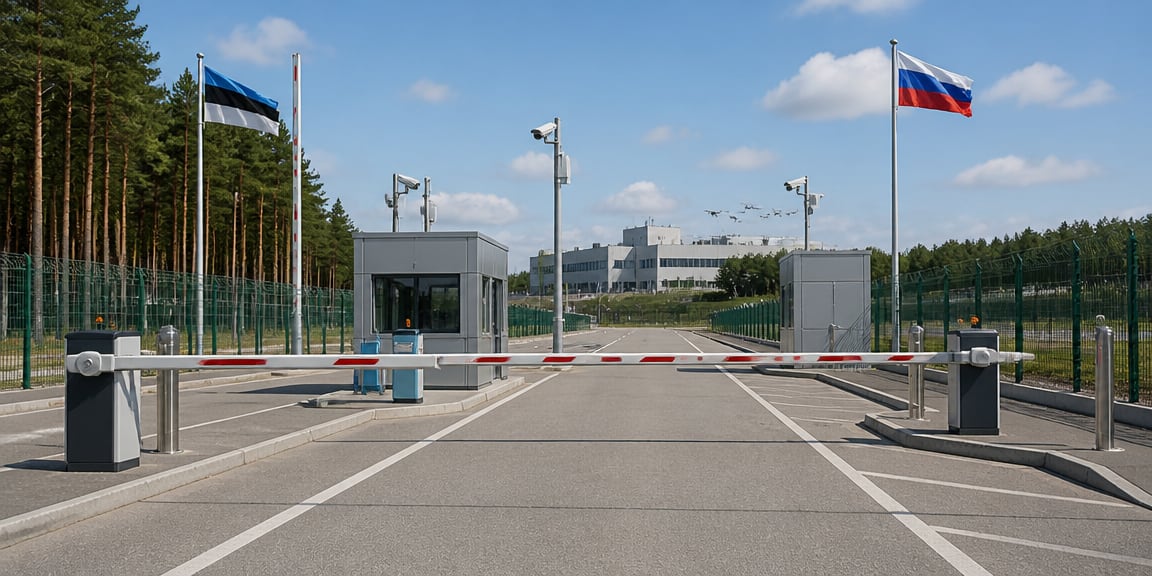
Estonia to close all Russia border crossings from December 1 after alleged GRU‑ordered sabotage attempt
Narrative Snapshot
Across European and international outlets, there is broad alignment that Tallinn’s decision follows an alleged sabotage attempt targeting Threod Systems, a defense firm near Tallinn, and that Estonian officials attribute the operation to Russia’s GRU military intelligence. Multiple reports converge on the same operational details: the closure date of December 1 and the detention of eight suspects linked to an attempted arson (France24; South China Morning Post; The Guardian; Al Jazeera English; Deutsche Welle; The Hindu; Ukrinform; Kyiv Independent; Japan Times; Le Monde).
Outlets differ in emphasis and incident characterization. The Guardian underscores operational restraint, noting that company security intervened and that authorities reported no injuries or damage, while Deutsche Welle states the factory was “set alight,” presenting a starker depiction of the incident. South China Morning Post and Le Monde highlight the Estonian foreign minister’s assertion of “clear evidence” pointing to GRU involvement. Clarin extends Tallinn’s rationale, reporting that the closure aims to reduce hostile activities and curb sanctions evasion.
Russian state media adopt a distinct frame. One TASS dispatch relays Estonia’s closure announcement, while another cites Foreign Ministry spokesperson Maria Zakharova saying Moscow will verify the information and, if confirmed, will view it as “another bout of aggressive and unbridled Russophobia,” signaling an immediate contest over attribution and proportionality.
What Happened
Estonia announced it will close all border crossing points with Russia from December 1, as stated by Foreign Minister Margus Tsahkna and reported internationally (France24; TASS; South China Morning Post; Le Monde). The move followed an incident at Threod Systems in Viimsi in the early hours of November 14, described by Estonian authorities as an attempted arson and suspected sabotage ordered by Russia’s GRU; eight people were detained (The Guardian; Al Jazeera English; The Hindu; Ukrinform, Nov. 16; Kyiv Independent). Tsahkna said Tallinn has “clear evidence” of GRU involvement, and Prime Minister Kristen Michal publicly referred to a GRU‑ordered “sabotage attempt” (South China Morning Post; Le Monde). The Guardian reported no injuries or damage after the firm’s security responded. Russia’s Foreign Ministry said it would check information about the closure and, if confirmed, would deem it Russophobia (TASS). Clarin reported Tallinn’s stated aims include reducing hostile activities and preventing sanctions evasion.
Why It Matters
Estonia’s border closure is presented as a security countermeasure against alleged Russian hybrid operations, a pattern explicitly named by Deutsche Welle and situated by Japan Times within the broader hostilities tied to Russia’s war against Ukraine. If sustained, the move elevates border management to a frontline instrument of national resilience, signaling that suspected cross‑border covert action can draw immediate, system‑level responses. It also sharpens the diplomatic confrontation: Moscow’s stated intent to verify and potentially denounce the step as “Russophobia” illustrates the narrowing space for de‑escalatory dialogue (TASS).
The rationale reported by Clarin—disrupting hostile activity and sanction‑evasion channels—connects the closure to enforcement dynamics that extend beyond a single incident. For policymakers, the episode illustrates how industrial security, law enforcement, and border policy converge under hybrid‑threat conditions, and how attribution claims—here framed as “clear evidence” against the GRU—can drive rapid policy shifts with regional spillovers.
Diverging Narratives
Attribution is the core split. Estonian leaders publicly assert they possess “clear evidence” that the GRU ordered the operation against Threod Systems, a drone manufacturer (South China Morning Post; Le Monde; The Guardian). Russian officials have not engaged substantively with those claims; instead, the Foreign Ministry says it will check reports of the border closure and may classify the move as “unbridled Russophobia” if confirmed (TASS). The asymmetry lies between Tallinn’s specific allegation and Moscow’s framing of the policy response as hostility without addressing the sabotage details.
Accounts of the incident’s impact vary. Several outlets call it an “attempted arson” and note eight detentions (Al Jazeera English; The Hindu; Ukrinform; Kyiv Independent), while The Guardian reports no injuries or damage after security intervened. In contrast, Deutsche Welle writes that the factory “was set alight,” implying a fire occurred. The extent of material damage remains unclear in the aggregated record provided. Motive framing also diverges in emphasis: The Guardian connects the episode to Estonia’s support for Ukraine, Japan Times situates it in the war’s broader hostilities, and Clarin stresses Tallinn’s intent to curtail hostile activity and sanctions evasion.
What Happens Next
Three decision points emerge from reported positions. First, implementation: Estonia has set December 1 for closing all border crossings; analysts should watch for operational directives confirming execution and any official statements adjusting scope or timing (France24; TASS; Le Monde). Second, evidentiary disclosure and prosecutions: authorities detained eight individuals and officials claim “clear evidence” of GRU direction; further legal filings or public briefings could clarify the factual record and reconcile differing accounts of damage (The Guardian; Al Jazeera English; The Hindu; Ukrinform; South China Morning Post; Le Monde). Third, Russian diplomatic positioning: the Foreign Ministry signaled it is verifying reports and may publicly frame the closure as Russophobia; subsequent statements will indicate whether Moscow limits its response to rhetoric or escalates diplomatically (TASS). Monitoring these signals will show whether the episode remains a contained security and judicial matter or hardens into a broader bilateral standoff.