
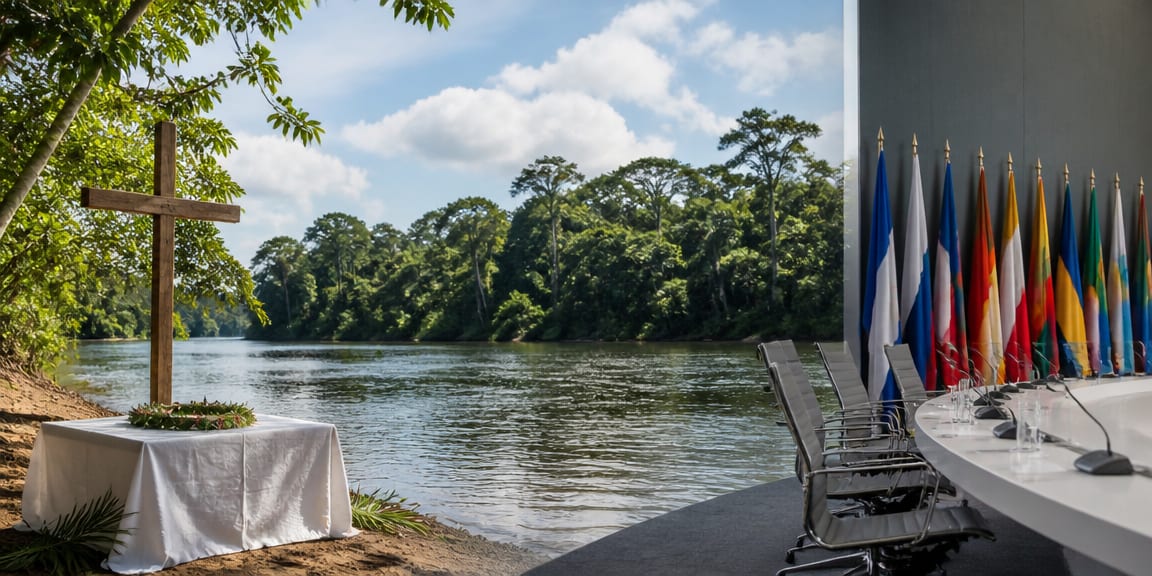
In Peru’s Amazon, Pope Leo XIV demands justice for slain Indigenous defenders as global calls for climate justice escalate at COP31
Narrative Snapshot
Latin American outlets concentrated on the on-the-ground realities Pope Leo XIV named in Pucallpa: Clarín highlighted murders of Indigenous leaders and concrete environmental harms such as indiscriminate deforestation, oil spills, and pollution from irregular mining, and added drug trafficking’s pull on vulnerable youth while urging an end to treating the Amazon as a mere resource reservoir. Folha de S.Paulo framed the speech as a critique of “market logic” that sacrifices nature for the immediate gain of a few. Telesur English emphasized the first-ever papal Mass in the Peruvian Amazon and the homily’s social message that labor exploitation is itself a form of environmental depredation.
UK, French, and Qatari coverage converged on the justice frame. The Guardian, Al Jazeera English, and Le Monde all foregrounded the demand for accountability for murdered environmental defenders and support for Indigenous efforts to halt illegal logging and mining; Le Monde echoed the theological pairing that “the cry of the earth and the cry of the poor rise together.” Parallel reporting from Africa, China, and Latin America on COP31 cast this message within a policy agenda: Mail & Guardian and AllAfrica centered António Guterres’s call for a Climate Justice Pact and taxation of fossil fuel profits, while CGTN underscored the finance gap and the need to move from goals to implementation for developing nations.
What Happened
On Sunday, November 15, Pope Leo XIV traveled into Peru’s Amazon and presided over the first papal Mass ever celebrated in the region, in Pucallpa, denouncing environmental destruction and the killing of Indigenous leaders who defend their lands. He backed Indigenous efforts to stop illegal logging and mining and warned against treating the Amazon as a resource storehouse, critiquing “market logic” that prioritizes short-term profit (Folha de S.Paulo; The Guardian; Clarín; Le Monde; Al Jazeera English; Telesur English). Clarín detailed harms from deforestation, oil spills, and pollution linked to irregular mining, and noted concerns about drug trafficking. The visit occurred as COP31 convened in Türkiye, where UN Secretary-General António Guterres pressed for a Climate Justice Pact, including taxing fossil fuel windfall profits, tripling renewables by 2035, accelerating the fossil fuel phase-out, and closing finance gaps for developing countries (Mail & Guardian; Telesur English; CGTN; AllAfrica).
Why It Matters
The papal intervention aligns moral authority with a widening international push to translate climate justice rhetoric into concrete redistribution and protection measures. By calling for justice for murdered environmental defenders and endorsing Indigenous land protection, the Pope’s message intersects with COP31 demands that rich nations and oil companies finance transition and resilience in countries that contributed least to emissions (Mail & Guardian; AllAfrica). CGTN’s focus on shrinking climate finance and weak implementation, alongside AllAfrica’s coverage of labor demands for green jobs and affordable energy, underscores institutional capacity gaps that complicate delivery. Le Monde’s coupling of ecological and social “cries” mirrors policy framings that integrate rights, livelihoods, and biodiversity. For decision-makers, the convergence of religious, labor, and multilateral voices raises pressure on negotiations about fossil fuel phase-out language, windfall taxation, and measurable finance flows, while spotlighting security risks for frontline defenders and the legitimacy costs of impunity.
Diverging Narratives
Coverage differs on emphasis and remedy. Latin American outlets catalogued specific drivers—irregular mining, oil spills, and narcotrafficking—alongside the Pope’s denunciations, with Clarín urging a shift away from extractive views of territory. Folha distilled the critique to systemic “market logic,” while Telesur broadened it to class and work, calling labor exploitation itself an environmental harm and detailing cultural elements of the Mass that signaled alignment with Amazonian Indigenous communities. Anglo-French reporting concentrated on accountability for killings and institutional support for Indigenous self-defense of territory (The Guardian; Le Monde; Al Jazeera English). On the policy plane, Mail & Guardian and AllAfrica stressed Guterres’s proposed Climate Justice Pact and taxation of fossil fuel profits, whereas CGTN focused on implementation deficits, the Global South’s limited emissions, and a shrinking finance pipeline. AllAfrica noted unresolved questions at COP31 over finance and the future of fossil fuels, framing the gap between expansive justice claims and negotiable, enforceable instruments. Separately, Al Jazeera reported the Pope met six clergy abuse survivors in Peru while hundreds more said they remain excluded, introducing a parallel justice demand within church governance.
What Happens Next
The immediate decision points cluster at COP31. If governments advance Guterres’s Climate Justice Pact, watch for negotiating text that includes taxing fossil fuel windfall profits, tripling renewable capacity by 2035, and explicit fossil fuel phase-out language (Mail & Guardian; Telesur English; AllAfrica). Absent movement, CGTN’s reported implementation gap and finance shortfalls for developing nations will likely persist as key indicators. Track whether delegations reconcile AllAfrica’s labor demands for green jobs, affordable energy, and sizable funding with commitments that can be independently verified. In Peru, the Pope’s backing of Indigenous efforts and call for justice set expectations; analysts should monitor signals of concrete protection and accountability measures for environmental defenders as a test of whether moral appeals translate into policy. Separately, Al Jazeera’s report on survivor exclusion creates a decision point for church authorities on broadening engagement; future steps will be evident in the scope and transparency of subsequent meetings.