
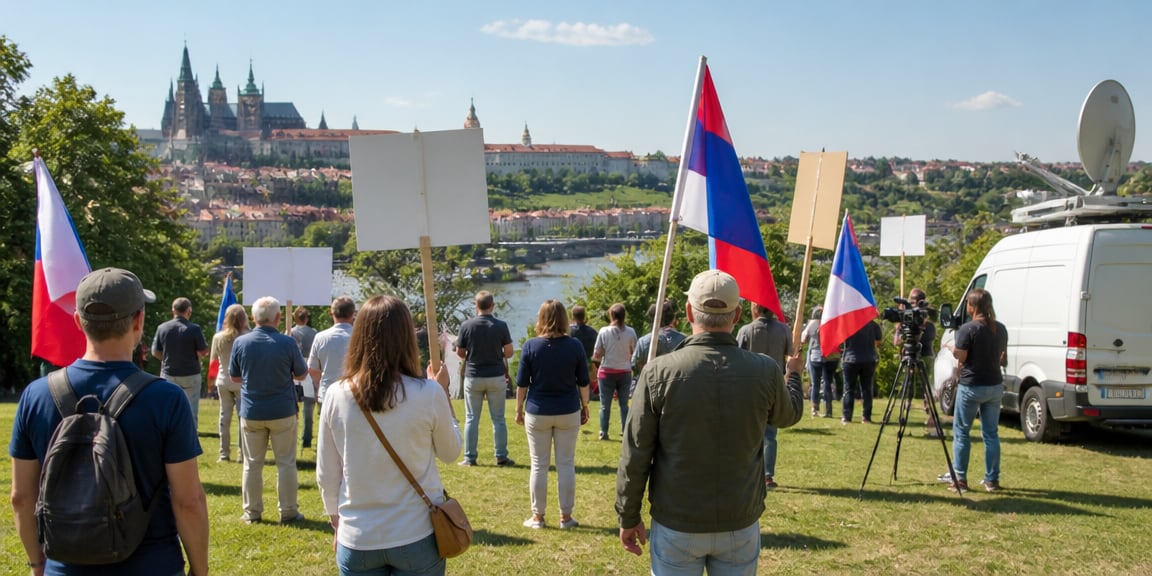
Czechs mount mass protest in Prague against plan to replace public media fees with state funding
Narrative Snapshot
Across outlets, there is broad convergence on scale, symbolism, and stakes. Reporting from France-based and German outlets highlights turnout in the “hundreds of thousands,” with France24 relaying organisers’ claims that the crowd surpassed a 200,000-strong March rally and could be the largest since the 1989 Velvet Revolution. Le Monde specifies 400,000 and anchors the event in that historical benchmark. The Hindu adds geographic resonance: the demonstration filled Prague’s Letná Park, a venue indelibly associated with 1989.
Descriptions of the government’s intent and character vary. The South China Morning Post and Bangkok Post describe a “nationalist government” led by Prime Minister Andrej Babis and foreground opponents’ warnings that direct state funding would threaten media independence. BBC and the Times of Israel add the government’s position: broadcasters must cut costs, and public and private outlets show bias. France24’s interview with presenter Daniel Stach personalizes the stakes for Czech journalism, while Deutsche Welle’s advance reporting on a fast-tracked bill and strike actions underscores that the mobilization extends beyond a single rally.
Notably, turnout estimates diverge. While most reports cite “hundreds of thousands,” the Times of Israel refers to “tens of thousands,” reflecting the absence of an authoritative, shared count even as outlets agree this was an exceptionally large protest.
What Happened
After days of strike threats and mobilization flagged by Deutsche Welle, a mass demonstration filled Prague on Sunday against a government plan to abolish licence fees for Czech Television and Czech Radio and replace them with direct state budget funding. Coverage consistently puts turnout in the hundreds of thousands, with France24 citing organisers who said the rally exceeded a March protest of more than 200,000 and could be the largest since 1989; Le Monde reports 400,000. The Hindu locates the protest at Letná Park, echoing the Velvet Revolution’s symbolism. Critics across outlets argue the reform would heighten dependence on the state and stifle media freedom. The coalition government counters that public broadcasters must cut costs, and, per the Times of Israel, accuses public and private media of bias. France24 features star presenter Daniel Stach, who says he would leave rather than work under the changes.
Why It Matters
The confrontation centers on how funding structures shape editorial autonomy in public-service media. Multiple outlets report critics’ fear that shifting from licence fees to direct state appropriations would increase political leverage over Czech Television and Czech Radio, eroding safeguards that have underpinned post-1989 democratic norms. BBC and Al Jazeera highlight concerns about government influence, while the Times of Israel notes the specific argument that removing a payer–audience link weakens public accountability and increases vulnerability to pressure. Conversely, the government’s emphasis on cutting costs, reported by the BBC, frames reform as fiscal stewardship and a response to perceived bias. The protest’s reported size and symbolism—Letná Park and references to the Velvet Revolution—signal that changes to public media are seen domestically as system-level questions about institutional independence, not a technical budget shift, and therefore carry implications for governance credibility and social trust.
Diverging Narratives
The core split lies in interpretations of consequence and intent. Critics, cited across Deutsche Welle, France24, Al Jazeera, and the South China Morning Post, argue that replacing licence fees with state budget transfers would make broadcasters more dependent on government, chilling editorial independence and press freedom. The government, per the BBC, frames the change as necessary cost-cutting, and, as reported by the Times of Israel, also alleges bias at both public and private outlets—suggesting reform as corrective rather than coercive.
There is no single authoritative turnout figure. While France24 and Le Monde describe the protest as potentially the largest since 1989, with Le Monde stating 400,000, the Times of Israel cites “tens of thousands,” and several outlets settle on “hundreds of thousands.” This variation reflects differences in sourcing and methodology rather than disagreement over the event’s significance. Another unresolved element is the legislative trajectory: Deutsche Welle notes a fast-tracked bill and strike actions, but outlets do not report a definitive parliamentary outcome or concrete editorial safeguards that might accompany any funding change.
What Happens Next
Two near-term decision points emerge. First, the legislative path: Deutsche Welle reports a fast-tracked bill to alter funding. If the government advances the plan unchanged, analysts should watch for swift parliamentary movement and whether appropriations mechanisms concentrate discretion in the executive. Alternatively, visible recalibration—slowing the timetable or amending the proposal—would suggest the protest’s leverage and could preserve licence fees or introduce guardrails around state transfers.
Second, institutional response within public media: France24’s interview with Daniel Stach signals potential high-profile departures, while Deutsche Welle references strike actions around the proposal. Sustained or escalating labor action and resignations would indicate deepening internal resistance; a pause or engagement on safeguards would suggest a negotiated path. Across scenarios, indicators include official turnout tallies, government messaging on cost-cutting versus bias, and any commitments to independence protections parallel to funding changes.