
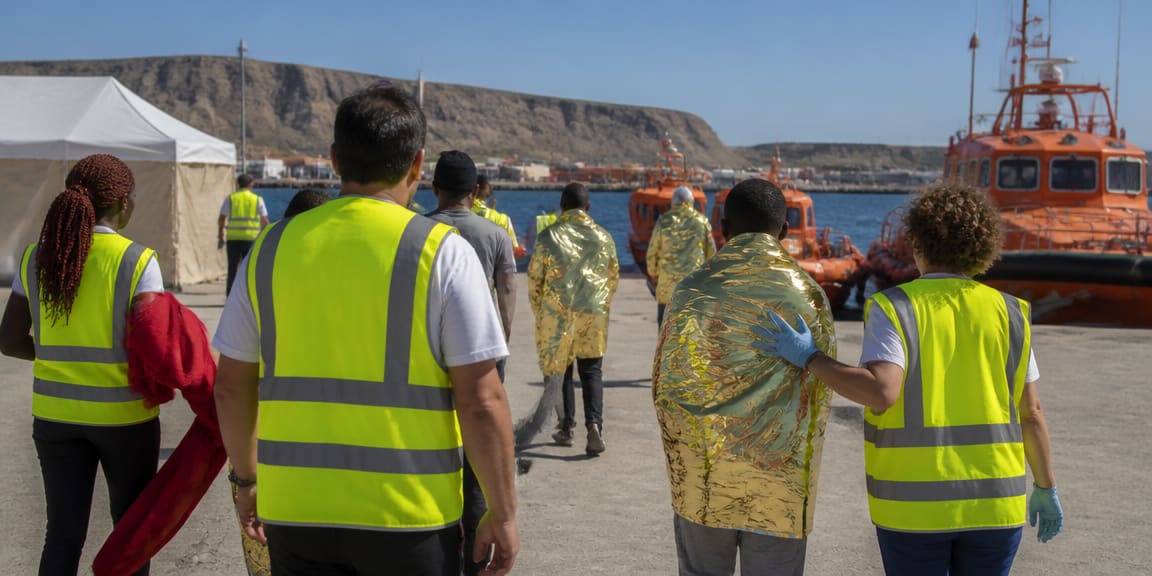
Nearly 2,200 migrants reach Spain’s Canary Islands in 48 hours
Narrative Snapshot
Across outlets, the core picture is consistent: Spain’s maritime rescue service reported nearly 2,200 arrivals to the Canary Islands over a two‑day span, with several reports noting this continues a recent surge linked to departures from West African countries. France 24 adds that island authorities declared a migration emergency earlier in the week and underscores the Canaries’ role as a principal entry point to Europe, citing more than 13,000 arrivals between January and the end of last month according to Spain’s Interior Ministry.
Coverage diverges on emphasis and scope. Deutsche Welle isolates the single‑day spike—nearly 1,600 arrivals on Saturday—while identifying predominant nationalities as Senegalese, Gambian, and Guinean, and situates the surge alongside a recent migration crisis in Spain’s North African enclave of Ceuta. France 24’s reporting from Madrid concentrates on the lethality of the Atlantic route and the use of ill‑equipped, overcrowded boats, elevating the humanitarian risk profile as a central lens.
Al Jazeera characterizes the weekend as a record inflow and links continuing arrivals to the limits of the European Union’s new migration and asylum laws, which it says have largely failed to curb movement to Spanish territories. Clarin widens the frame further, placing the spike within an election campaign defined by debate over migration controls, asserting more than 3,500 arrivals over three days, describing Saturday as the busiest rescue day in more than three decades, and highlighting Vox’s pledge to harden policy and “accelerating climatic conditions” as drivers.
What Happened
Spain’s maritime rescue service said nearly 2,200 migrants reached the Canary Islands by boat over a two‑day period, with the Spanish coastguard confirming the figure on Sunday. Deutsche Welle reported that nearly 1,600 arrived on Saturday alone, and that most were from Senegal, Gambia, and Guinea. France 24 noted the arrivals continue a recent surge from West African countries and that island authorities declared a migration emergency earlier in the week. It also cited the Interior Ministry in reporting more than 13,000 arrivals to the Canaries from January through the end of October, underlining the archipelago’s status as a main European entry point for African migrants. France 24’s Madrid correspondent described the Atlantic crossing from West Africa to the Canaries as one of the world’s deadliest routes, typically undertaken in overcrowded, poorly equipped boats.
Why It Matters
The declared migration emergency in the Canaries and the islands’ appeal for central government action (as reported by France 24) foreground institutional capacity at a key EU external border. Al Jazeera’s assessment that new EU migration and asylum laws have not stemmed flows situates the episode within a broader policy stress test for Europe’s emerging framework, raising questions about the efficacy of deterrence and legal pathways in the Atlantic corridor. Deutsche Welle’s linkage to a recent crisis in Ceuta indicates that pressure points are distributed across Spain’s border periphery, with potential implications for intra‑state resource allocation and crisis management. Clarin’s focus on an election campaign shaped by migration controls—and Vox’s pledge to toughen policies—suggests domestic political incentives will condition Spain’s response, with humanitarian risks on a deadly sea route, highlighted by France 24, keeping operational rescue capacity at the center of immediate decisions.
Diverging Narratives
Outlets differ on scale and characterization. The Associated Press report carried by the Toronto Star and multiple France 24 updates align around nearly 2,200 arrivals in 48 hours, whereas Deutsche Welle isolates nearly 1,600 on Saturday, and Clarin cites more than 3,500 over three days and calls Saturday the highest rescue day in over three decades. Al Jazeera labels the influx a record, a framing that Clarin’s “highest in decades” context supports, but other outlets mostly present it as part of a surge without invoking superlatives.
They also diverge on causation and policy framing. Al Jazeera links continued arrivals to the limited impact of the EU’s new migration and asylum laws. Clarin emphasizes domestic political dynamics—an election campaign and Vox’s promises to harden migration policy—while additionally citing “accelerating climatic conditions” as a driver; other outlets do not take up that causal claim. France 24 centers local governance, reporting a declared emergency and calls for action from the Canary authorities, and pairs that with on‑the‑ground accounts of the route’s lethality. Deutsche Welle adds origin-country detail and juxtaposes the Canaries surge with Ceuta’s recent crisis, stressing the breadth of Spain’s border management challenge.
What Happens Next
Key decisions cluster at two levels. First, Spain’s domestic response: France 24 reports the Canaries have urged government action amid a declared emergency. Analysts should watch for concrete measures from Madrid—such as formally announced support packages or operational commitments—to assess whether island authorities gain capacity relief, or whether the emergency posture persists with limited central intervention. Second, the EU policy arena: Al Jazeera’s contention that new migration and asylum laws have not curbed flows puts implementation under scrutiny; signals would include official statements defending performance or indicating adjustments in how the framework is applied to Atlantic routes.
Operationally, the immediate barometers are arrival volumes and rescue activity on the West Africa–Canaries corridor, which France 24 describes as exceptionally dangerous and Deutsche Welle links to specific origin countries. Any shift in these indicators will shape the balance between humanitarian imperatives at sea and policy debates ashore.