
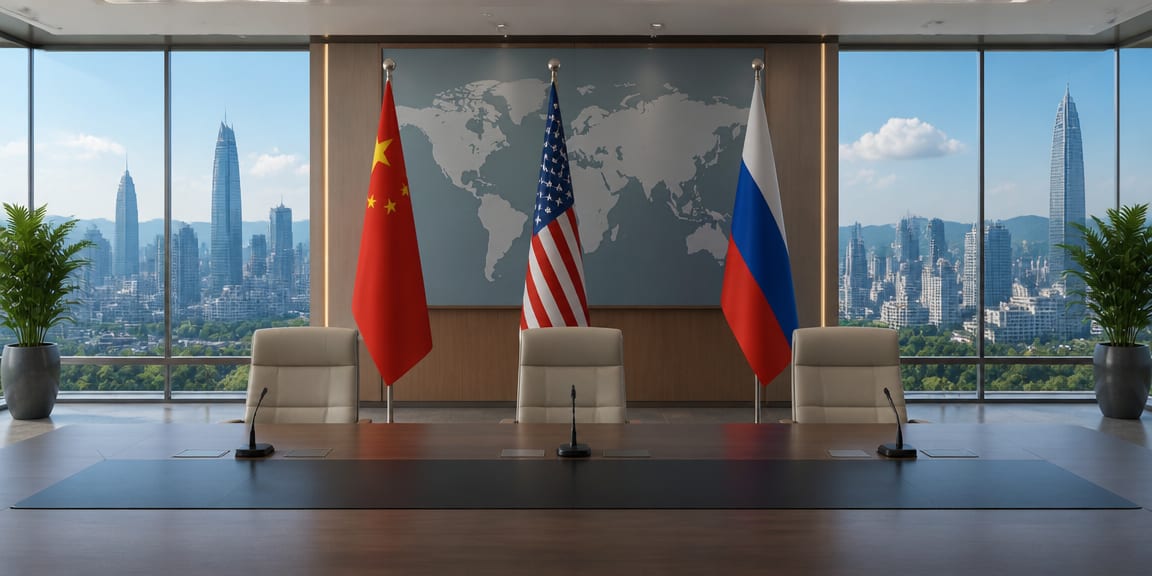
China confirms first Trump–Xi–Putin trilateral in Shenzhen with nuclear arms and Iran on the docket
Narrative Snapshot
Across outlets there is broad alignment that the meeting is unprecedented and centered on nuclear risk and strategic stability. U.S. and European reporting emphasizes President Trump’s intent to raise nuclear disarmament, echoed by the White House and repeated across the BBC, NBC, France 24, Le Monde and Deutsche Welle, while several outlets add that Iran will be discussed.
Coverage diverges most clearly on Ukraine. Multiple U.S. and European sources say it is not expected to be on the agenda, with some adding Washington has a separate negotiation channel with Kyiv and Moscow. Russian state media flags Ukraine as a likely topic. Ukrainian and several European voices register concern that Kyiv could be sidelined, even as others stress parallel talks continue.
Regional lenses color the framing. Japanese and Italian outlets highlight allied and European anxieties about precedent and absence, whereas Australia welcomes dialogue. Chinese and Russian outlets present the session as pragmatic risk management and a channel-opening exercise for crisis communication.
What Happened
Beijing confirmed that Xi Jinping will host Donald Trump and Vladimir Putin for a first-ever trilateral meeting in Shenzhen on November 19 on the sidelines of APEC, after prior confirmations from Washington and Moscow. The White House has said Trump will press for discussions on reducing nuclear arsenals, with a senior U.S. official adding that Iran will be on the agenda. Several outlets report that Ukraine is not expected to be discussed, with Washington pursuing a separate diplomatic track with Kyiv and Moscow. Russian state media, by contrast, has included Ukraine among anticipated topics. Deutsche Welle reported a senior U.S. official does not expect an agreement to emerge, and Japan Times framed the gathering as symbolically significant but likely light on substance. TASS detailed the venue and timing at Shenzhen’s Kylin Villa, while the Guardian noted Australia’s public support and European reservations alongside warnings from Ukraine’s president.
Why It Matters
A trilateral nuclear dialogue among the United States, China and Russia would mark a departure from the historically bilateral U.S.–Russia arms control architecture and acknowledge China’s role in strategic stability, a shift noted by regional analysis in Hong Kong press and by the White House’s stated goals. Even without agreements, officials and experts quoted by Deutsche Welle and TASS frame the session as a potential crisis-communication channel that could slow fragmentation in global governance. Allied concerns reported by Japan Times, Corriere della Sera and the Guardian underscore risks that ad hoc great‑power formats may sideline partners on issues like Ukraine and Taiwan, complicating alliance management. Hosting the meeting allows Beijing to project convening power, though Deutsche Welle cautions the optics could favor Moscow and carry reputational risks. For multilateral forums, an APEC‑side trilateral on hard security highlights how economic venues are being leveraged to address strategic issues.
Diverging Narratives
Whether Ukraine features at all is contested in the coverage. Le Monde, the New York Times and Middle East Eye cite U.S. officials saying it is not on the agenda, with MEE adding that Washington has “a whole other track” of talks with Kyiv and Moscow. South China Morning Post notes Trump’s public emphasis on nuclear issues “less on Ukraine.” By contrast, RT, citing AP, includes Ukraine among expected topics, while France 24’s phrasing leaves room for ambiguity. The Times of Israel and the Guardian highlight President Zelenskyy’s warning about a “Yalta‑like” carve‑up, reflecting European unease even amid assurances of separate Ukraine diplomacy.
Expectations management also splits. The White House aims to push a nuclear disarmament initiative, echoed in multiple outlets, whereas Deutsche Welle relays a U.S. assessment that no agreement is expected. TASS amplifies expert views that the value lies in opening a crisis channel. Regional perspectives vary: Japan Times cautions about precedent for allies; Corriere della Sera stresses European absence and multiple flashpoints; the Guardian records Australia’s welcome for dialogue.
What Happens Next
Several decision points emerge from the reporting. First, whether the three leaders commit to a follow‑on process on nuclear risk—such as a working group or roadmap—will indicate if this moves beyond symbolism, given U.S. aims and parallel expert calls for crisis communication. If they announce only general principles, Deutsche Welle’s “no agreement expected” signal holds; a concrete mechanism would align with TASS’s channel‑opening narrative.
Second, watch whether Ukraine remains on a separate “track.” Confirmation of continued or intensified U.S. envoy engagements with Kyiv and Moscow, as referenced by Middle East Eye, would address concerns raised in European coverage and by Zelenskyy.
Third, allied consultation signals matter. German urging for U.S.–Europe coordination reported by the Guardian, versus Australia’s endorsement of dialogue, frames how partners judge the process. Finally, Beijing’s management of optics—flagged by Deutsche Welle—will be evident in Chinese readouts that balance neutrality with ties to Moscow.