
Rubio says no evidence links US tech outages or points to cyberattack
Narrative Snapshot
Across outlets, coverage converges on the administration’s core message: officials see no evidence that the recent, high‑profile service disruptions share a common cause or stem from a hostile actor. Several international desks center this reassurance without elaboration, reflecting a stabilizing, risk‑communication frame. Corriere della Sera and Al Jazeera English present the denial succinctly, while the BBC and Argentina’s Clarín emphasize the phrase “not under systemic attack,” underscoring efforts to dampen speculation.
Two Anglophone outlets broaden the aperture beyond the denial. The Guardian foregrounds the scope of disruption—naming Microsoft, major banks, American air traffic control, and the National Security Agency—and links the event to mounting political pressure on the White House. The New York Times adds a technical policy dimension, citing Rubio’s suggestion that a rush to patch systems, as artificial intelligence exposes vulnerabilities, may explain the failures. By contrast, The Hindu and The Guardian anchor the political accountability angle, noting criticism of President Donald Trump and demands for answers.
What Happened
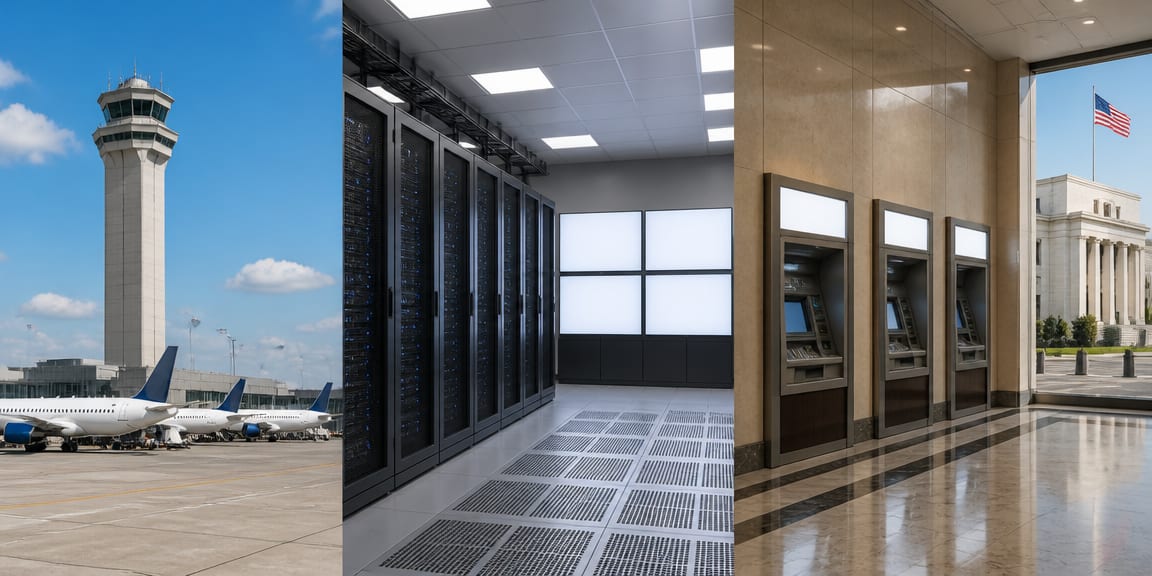
In recent days, multiple US digital and operational systems experienced outages, affecting Microsoft services, major banks, American air traffic control, and the National Security Agency. The disruptions grounded flights, limited bank access, cut off workplace access, and, in some cases, disrupted classified communications, according to The Guardian. On 18 November, Secretary of State Marco Rubio said there was “zero” evidence that the failures were linked to each other or to a cyberattack or malign actor, a message echoed by the BBC, Al Jazeera English, Corriere della Sera, and Clarín. The New York Times reported that Rubio suggested rapid patching—amid vulnerabilities exposed by artificial intelligence—may help explain the failures across sectors. The Hindu and The Guardian reported a groundswell of criticism toward the White House, with allies and opponents pressing for an explanation.
Why It Matters
The outages touched aviation, banking, enterprise IT, and national security systems, highlighting interdependencies between public infrastructure and private digital platforms. Rubio’s assertion that the US is not under a “systemic attack,” reported by the BBC and Clarín, is intended to stabilize markets, reassure travelers, and deter escalatory responses. Yet the New York Times’ account of AI‑exposed vulnerabilities and rushed patching points to a structural challenge: maintaining resilience as complex, widely used systems face faster vulnerability discovery cycles. This places a premium on coordinated incident response and risk communication between government and critical providers such as Microsoft and financial institutions. Politically, as noted by The Hindu and The Guardian, demands for accountability elevate expectations for transparent diagnostics from the administration. For policy planners, the episode foregrounds patch management, cross‑sector contingency planning, and public guidance to counter online theories that can complicate crisis management, as the BBC observed.
Diverging Narratives
Outlets agree on the administration’s headline claim—no evidence of linkage or hostile action—but vary in what they treat as the salient risk. The BBC and Clarín highlight the absence of a “systemic attack,” framing the story as a reassurance against panic. Corriere della Sera and Al Jazeera English convey the same bottom line with minimal context. The Guardian, by detailing the breadth of affected entities—including the NSA—emphasizes the sensitivity of the disruptions and pairs it with reporting on political pressure facing the White House. The Hindu similarly focuses on the criticism directed at President Trump.
Only the New York Times surfaces a potential operational driver, reporting Rubio’s suggestion that accelerated patching in response to AI‑exposed vulnerabilities may underlie recent failures. That interpretation shifts attention from adversary attribution to governance of software maintenance at scale. Unresolved in all accounts are the precise root causes within each affected system and whether post‑incident analyses will corroborate the current assessment of unlinked, technical failures.
What Happens Next
Two decision tracks are implicit in the coverage. First is attribution and disclosure: if ongoing reviews by affected providers and agencies continue to show no common cause, messaging will likely remain focused on sector‑specific remediation and public reassurance, as reflected in statements reported by the BBC, Al Jazeera English, Corriere della Sera, and Clarín. A shift would be signaled by any official attribution of a shared vulnerability or coordinated activity, which would alter the administration’s “no linkage” stance noted across outlets.
Second is operational policy around patching and resilience. The New York Times’ reporting on AI‑accelerated vulnerability exposure and rushed patching points to potential adjustments in how enterprises and agencies stage updates and manage downtime. Analysts should watch for technical post‑mortems from Microsoft, financial institutions, aviation authorities, or relevant government entities, as well as any administration guidance that addresses maintenance practices and cross‑sector coordination. The political scrutiny described by The Hindu and The Guardian heightens the likelihood of more granular public explanations.