
Serbia’s new parliament convenes as student-led movement assumes majority
Narrative Snapshot
Across outlets, the session’s symbolism is clear: the legislature reconvened under a new majority born from a student-driven campaign, and that transition was publicly marked by applause and visible supporter turnout at the building itself. Al Jazeera English and France24 foreground crowds cheering the incoming lawmakers, while Balkan Insight and Deutsche Welle emphasize the formalities of a constitutive session and oath-taking.
European coverage adds institutional texture. Deutsche Welle notes the 90-day window to form a government, and France24 specifies seat distribution and the movement’s composition, highlighting an unusual pipeline of candidates selected by student assemblies from across professional sectors. Corriere della Sera links the bloc’s size to an agenda of institutional reform and anti-corruption, while the Bangkok Post and France24 stress that the vote ended 14 years of rule by the Serbian Progressive Party. The Toronto Star, via AP, is the only source to cast the outcome as ousting the then president alongside his party, a framing not echoed elsewhere.
What Happened
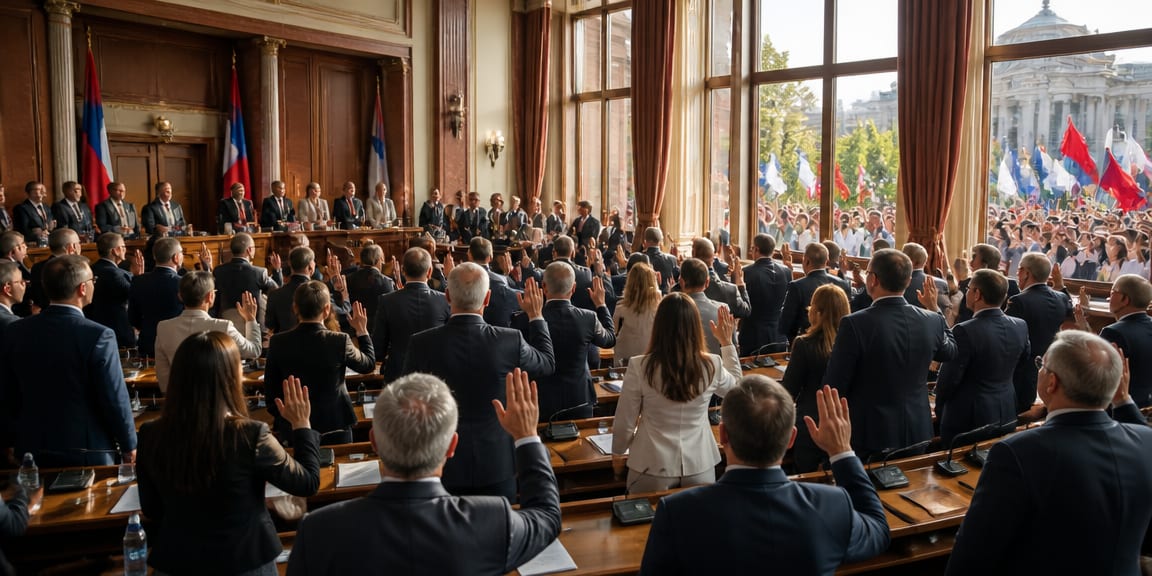
Newly elected Serbian MPs gathered for parliament’s constitutive session following last month’s vote in which the Student List secured a majority. The session featured oath-taking by the movement’s candidates, who were greeted by hundreds of supporters outside as they entered the chamber. Reporting from France24 puts the Student List at 140 of 250 seats, with the Serbian Progressive Party holding 104. Deutsche Welle reports that, as the new majority, the Student List has 90 days to form a government. Outlets including the Bangkok Post and France24 describe the election as ending 14 years of rule by the Serbian Progressive Party. France24 adds that the Student List brings together academics, professionals, farmers, actors, and activists selected through student assemblies. Corriere della Sera reports the movement aims to pursue institutional reforms and anti-corruption measures.
Why It Matters
The transfer of parliamentary control from a long-entrenched party to a student-led slate signals a potential reordering of Serbia’s institutional priorities and political recruitment patterns. With 140 seats reported by France24, the Student List holds a working majority in a 250-member chamber, positioning it to steer legislative scheduling and initial agenda-setting once a cabinet is formed within the 90-day window noted by Deutsche Welle. That timeline shapes early state capacity questions, from ministerial appointments to the pace of policy initiation.
Coverage in Corriere della Sera that the bloc aims to reform institutions and combat corruption frames the transition as programmatic rather than merely cyclical. France24’s description of candidate selection via student assemblies suggests a nontraditional conduit for political representation that could recalibrate parliamentary norms and oversight dynamics. For external stakeholders, these structural shifts affect how to interpret Serbia’s near-term policy direction once the government formation process concludes.
Diverging Narratives
Outlets largely agree on the core facts of the parliamentary opening, majority status, and the end of the Serbian Progressive Party’s long spell in power. Differences lie in framing and specificity. The Toronto Star, citing AP, uniquely states the election “ousted then President Aleksandar Vucic and his party,” whereas the Bangkok Post and France24 confine their characterization to ending 14 years of party rule, without addressing the presidency. This creates a variance in how comprehensively the change in power is described.
Another divergence concerns the movement’s profile and platform. France24 details the Student List’s heterogeneous composition and its selection through student assemblies, while Corriere della Sera attributes a reform-and-anti-corruption agenda to the bloc. Other outlets remain focused on procedure and ceremony, reporting oath-taking and session opening without programmatic claims. Finally, some coverage centers public enthusiasm at the parliament steps, underscoring mobilized supporters, while regional and German reporting prioritize institutional mechanics such as the constitutive session and the 90-day government formation clock.
What Happens Next
The principal decision point is government formation within the 90-day window identified by Deutsche Welle. With 140 seats reported by France24, the Student List can shape cabinet composition and the initial legislative calendar; analysts should watch for the nomination of a prime minister-designate and early ministerial portfolios as indicators of governing priorities. Corriere della Sera’s reporting on plans to reform institutions and fight corruption sets expectations for the first legislative package; the sequencing and scope of any bills would clarify how the majority intends to use its numbers.
The size of the opposition also matters. France24 reports 104 seats for the Serbian Progressive Party, making it a substantial bloc. How it positions itself in debates and procedural tactics will influence the tempo of early legislation. Visible public support at the opening session, noted by Al Jazeera English and France24, provides a backdrop against which initial policy moves and parliamentary dynamics will be interpreted.