
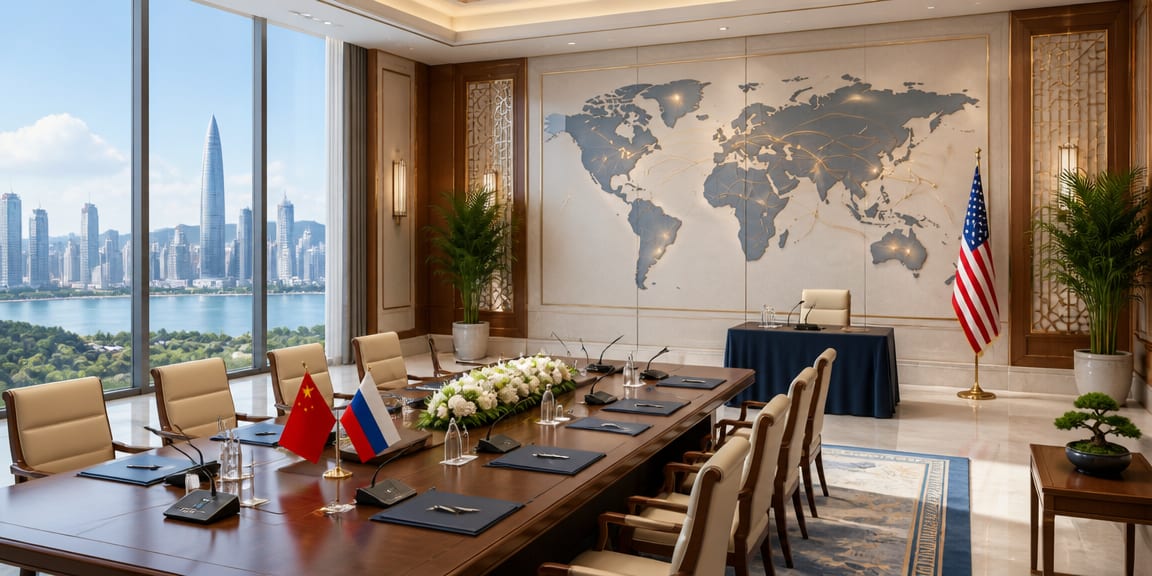
Xi and Putin meet in Shenzhen, hail partnership and a “fairer” multipolar order ahead of planned Trump–Xi–Putin summit
Narrative Snapshot
Across outlets, there is clear agreement that the Nov. 18 Xi–Putin bilateral in Shenzhen paired close-door consultations with expansive public messaging about the China–Russia relationship and global order. TASS described a two-stage format—first with delegations, then a smaller group—while ANSA highlighted headline lines from both leaders: Vladimir Putin touting a “more just multipolar world order” with China, and Xi Jinping saying the Beijing–Moscow relationship contributes to a “more stable world.” Japan Times emphasized that both leaders also attacked Western “protectionism” and sanctions in public remarks.
Where framing diverges is over the stakes and optics heading into the Nov. 19 trilateral. Chinese and Russian official or aligned channels stress “strategic stability” and the value of great-power communication, reflected in Chinese Foreign Ministry and party messaging about the summit’s “pioneering” significance and the importance of maintaining stability (CGTN; TASS). European and U.S. outlets emphasize anxieties around Ukraine: France24 reported Trump’s intent to raise it “despite” Xi seeing the war as not China’s problem, and The Hindu noted the U.S. had previously signaled Ukraine would not be on the trilateral agenda before Trump said otherwise. Le Monde reads China’s hosting as a bid to appear indispensable while constraining space for contentious issues, whereas Deutsche Welle underscores the risk that summit optics favor Moscow. The Kremlin called the meeting’s symbolism hard to overestimate yet dismissed “Yalta 2.0” comparisons as the games of political scientists (The Guardian, live).
A third current in coverage tempers expectations. South China Morning Post argued symbolism will outweigh concrete outcomes, consistent with Chinese statements about managing differences and U.S. officials “tempering expectations” for immediate agreements (SCMP; Telesur English citing the White House). This mix—assertive Sino-Russian rhetoric, Western concern over Ukraine, and low expectations for deliverables—frames the trilateral that is scheduled, not completed.
What Happened
Xi Jinping and Vladimir Putin held a bilateral meeting in Shenzhen on Nov. 18 on the sidelines of APEC, one day before a planned Trump–Xi–Putin trilateral. Russian and Chinese readouts stressed the depth and format of the talks: TASS reported the session began with delegations and moved to a smaller group, and Le Monde’s live coverage noted the leaders had started their meeting. Publicly, both leaders cast their partnership as stabilizing and system-shaping. ANSA quoted Putin arguing that with Russia and China there is a “more just multipolar world order,” and Xi saying the Beijing–Moscow relationship makes for a “more stable world.” Japan Times reported that Xi and Putin also blasted Western “protectionism” and sanctions in remarks ahead of the trilateral. The bilateral concluded as Trump’s arrival was still pending for the Nov. 19 summit, which Beijing has billed as “pioneering” but with expectations for immediate deals toned down (CGTN; Telesur English).
Why It Matters
The Shenzhen bilateral crystallized a China–Russia narrative about world order—multipolarity over Western primacy, opposition to sanctions and protectionism, and claims that their ties add stability (ANSA; Japan Times). Hosting the encounter helps Beijing project indispensability at APEC while, as Le Monde argues, attempting to limit space for contentious issues; Deutsche Welle highlights the countervailing risk that the optics disproportionately favor Moscow. Chinese and party-linked messaging underscores “strategic stability” and major-power communication (CGTN; TASS), positioning the planned trilateral as process-focused rather than outcome-driven, a line echoed by SCMP and by U.S. signals that immediate agreements are unlikely (Telesur English).
For policymakers, this matters across three regimes: sanctions and trade norms challenged by Xi–Putin rhetoric; the P5 dynamic, with Beijing leveraging convening power even as it seeks to avoid taking ownership of Ukraine discussions (France24; The Hindu); and arms control, where Washington aims to raise nuclear issues in an environment many outlets frame as symbolic and tightly managed by the host.
Diverging Narratives
Official and aligned Chinese and Russian channels emphasize continuity and stability. CGTN presented the upcoming trilateral as a chance to “manage differences” and strengthen strategic stability, and a senior CPC official told TASS the summit’s significance for global peace rests on great-power stability. Kremlin messaging to Western media was similar on importance but rejected historical analogies such as “Yalta 2.0” (The Guardian, live).
Western and some Asian outlets highlighted sharper edges. ANSA and Japan Times foregrounded Xi’s and Putin’s public claims—multipolar order and denunciations of Western protectionism and sanctions—underscoring the ideological contrast with U.S. and European positions. France24 and The Hindu focused on Ukraine-related ambiguity: Xi is described as viewing the war as not China’s problem, yet Trump has said he will raise it, reversing earlier U.S. signaling that it would be kept off the trilateral agenda. Le Monde reads China’s role as stage-managing scope to avoid difficult topics while seeking centrality, and Deutsche Welle flags the reputational risk Beijing runs if the optics skew too far toward Moscow. SCMP’s view that symbolism will likely outweigh concrete results adds a further check on expectations.
What Happens Next
Three decision points will shape outcomes. First, the trilateral agenda: whether Ukraine appears in official readouts will test the tension between Trump’s stated intent to raise it (France24) and prior U.S. indications it would be excluded (The Hindu), against Beijing’s interest in constraining contentious issues (Le Monde). Analysts should watch Chinese and Kremlin post-meeting summaries for any mention—or deliberate omission—of Ukraine.
Second, strategic stability language: U.S. officials have telegraphed a push on nuclear arms issues (France24; Al Jazeera English; Telesur English). Indicators include references to arms control frameworks or “strategic stability” beyond generic phrasing in leaders’ statements.
Third, trade and sanctions framing: given Xi’s and Putin’s criticism of Western “protectionism” and sanctions (Japan Times), observe whether similar wording appears in trilateral rhetoric. Across all three, tone and specificity in official communiqués and press availabilities—rather than the mere fact of a meeting—will signal how much China, as host, allows substance to surface.