
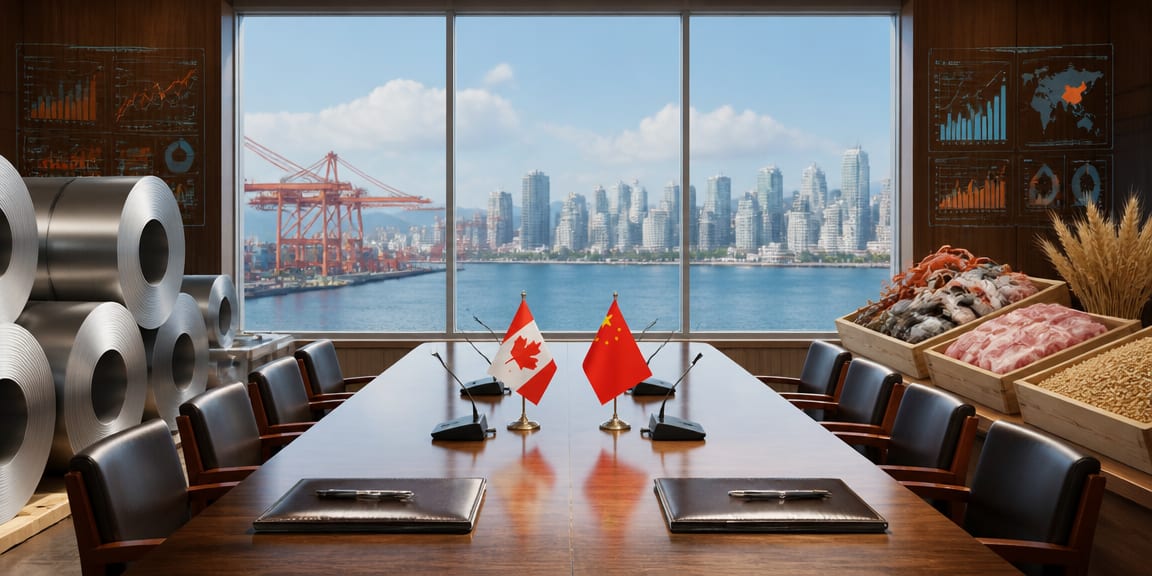
Canada and China extend trade exemptions and ease tariffs in Xi–Carney meeting ahead of APEC
Narrative Snapshot
Across outlets there is broad agreement that the Xi–Carney meeting yielded concrete tariff relief and a two-year extension of existing exemptions, with coverage converging on steel and aluminum on the Canadian side and agricultural and aquatic goods on the Chinese side. Chinese state media emphasize a consensual process—“mutual respect” and “win-win cooperation”—and present the measures as a supplementary arrangement that consolidates recent rounds of talks. International outlets largely frame the developments as part of a Canadian bid to diversify trade ties.
Descriptions of the agreement’s scope diverge. Chinese coverage refers to a two-year extension under a preliminary joint arrangement and highlights additional consensuses on e-commerce, bank branches, and the business environment, while several English-language outlets characterize a broader “trade pact” and “fresh tariff reliefs.” Others stress sector-specific moves, noting tariff cuts on Canadian pork and seafood and Canadian exemptions for Chinese steel and aluminum.
What is most at stake varies by outlet. Some foreground strategic diversification away from the United States, contrasting the cordial optics in Shenzhen with strained Canada–U.S. trade dynamics. Others stress implementation and feasibility, especially in sensitive sectors. The auto angle draws scrutiny: interest in Chinese automakers as “other options” for Canada’s embattled sector is reported alongside skepticism about practical hurdles. Financial-services access and e-commerce cooperation appear as emerging, but as yet under-specified, channels for deepening ties.
What Happened
Prime Minister Mark Carney arrived in China on Monday and met President Xi Jinping in Shenzhen on Tuesday, ahead of the Asia-Pacific Economic Cooperation leaders’ meeting scheduled for November 18–19. Multiple outlets report a new trade agreement or supplementary arrangement featuring tariff relief and a two-year extension of exemptions under a preliminary joint framework. According to Chinese and international reporting, Canada will expand exemptions for Chinese steel and aluminum, while China will reduce barriers affecting Canadian exports, including tariff cuts on pork and seafood and adjustments to anti-discrimination measures on certain agricultural and aquatic products. Chinese authorities also cited positive consensus on e-commerce cooperation, the establishment of branches of Chinese-funded banks in Canada, and improvements to the business environment. Coverage notes this meeting as the leaders’ second this year and situates it within Ottawa’s attempt to reset ties with Beijing, with Carney describing greater predictability and stability in recent exchanges.
Why It Matters
The measures fit a wider recalibration of Canada’s trade posture. Outlets link the deal to Ottawa’s effort to reduce reliance on the United States and manage a more diversified set of economic relationships amid ongoing trade frictions. Easing tariffs on food exports and extending exemptions for steel and aluminum suggest targeted relief for sectors exposed to cross-border headwinds, while the two-year horizon offers planning signals for firms navigating price and market-access volatility. The inclusion of e-commerce cooperation and a pathway for Chinese bank branches indicates potential broadening beyond goods trade into digital and financial domains, subject to regulatory processes. Framed against APEC’s convening in Shenzhen, the episode underscores how regional forums can coincide with bilateral adjustments, even as North American dynamics remain a salient backdrop. For policymakers, the arrangement tests the balance between diversification gains and alignment costs within existing alliance and market structures.
Diverging Narratives
Several outlets stress strategic rebalancing by Canada, portraying the agreement as part of reducing dependence on the U.S. and contrasting the cordial Shenzhen optics with a strained Canada–U.S. relationship. Others foreground the bilateral thaw itself, describing fresh concessions as Ottawa seeks a reset and reporting Carney’s assessment of improved predictability and stability. Chinese coverage emphasizes consensus-building and mutual benefit, placing the measures within multiple rounds of consultations and highlighting prospective cooperation in e-commerce, banking, and the business environment.
There is also variation in how the deal is labeled and specified. One outlet calls it a trade pact, others describe broader tariff reliefs, while Chinese reporting frames it as a two-year extension of exemptions under a preliminary joint arrangement. Sectoral details differ in emphasis: some specify Chinese cuts on Canadian pork and seafood and Canadian exemptions for Chinese steel and aluminum, while Chinese sources refer more generally to adjustments on “certain” agricultural and aquatic products. On industrial policy, the suggestion that Chinese automakers could substitute for American ones in Canada is reported alongside cautions that such a shift would not be easy, a note of skepticism absent from the bilateral communiqués and Chinese reporting.
What Happens Next
Implementation choices now shape outcomes. The two-year extension requires operational steps: Canada’s expansion of steel and aluminum exemptions and China’s adjustment of anti-discrimination measures on specified agricultural and aquatic products. Analysts should watch for formal regulatory notices or guidance from trade ministries detailing product coverage and timing. The reported consensus on e-commerce and on enabling branches of Chinese-funded banks in Canada points to financial and digital policy decisions ahead; licensing applications, supervisory reviews, and any memoranda setting cooperation parameters will indicate depth and pace. In autos, the prime minister’s openness to Chinese manufacturers creates a fork: facilitation of market entry would signal a stronger diversification push; a cooler reception or absence of enabling policies would keep the idea aspirational. With APEC leaders meeting in Shenzhen, any further joint statements or sectoral add-ons will clarify whether the Shenzhen announcements are capped or a foundation for additional steps.