
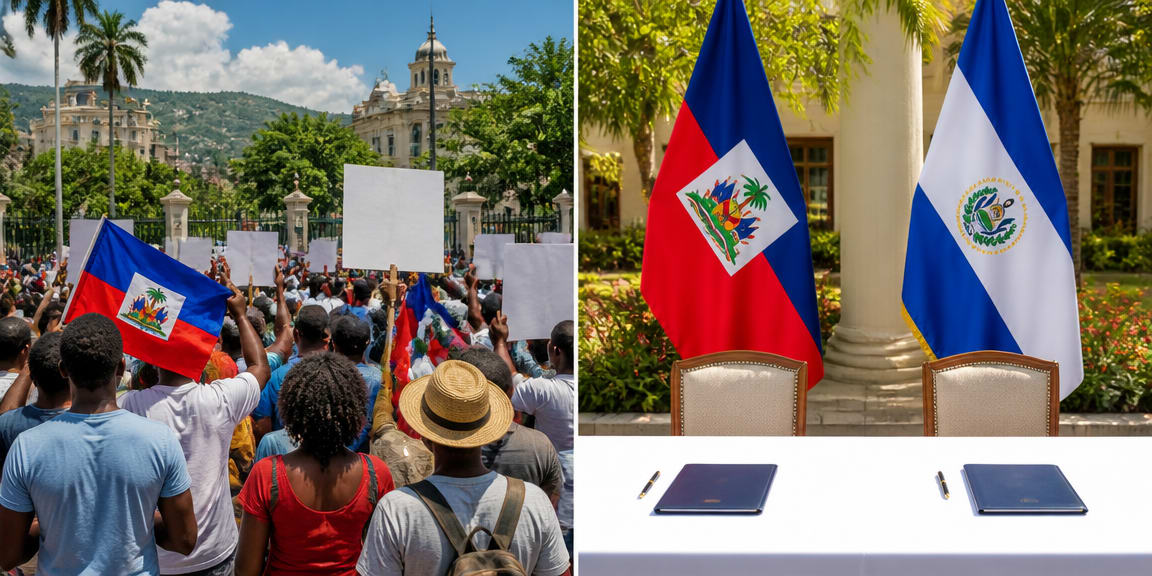
Haitians rally behind Salvadoran troops as Port-au-Prince and San Salvador formalize security cooperation
Narrative Snapshot
Across outlets, there is broad agreement that public displays of support inside Haiti for El Salvador’s anti-gang deployment have been large and visible. France24, Al Jazeera, Folha de S.Paulo, and Fox News all describe sizable marches praising President Nayib Bukele and Salvadoran soldiers, with Al Jazeera also publishing images highlighting that sentiment. Coverage from Clarin extends this enthusiasm to elements of the Haitian diaspora, while noting a parallel current of skepticism.
Where emphasis diverges is on sustainability and end-states. France24 foregrounds expert warnings that popular support could sour without a plan to reduce violence durably and reinforce Haiti’s police. Al Jazeera contrasts celebratory scenes with a narrower operational objective, reporting that Salvadoran forces will depart once kidnapped technicians are rescued. Brazilian coverage centers the formal bilateral framework underpinning the deployment, while North American and Asian outlets spotlight a kinetic milestone: Bukele’s claim, amplified by video, that troops destroyed a gang leader’s mansion.
The result is a composite picture in which immediate public approval, tactical strikes, and new government-to-government coordination are all documented, but longer-term governance and security sector questions sit unresolved and explicitly flagged in several reports.
What Happened
Multiple outlets report that on November 17 large crowds in Port-au-Prince rallied in support of Salvadoran troops fighting gangs. Folha de S.Paulo says the demonstrations coincided with Haiti’s formalization of a cooperation agreement with El Salvador. Al Jazeera English reports the Salvadoran security minister has said the troops will leave once kidnapped technicians are rescued. France24 notes the public backing comes alongside expert cautions about the need for a long-term security plan and police strengthening. The Toronto Star (AP) and South China Morning Post report that on November 18 President Nayib Bukele said his forces demolished the mansion of a prominent Haitian gang leader known as Jeff, sharing a video of the strike; they add it was not immediately clear if he was killed. Fox News reports Haiti’s justice minister planned to travel to San Salvador to discuss anti-gang strategies and ongoing cooperation. Clarin describes diaspora reactions marked by hope and skepticism.
Why It Matters
The reports collectively point to an emerging bilateral security arrangement shaping Haiti’s fight against armed gangs. Folha de S.Paulo’s account of a formal cooperation agreement, paired with Fox News’s reporting that Haiti’s justice minister planned consultations in San Salvador, indicates a state-to-state framework beyond ad hoc assistance. Al Jazeera’s note that Salvadoran forces will depart once kidnapped technicians are freed defines a contingent mission scope, while France24’s expert warnings highlight a structural test: whether external force can be translated into lasting reductions in violence through institutional strengthening of Haiti’s police. Public marches documented by France24, Al Jazeera, and Fox News create political space for continued cooperation but, as Clarin underscores from the diaspora vantage point, do not erase skepticism about outcomes. For policymakers, the key implications are the durability of the bilateral channel, the clarity of exit conditions, and whether operational gains are paired with domestic capacity-building that Haitian and international actors can sustain.
Diverging Narratives
Accounts differ in what they treat as decisive. Al Jazeera’s November 17 reporting centers an explicit exit condition tied to rescuing kidnapped technicians, implying a bounded intervention, while France24 highlights expert concern that momentum could falter without a longer-term plan and police reinforcement. The scale of public mobilization is consistently depicted as significant, though phrasing varies: France24 and Folha de S.Paulo cite thousands, Al Jazeera also documents street celebrations, and Fox News echoes the “thousands” figure alongside pro-Bukele slogans attributed to Reuters. On the operational track, the Toronto Star (AP), South China Morning Post, and Folha de S.Paulo focus on Bukele’s announcement and video of the mansion strike against a leader known as Jeff, noting the unresolved question of whether he was killed. Clarin adds a diaspora perspective that blends approval of Salvadoran action with ongoing worry about violence. Together, the coverage aligns on immediate support and notable tactical actions, while differing on mission duration, strategic sufficiency, and the benchmarks that would constitute success.
What Happens Next
Key decision points emerge directly from the reporting. First is mission duration: Al Jazeera quotes Salvadoran authorities tying troop withdrawal to the rescue of kidnapped technicians, so confirmation of those rescues will be the clearest indicator of whether forces begin to depart or remain engaged. Second is the institutional channel: Folha de S.Paulo’s report of a formal cooperation agreement, and Fox News’s note that Haiti’s justice minister planned talks in San Salvador, make any published terms, joint statements, or follow-on agreements pivotal signals of scope and division of effort. Third is operational tempo and outcomes: further officially acknowledged strikes like the mansion demolition—tracked by the Toronto Star (AP) and South China Morning Post—will indicate whether the campaign targets leadership nodes or expands. Finally, as France24 reports, watch for concrete steps to bolster Haiti’s police; absent such measures, rising expectations captured across outlets could become harder to sustain.