
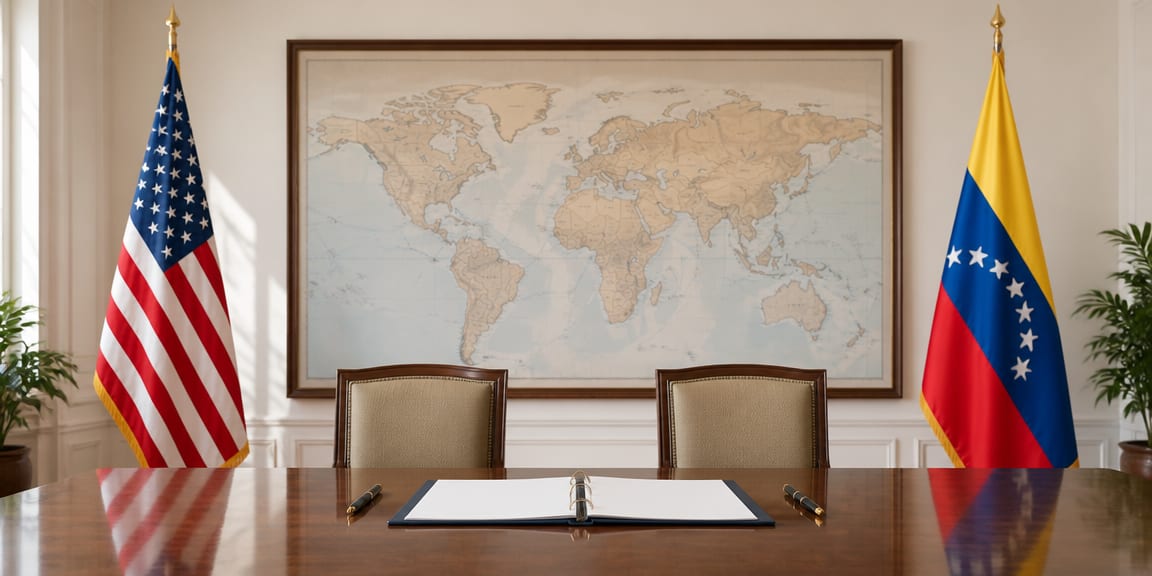
US and Venezuela sign deal to re-establish military ties during Hegseth’s Caracas visit
Narrative Snapshot
Across outlets, the reporting converges on a single development: US Defense Secretary Pete Hegseth made an unannounced trip to Caracas and formalized a renewed defense partnership, with coverage consistently describing a resumption or re-establishment of military ties. Where they diverge is in scope and emphasis. Some foreground operational components—training, intelligence sharing, and counternarcotics—while others stress modernization of Venezuela’s armed forces or the symbolic weight of the visit as the most senior US engagement since January.
The framing of January’s US-led capture of Nicolás Maduro differs more sharply. Several outlets relay Hegseth’s characterization of Venezuela’s shift from “aggressive regional threat” to “compliant security partner,” while Argentine coverage elevates triumphant language about a casualty-free operation that “brought the narcoterrorists before justice.” Brazilian reporting is more pointed, describing Delcy Rodríguez as leading a “dictatorship” and underscoring Hegseth’s role in the Pentagon-led action. North American and European outlets largely use neutral references to “interim” authorities and an “ouster,” emphasizing the policy turn rather than legitimacy claims.
Personalization of Hegseth’s agency is notable. He is cast as both the architect of the January operation and the face of the new partnership, from Folha’s depiction of a Pentagon-led action “headed by Hegseth” to repeated quotations of his assurances about deepening cooperation. There is also some ambiguity—reflected across reports—about the precise configuration of Venezuela’s interim leadership, with references to an “interim president,” “interim authorities,” and, in one account, Rodríguez’s role.
What Happened
US Defense Secretary Pete Hegseth traveled to Caracas for meetings with Venezuela’s interim authorities and signed an agreement to re-establish military ties. Outlets report the accord covers training and intelligence sharing, with additional emphasis on anti-drug cooperation and modernization of Venezuelan military equipment. France24 notes Hegseth’s vow to crack down on drug traffickers, while Clarin reports the interim president also highlighted technical and energy cooperation alongside the defense track. The visit is described as the highest-level US engagement since US troops ousted or captured Nicolás Maduro in January. Hegseth praised “close cooperation” with the interim leadership and argued Venezuela had shifted from a major regional threat to a compliant security partner. Brazilian reporting says Hegseth met Delcy Rodríguez during the trip. Several outlets frame the pact as a formal “reestablishment” of a defense partnership after years of strained bilateral ties.
Why It Matters
The agreement marks an institutional pivot from prolonged estrangement to structured defense cooperation, signaling what France24 calls a dramatic shift in bilateral relations and what Deutsche Welle terms the reestablishment of a defense partnership. By reinstating channels for training and intelligence sharing and prioritizing counternarcotics operations, the deal creates mechanisms that can outlast individual visits and speeches, embedding coordination into day-to-day security practice. Hegseth’s characterization—reported by the South China Morning Post and The Hindu—of Venezuela’s move from “aggressive regional threat” to “compliant security partner” frames the change as a shift in hemispheric security posture rather than a transactional arrangement. Argentine coverage adds that modernization of Venezuelan forces is an explicit goal, aligning defense reform with the renewed partnership. For policymakers, the combination of anti-drug commitments and force modernization suggests near-term operational cooperation with medium-term institutional lock-in, potentially reshaping regional enforcement patterns after years of bilateral rupture.
Diverging Narratives
Accounts vary most in the language used to describe both January’s operation and the new authorities. The South China Morning Post and The Hindu amplify Hegseth’s strategic framing of a threat-to-partner transition, while France24 and Deutsche Welle stress process and policy—renewed cooperation and a repaired partnership. Clarin presents the January action in celebratory terms, calling it casualty-free and asserting it “brought the narcoterrorists before justice,” and quotes Hegseth as saying a “27-year problem” for the hemisphere was resolved. Folha de S.Paulo describes Delcy Rodríguez as heading a “dictatorship” since Maduro’s capture and highlights that the military action was Pentagon-led and “headed by Hegseth.” By contrast, the Toronto Star and European outlets consistently refer to “interim” authorities and an “ouster” without adopting charged descriptors. There is also uneven specificity about the deal’s contents: some outlets mention training, intelligence sharing, anti-drug efforts, and modernization; others keep to broader formulations, leaving the full scope and modalities of implementation opaque in current coverage.
What Happens Next
Implementation choices will determine the depth of this reset. If training and intelligence-sharing commitments reported by the South China Morning Post move quickly into joint courses, advisory deployments, or standing liaison mechanisms, cooperation could normalize at the working level; delays or minimal activity would suggest a largely symbolic pact. France24’s account of a counternarcotics push implies operational indicators to watch: joint interdictions, shared targeting, or publicized seizures attributed to bilateral coordination. Clarin’s references to equipment modernization point to forthcoming decisions on procurement or assistance packages; announcements about platforms, maintenance, or training pipelines would clarify scale. The interim president’s emphasis on technical and energy cooperation, reported by Clarin, suggests parallel tracks beyond defense, so follow-on agreements will be a signal of breadth. Given Deutsche Welle’s framing of a reestablished partnership and France24’s note on the visit’s seniority, additional high-level engagements or published terms of the accord would indicate consolidation.