
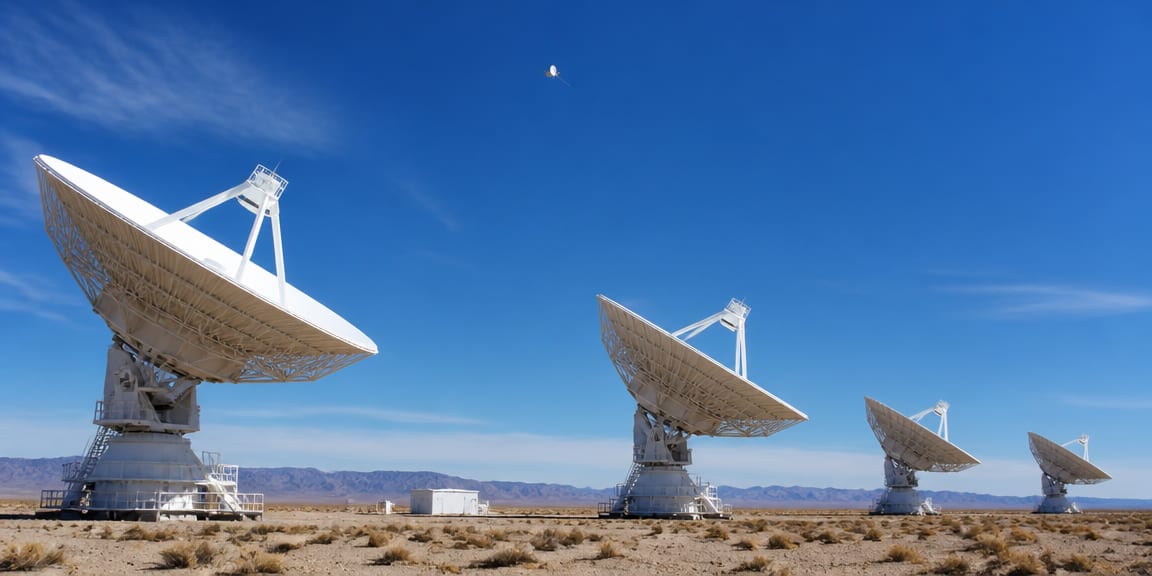
Voyager 1 reaches one light-day from Earth
Narrative Snapshot
Across outlets, there is broad agreement on the milestone and what it signifies: Voyager 1 is the farthest human-made object and is now roughly one light-day—about 26 billion kilometers or more than 16 billion miles—from Earth, in interstellar space. Coverage converges on the communications consequence that it takes 24 hours for radio signals to reach the probe, which several reports use to anchor the scale of the achievement.
Where coverage diverges is in framing. Some emphasize the symbolic nature of the threshold—CBC News characterizes it as arbitrary yet important—while others situate it within the long arc of solar system geography. Le Monde underscores that even at this distance, it could take 30,000 years to leave the Solar System definitively, tempering celebratory headlines with context about competing boundary definitions that also appear in earlier reporting from the Bangkok Post asserting the probe “exited our solar system years ago.”
Outlets also vary in emphasis and precision. ANSA leads with a numeric distance of 25.9 billion kilometers. The Hindu describes the milestone as calculated by NASA and “believed” to have been reached, highlighting its derived nature. Folha de S.Paulo stresses performance—61,000 km/h—and the “first human creation” to cross this line. Clarin focuses on NASA’s public celebration and the advance in technology since 1977, while the New York Times and Al Jazeera center the mission’s 49-year continuity and the fact that Voyager 1 is still sending messages home.
What Happened
On November 18, 2026, multiple outlets reported that NASA calculated Voyager 1 to be one light-day from Earth, the distance light travels in 24 hours, or about 26 billion kilometers and more than 16 billion miles. CBC News and Le Monde emphasize the operational corollary: it now takes 24 hours for radio signals to reach the spacecraft. The Hindu likewise notes NASA’s calculation and places the figure at roughly 26 billion kilometers, in line with ANSA’s 25.9 billion-kilometer estimate and Al Jazeera’s more than 16 billion miles. Folha de S.Paulo adds that Voyager 1 is traveling at about 61,000 kilometers per hour and became the first human-made object to reach this distance. The Bangkok Post had previewed the approach to this threshold days earlier and then reported its passage. Several outlets, including CBC News and the New York Times, place the probe in interstellar space.
Why It Matters
The milestone provides a concrete communications benchmark for interstellar operations. With signal travel now taking 24 hours one way, as noted by CBC News and Le Monde, the mission illustrates the latency realities of deep-space science and the patience required for command-and-control across interstellar distances. It simultaneously demonstrates institutional endurance: after 49 years, the spacecraft still transmits from beyond the heliosphere, as underscored by the New York Times and Al Jazeera, and NASA publicly marked the achievement, according to Clarin.
Coverage also highlights how boundaries are communicated to the public. While some stories emphasize that Voyager 1 is in interstellar space, Le Monde’s reminder that it may take 30,000 years to leave the Solar System definitively sits alongside earlier Bangkok Post language that it exited years ago, reflecting different usages of “Solar System” and reinforcing the need for clarity in scientific communication. Together, these elements speak to how agencies and media translate complex scales into policy-relevant narratives about capability, longevity, and expectations.
Diverging Narratives
Disagreement is not over whether the milestone occurred but over how to interpret it. CBC News calls a light-day an arbitrary yet important line, foregrounding its communicative utility rather than a physical boundary. Le Monde, meanwhile, counterbalances the milestone with the estimate that fully departing the Solar System could take 30,000 years, signaling that “interstellar” status coexists with a very long residency in the Sun’s wider domain. By contrast, the Bangkok Post’s earlier report that Voyager 1 exited the Solar System years ago positions the heliopause crossing as a completed transition, revealing competing conventions about where the Solar System ends.
There is also variance in how certainty is conveyed. The Hindu writes that NASA “calculated” and “believed” the milestone was reached, emphasizing derived measurement. Others anchor attention in record-setting language, with Folha de S.Paulo calling it the first human creation to reach such a distance and Clarin describing NASA’s celebration and the mission’s technological significance. Precision and framing choices differ as well: ANSA’s numeric distance contrasts with outlets like the New York Times and Al Jazeera that stress longevity and continued data return.
What Happens Next
Voyager 1 continues outward in interstellar space, and the communications lag will lengthen beyond the current 24-hour one-way light time noted by CBC News and Le Monde. Analysts should watch for NASA’s periodic distance updates—reported by The Hindu and ANSA as approximately 26 billion kilometers and 25.9 billion kilometers, respectively—and continued confirmation that the spacecraft is still sending messages, as highlighted by the New York Times. Expect future coverage to revisit boundary language, given Le Monde’s 30,000-year horizon for definitively leaving the Solar System and the Bangkok Post’s earlier framing that Voyager 1 had already exited it. How agencies and media choose to characterize subsequent distance markers and latency milestones will shape public understanding of the mission’s trajectory and the scales relevant to interstellar science, even as the probe steadily moves farther from Earth.