
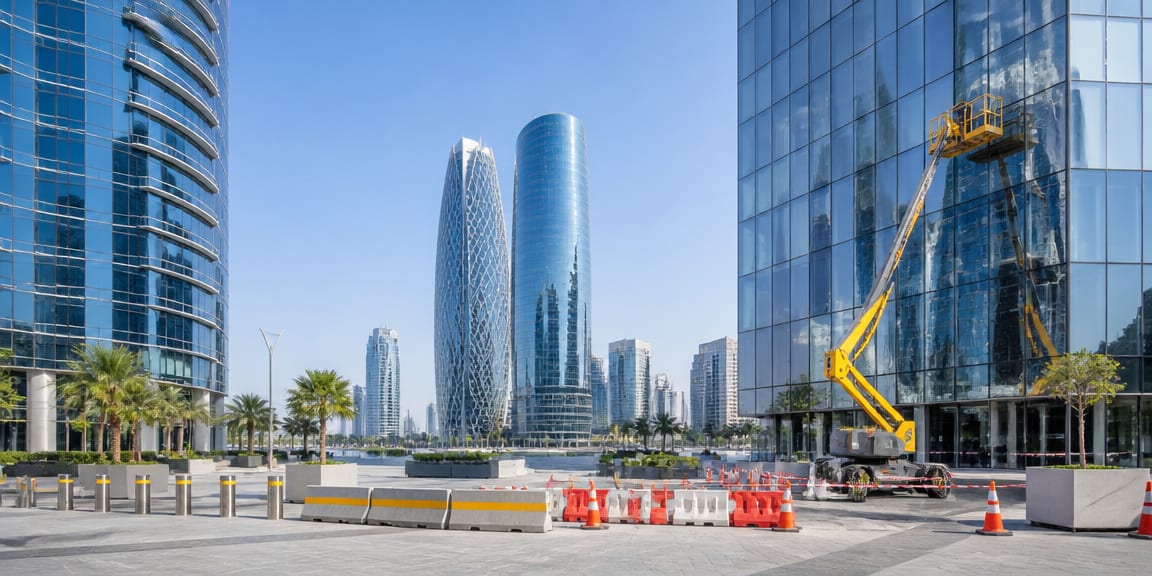
Riyadh’s sovereign wealth fund tower damaged in suspected Houthi strike, as Saudi authorities report no casualties
Narrative Snapshot
Across outlets, the core facts align: a projectile hit Riyadh’s Public Investment Fund (PIF) Tower, blowing out windows across multiple floors and bending parts of the facade, with authorities reporting no injuries and access to the King Abdullah Financial District curtailed. Coverage based in Asia and the Middle East leans into operational detail and business optics, noting seven to eight floors affected and that this is the second strike on the financial district in less than two weeks, following damage to an Aramco building.
Anglophone and francophone reporting diverges on severity and verifiability. Some emphasize Saudi restrictions on filming blast sites and the initial absence of imagery, while others cite video purporting to show the strike and photos of repairs underway. Official framing also diverges: Saudi authorities describe a terrorist attack, while the Houthis claim precision retaliation with cruise missiles. For policy audiences, the stakes are the credibility of Saudi air defenses, the resiliency of Riyadh’s investment hub, and how battlefield gains near Bab al‑Mandab intersect with cross‑border strike capacity.
What Happened
Witnesses and officials reported that Riyadh’s PIF Tower was damaged on Thursday, with windows destroyed across roughly seven to eight floors and sections of the metal facade bent. Saudi authorities said there were no injuries, called it a terrorist attack, and closed off access points to the King Abdullah Financial District while evacuations proceeded. The strike follows an 8 November incident that damaged an Aramco building in the same district. A Houthi military spokesman said the group targeted Riyadh’s financial center and King Khalid International Airport with “a large number of cruise missiles,” framing the action as retaliation. Imagery was initially limited amid Saudi restrictions on filming, though outlets later referenced video purporting to show a projectile hitting the tower and a government photo depicting notable but limited visible damage. Saudi media and regional press also reported a subsequent coalition strike on a missile platform near Sanaa.
Why It Matters
The incident underscores pressure on Saudi air and missile defenses at a time when the kingdom is courting investment anchored by PIF and its flagship projects. Reporting links the strike to a broader uptick in Houthi operations against airports, energy infrastructure, military sites, and now high-profile financial district targets—testing deterrence and crisis management in the capital. The episode lands as Washington prepares to augment Saudi air defense planning, with the head of US Central Command and several dozen advisors expected to assess capabilities on the ground. It also coincides with intensified regional maneuvering: Iranian diplomatic outreach to Pakistan and Oman amid maritime incidents and claims of Houthi missile launches toward Saudi territory. Taken together, the attack connects urban security, economic signaling, and contested regional escalation frameworks centered on Yemen and the Red Sea corridor.
Diverging Narratives
Saudi authorities characterize the strike as a terrorist attack that caused material damage but no casualties, emphasizing rapid perimeter control and emergency response. Houthi statements claim a deliberate, precise operation using cruise missiles against the financial center and the main airport, framed as retaliation for Saudi actions in Yemen. Outlets vary on evidentiary confidence: some note the kingdom’s strict rules against filming blast sites and the absence of immediate imagery; others cite video purporting to show impact and government-released photos with crews replacing glass. There is also variation in how the building is described, with most calling PIF Tower Riyadh’s tallest skyscraper while one report labels it the second-tallest. Business-focused coverage highlights the reputational hit to Saudi Arabia’s investment narrative after two strikes in under two weeks, while regional and Russian outlets place the attack within a wider military theater, from reported launcher strikes near Sanaa to Houthi advances along the Red Sea. One US media commentary, relayed by Middle East Eye, asserts the Houthis are “occupying” part of Saudi Arabia; none of the other sources provided corroborate that claim.
What Happens Next
Three decision points emerge. First, air defense posture: US Central Command’s expected advisory deployment to Saudi Arabia signals a review of gaps; watch for announced adjustments, deployments, or procurement signals following that assessment, alongside reported interception rates in coming weeks. Second, target selection and tempo: the Houthis say they used cruise missiles and have stepped up attacks across sectors; monitor whether strikes continue to focus on high‑visibility economic symbols in Riyadh or shift toward airports and energy assets, and whether Saudi authorities maintain rapid containment without casualties. Third, regional escalatory ladders and diplomacy: Saudi-led coalition strikes on launch infrastructure near Sanaa, Iranian diplomatic engagements with Pakistan and Oman, and battlefield movements near Bab al‑Mandab and Aden will shape leverage; indicators include reported launcher neutralizations, statements following Tehran’s regional visits, and whether southern Yemeni forces continue redeployments from the Red Sea corridor toward Aden.