
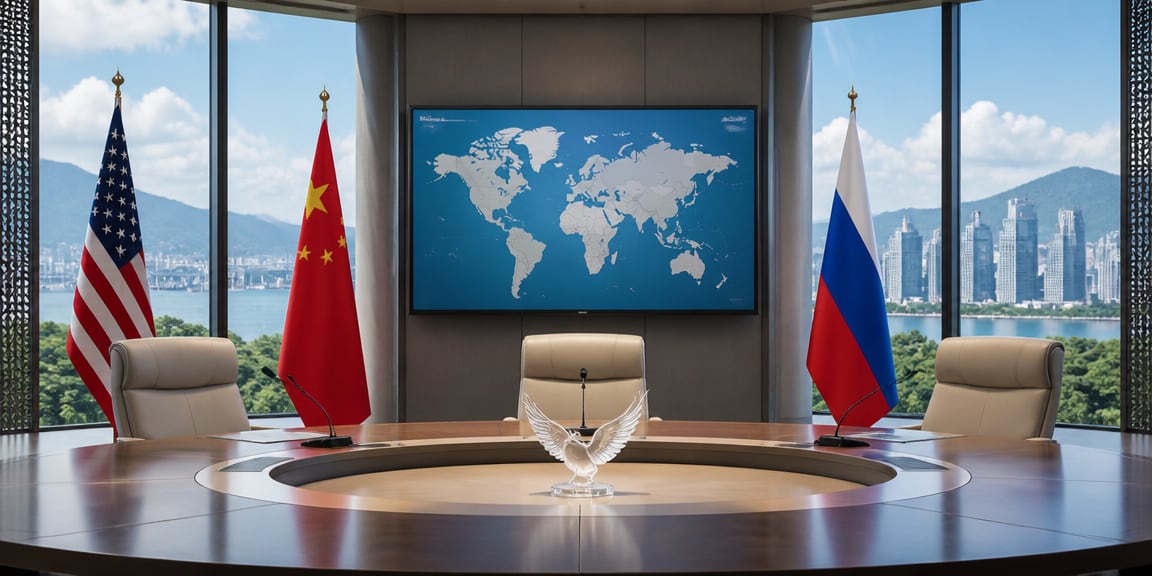
Trump, Xi and Putin hold first-ever trilateral talks in Shenzhen with Ukraine war and nuclear risks on the agenda
Narrative Snapshot
Across outlets, there is broad agreement that the Shenzhen encounter was unprecedented and centered on Ukraine and nuclear risk reduction, but coverage diverges on objectives, process design, and implications. Chinese state media frame the meeting as opening channels to “manage differences” and support world stability, emphasizing symbolism over deliverables and, post-fact, highlighting a joint “Declaration toward Peace” (CGTN, Nov 18–19). Russian official readouts underscore extensive focus on Ukraine and shared interests with Washington and Beijing in resolving conflicts (TASS, Nov 19), while a Kremlin-linked envoy adds that Europeans are hindering leader-level dialogue (TASS, Nov 19). Western reports stress the absence of breakthroughs and the exclusion of Kyiv and European actors from the room, drawing attention to process risks and optics (Fox News, Nov 19; France24, Nov 19). Ukrainian state media foregrounds U.S. efforts to enlist China directly in talks with Russia on ending the war (Ukrinform, Nov 19), signaling a potential, if undefined, negotiating channel.
A second axis of divergence concerns historical framing and strategic intent. One Argentine outlet reports Vladimir Putin likening the meeting to Yalta and urging acceptance of “realities” in ongoing conflicts, implicitly Ukraine (Clarín, Nov 19), while Russian experts quoted by RT reject Yalta analogies and caution against expecting concrete decisions (RT, Nov 18). Pre-summit Chinese signaling suggested Ukraine would not be on the agenda (France24, Nov 18), contrasting with U.S., Russian, Canadian, and European reporting that it was central once leaders sat down (CBC News, Nov 19; TASS, Nov 19; Le Monde, Nov 19).
What Happened
In Shenzhen on the sidelines of the APEC summit, U.S. President Donald Trump held separate bilaterals with Russian President Vladimir Putin and Chinese President Xi Jinping before convening a first-ever trilateral session with both (Le Monde, Nov 19; ANSA, Nov 19; CBC News, Nov 19). Trump and Putin met for roughly 40 minutes, with the Kremlin later saying they discussed resolving the war in Ukraine and bilateral ties; a presidential envoy said both were committed to a peaceful resolution (Le Monde, Nov 19; TASS, Nov 19; ANSA, Nov 19). Putin said most of his meeting with Trump was devoted to Ukraine and that he also discussed it with Xi (TASS, Nov 19). Trump told Xi that Washington and Beijing should work together to end the war and discuss it at a summit with Putin (Ukrinform, Nov 19), and publicly argued the U.S., China, and Russia are uniquely positioned to reduce nuclear arsenals (Le Monde, Nov 19; CBC News, Nov 19). Multiple outlets reported no major breakthrough (Fox News, Nov 19). The talks unfolded as Ukraine struck the Crimean Bridge again earlier in the week (Le Monde, Nov 19).
Why It Matters
The Shenzhen meeting tests whether great-power minilateralism can shape high-stakes files—Ukraine and nuclear risk—outside inclusive European and transatlantic formats. French outlets highlight concerns that leader-level bargaining among Washington, Moscow, and Beijing could sideline Kyiv and European governments, even as Ukraine-related issues are discussed (Le Monde, Nov 19; France24, Nov 19). At the same time, re-opening a channel among the top three nuclear powers touches an arms-control landscape hollowed out by the demise of key treaties; Trump and Xi both referenced strategic stability and nuclear risk reduction as central themes (Le Monde, Nov 19; CBC News, Nov 19; CGTN, Nov 19). The trilateral also intersects with ongoing, fragmented diplomacy: CGTN reported earlier U.S.–Russia–Ukraine talks in Abu Dhabi yielded a prisoner exchange but left core disputes unresolved, with Moscow reiterating redlines on foreign troops and territory (CGTN, Nov 13). For decision-makers, the format raises choices about engagement, safeguards for allied equities, and whether to channel any momentum into inclusive mechanisms or allow a leader-centric track to harden.
Diverging Narratives
Chinese coverage casts the summit as a stabilizing effort to build communication channels and manage differences, pairing pre-meeting caution about scope with post-meeting emphasis on a “Declaration toward Peace” and Xi’s call for major-power comity (France24, Nov 18; CGTN, Nov 19). Russian official accounts accentuate substantive engagement on Ukraine with both Trump and Xi and assert shared conflict-resolution interests across the three capitals (TASS, Nov 19). A Kremlin-linked figure frames European actors as impeding top-level dialogue (TASS, Nov 19), a claim not echoed elsewhere in the set. Western reporting highlights process and optics over outcomes: Fox News and CBC describe a milestone without breakthroughs, and France24 notes Ukraine was discussed without Kyiv or European leaders present (Fox News, Nov 19; CBC News, Nov 19; France24, Nov 19). Ukrainian state media portrays U.S. outreach to bring China into talks with Putin on ending the war (Ukrinform, Nov 19), without detailing parameters or guarantees for Ukrainian participation. Historical analogies further split assessments: Clarín reports Putin comparing the meeting to Yalta and urging acceptance of “realities” in conflicts (Clarín, Nov 19), while RT features experts urging against Yalta comparisons and predicting no concrete decisions (RT, Nov 18).
What Happens Next
Key decision points emerge around institutionalization, inclusivity, and agenda. First, whether the trilateral becomes a standing channel on Ukraine and arms control will depend on follow-on signals: Xi’s call to strengthen communication and manage differences (CGTN, Nov 19) and Trump’s emphasis on dialogue (Fox News, Nov 19) point to a consultative pathway, but reporting of no breakthroughs and expert caution suggest limited short-term outputs (Fox News, Nov 19; RT, Nov 18). Second, watch whether China’s reported “Declaration toward Peace” is corroborated in U.S. or Russian readouts and translated into working groups or timelines (CGTN, Nov 19). Third, on Ukraine, monitor if Trump’s proposal that Xi join talks with Putin evolves into a defined process and whether Kyiv and European stakeholders are integrated, an issue flagged by French outlets and contested by a Russian envoy (Ukrinform, Nov 19; Le Monde, Nov 19; France24, Nov 19; TASS, Nov 19). Parallel indicators include continuation of the Abu Dhabi track and additional prisoner exchanges amid unresolved core disputes (CGTN, Nov 13).