
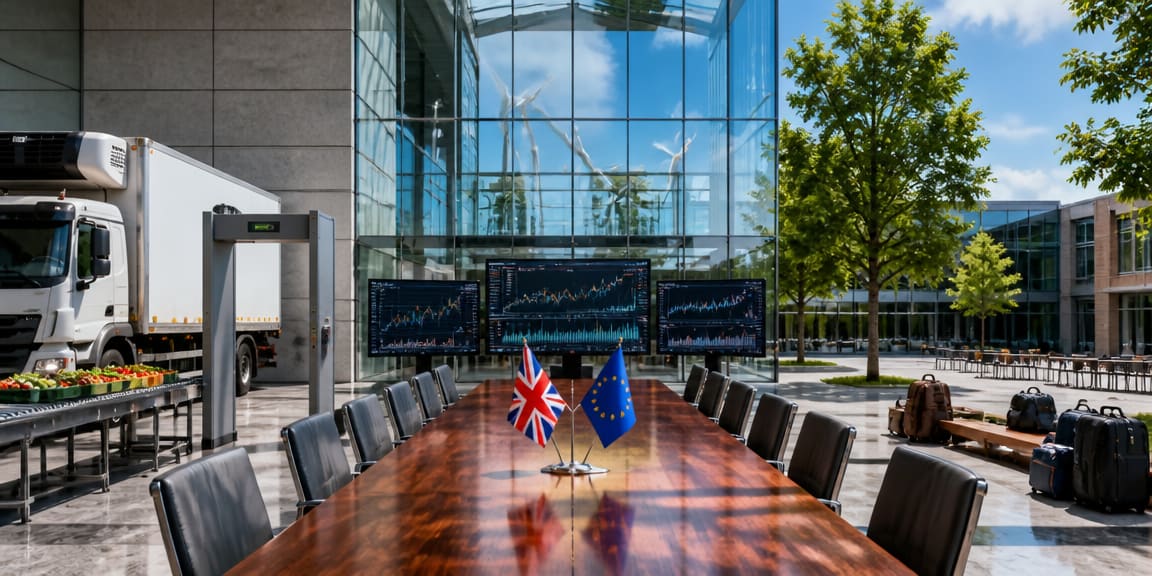
EU and UK agree landmark reset on food trade, youth mobility and carbon markets, with tuition fees talks pending
Narrative Snapshot
Across European and UK outlets there is broad agreement that the Brussels summit produced the most substantive post-Brexit reset to date, centered on three pillars: simplifying food export checks, launching a youth mobility scheme, and linking emissions trading systems. Coverage in France24, Deutsche Welle and ANSA emphasizes the “turning point”/“landmark” framing and leaders’ choreography, while the New York Times and BBC situate the deals as removing select barriers rather than reopening the single market.
Where reports diverge most is over conditionality tied to university tuition fees for EU students in the UK. Le Monde and the South China Morning Post describe the package as contingent or snagged on fees, echoed by the Guardian’s warning that fallout over fees could derail progress. Downing Street’s line, reinforced by subsequent BBC reporting, is that the deal stands independently while fees are negotiated. Telesur adds sharper brinkmanship, citing suggestions of EU threats to withhold application absent fee concessions, alongside a six‑month window to settle the issue.
Several outlets widen the frame beyond the three core files. Telesur highlights planned work on economic security, migration, digital cooperation and defense. The Guardian reports a draft commitment to a structured dialogue on returns of refused asylum seekers to third countries. The SCMP links the reset to a geopolitical context shaped by Russia’s war in Ukraine, US trade actions and China, while Italy’s La Repubblica adds detail on scheme parameters and notes a reported UK return to Erasmus+ from 2027.
What Happened
At a Brussels summit on November 20, 2026, UK Prime Minister Andy Burnham met European Commission President Ursula von der Leyen and European Council President António Costa to announce a set of EU‑UK “reset” agreements. Outlets report three core outcomes: easing sanitary and phytosanitary checks to facilitate food trade; a political agreement to link the EU and UK emissions markets with a target start in 2028; and a youth mobility scheme. Media describe youth provisions allowing up to 100,000 visas per side, with La Repubblica adding an under‑32 eligibility and stays up to three years, and the Guardian noting reciprocal access. Leaders presented the package as a turning point. Several reports say tuition fees for EU students in the UK remain unresolved, with a six‑month negotiation window. A Guardian report also cites a draft plan for a structured EU‑UK dialogue on returns to third countries. Clarin notes implementation dates will be set in a forthcoming joint statement.
Why It Matters
This reset operationalizes a sector‑by‑sector approach to rebuilding EU‑UK ties a decade after Brexit. SPS facilitation reduces frictions that have hit agri‑food supply chains since 2020, while an ETS linkage from 2028 would reconnect carbon markets, deepening liquidity and, per Folha de S.Paulo, helping firms avoid substantial border carbon charges. The youth scheme restores significant channels for early‑career mobility, skills circulation and academic exchange; La Repubblica’s reference to a UK return to Erasmus+ from 2027, if sustained, would compound this people‑to‑people reintegration.
Institutionally, the agreements test whether Brussels and London can implement technical alignment without reopening full single market participation. For governments and regulators, the package creates new joint workstreams on trade facilitation and carbon compliance, alongside prospective cooperation in migration, digital and security areas flagged by Telesur. Strategically, as the SCMP notes, geopolitical pressures have increased the premium on a workable EU‑UK partnership, making these files bellwethers for capacity to manage interdependence under political constraint.
Diverging Narratives
The sharpest divergence concerns whether the wider package is conditioned on lowering tuition fees for EU students. Le Monde reports the accords as contingent on ongoing fee talks, and the SCMP and Corriere della Sera underscore that fees were pushed back and remain a point of tension. The Guardian quotes Brussels‑side concerns that fees could snag implementation, and Telesur reports EU threats to crash the deal absent movement, while noting a six‑month window to negotiate. In contrast, Downing Street insists “the deal is done,” and a BBC follow‑up cites UK Foreign Secretary David Miliband asserting the agreement is not dependent on a tuition settlement.
There are also differences in scheme design details as reported. Telesur describes “up to 100,000” student visas on each side; the Guardian references 100,000 young Britons with reciprocal EU access; La Repubblica specifies an under‑32 threshold and up to three‑year stays. On trade, France24 and Al Jazeera stress immediate easing of food checks, whereas Le Monde frames this as restoring a common sanitary‑phytosanitary space linked to the broader package. Finally, while multiple outlets adopt “landmark” language, the New York Times and BBC frame outcomes as selective barrier removal with broader relationship issues left open.
What Happens Next
The first decision point is the six‑month negotiation on university tuition fees for EU students in the UK. The EU position, per Telesur, is equivalence with domestic fees; UK resistance and subsequent BBC reporting that the wider deal is not conditional define the range. Analysts should watch the joint statement’s conditionality language, Commission and Council readouts, and any UK moves to adjust fee policy.
Implementation will hinge on operational texts: the joint statement setting enforcement dates (Clarin), SPS guidance that translates “easier checks” into border practice (Le Monde, France24), and the roadmap to link ETS systems by 2028 (Folha de S.Paulo, Al Jazeera). Publication of youth scheme quotas, eligibility criteria and visa processing arrangements will signal delivery against the reported 100,000‑per‑side cap and age/duration parameters (Guardian, Telesur, La Repubblica).
Beyond the core files, watch for formal launch of the structured EU‑UK dialogue on returns to third countries reported by the Guardian, and scoping of additional cooperation tracks in economic security, digital and defense referenced by Telesur, as indicators of whether the reset broadens into a sustained agenda.