
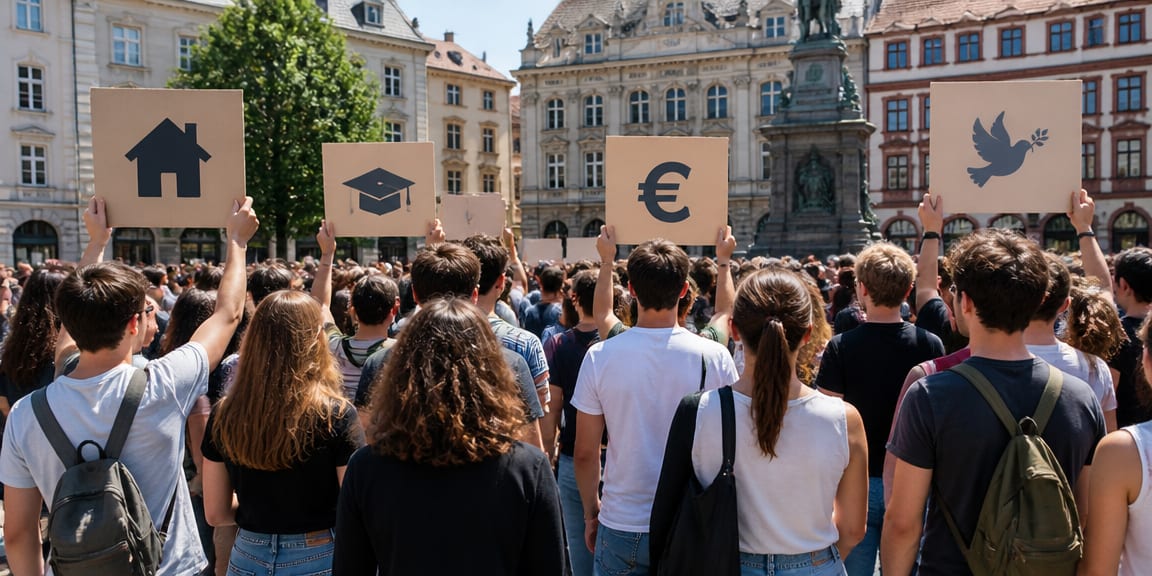
Coordinated youth protests sweep Europe over living costs, education and militarization
Narrative Snapshot
Across outlets, coverage converges on the scope and cross-border character of the mobilizations, with reports of demonstrations in more than 20 countries and themes that pair economic grievances with opposition to rising military spending. France24, the Guardian, BBC, and Bangkok Post foreground the breadth of participation and shared demands around housing, learning conditions, and budgets, while Le Monde emphasizes that unions, associations, and youth organizations extended actions through the weekend and framed them as an “international youth strike.”
Several sources accent the security dimension. Al Jazeera highlights German teenagers resisting conscription, and RT focuses on anti-war slogans and calls for shifting funds from weapons to education and welfare. Russian state media also foreground confrontations: TASS and RT detail pepper spray and arrests in Vienna, and scuffles outside Italy’s Education Ministry. By contrast, BBC and Deutsche Welle keep emphasis on issue-based grievances—education, climate, and affordability—without dwelling on clashes.
Country-specific dispatches add texture. France24 reports from Madrid on cost-of-living pressures; Le Monde and TASS cite large turnouts in Switzerland against rearmament; Deutsche Welle describes thousands of young people in Germany demanding improvements across schools, climate, and costs. The New York Times situates these protests within a broader pattern of Gen Z reshaping politics across ideological lines, while Bangkok Post relays Joseph Stiglitz’s assessment that the protesters’ concerns are “legitimate,” underscoring the policy breadth of the grievances.
What Happened
On Friday, coordinated youth-led protests took place across Europe, with organizers and news outlets reporting actions in more than 20—and in some accounts over 25—countries. Demonstrators targeted soaring living and housing costs, deteriorating learning conditions, and increased military spending, seeking to pressure governments through cross-border solidarity. In Germany, young people mobilized around education, climate, affordability, and opposition to conscription. In Spain, rallies formed part of the continent-wide push on cost of living and militarization. In Austria, a student rally in Vienna escalated when protesters moved toward a university entrance; police used pepper spray and made arrests. In Italy, protesters burned a cardboard tank and clashed with riot police outside the Education Ministry. In Switzerland, several tens of thousands protested against rearmament across roughly ten cities. Unions, associations, and youth groups extended actions through the weekend.
Why It Matters
The protests link fiscal and security choices, pressing governments over trade-offs between rearmament and social investment in education, housing, and public services. Multiple outlets report opposition to militarization, rearmament, and conscription alongside demands for affordability and better learning conditions, indicating that budget allocations—rather than single-issue grievances—are the focal point. The cross-border coordination described by France24, Le Monde, and the Guardian signals a transnational capacity among youth organizations to synchronize pressure on national policymakers, potentially shaping agenda-setting beyond any one capital. The New York Times frames this as part of a global Gen Z influence that has already produced electoral upsets, suggesting implications for parties calibrating positions on cost-of-living relief and defense spending. Stiglitz’s view, reported by Bangkok Post, that concerns are “legitimate” may resonate with officials weighing responses that address purchasing power and education without dismissing security priorities.
Diverging Narratives
Outlets diverge on emphasis and framing. The Guardian, BBC, France24, and Bangkok Post highlight the scale and multi-issue nature of the actions, with France24 and Al Jazeera citing participation across roughly 25 countries, while BBC and others describe “thousands” without specifying totals. Le Monde underscores organizational architecture—unions and youth bodies coordinating a multi-day “international youth strike”—which positions the events as sustained rather than episodic. Security-focused angles are strongest in Al Jazeera, TASS, and RT: Al Jazeera centers resistance to conscription in Germany; TASS reports a Vienna rally “turn[ing] violent”; RT details police pepper spray and arrests in Austria and confrontations in Rome, while also foregrounding anti-war slogans and demands for reallocating funds to education and welfare. By contrast, Deutsche Welle frames the German protests around education, climate, and costs, with less attention to clashes. The New York Times situates the mobilizations within a broader generational realignment spanning both far left and far right, a perspective that complicates any single ideological reading of the protests.
What Happens Next
Key decision points emerge where protesters’ demands meet fiscal and security agendas. Protesters seek to “increase pressure on governments,” so analysts should watch for cabinet statements or budget signals on education, housing, and social services, and whether officials explicitly link these to military outlays. In countries where conscription is salient, such as Germany per Al Jazeera’s reporting, monitoring government messaging on service obligations will indicate whether opposition is shaping policy debate. In Switzerland, where Le Monde and TASS report large anti-rearmament turnouts, track whether authorities address defense spending trajectories. The handling of demonstrations in Austria—where TASS and RT report pepper spray and arrests—bears on policing approaches to youth mobilization; any official reviews or guidance will signal the state’s posture. Finally, Le Monde’s note on weekend actions suggests the durability of coordination; observe whether unions and youth groups announce follow-on strikes or broaden coalitions.