
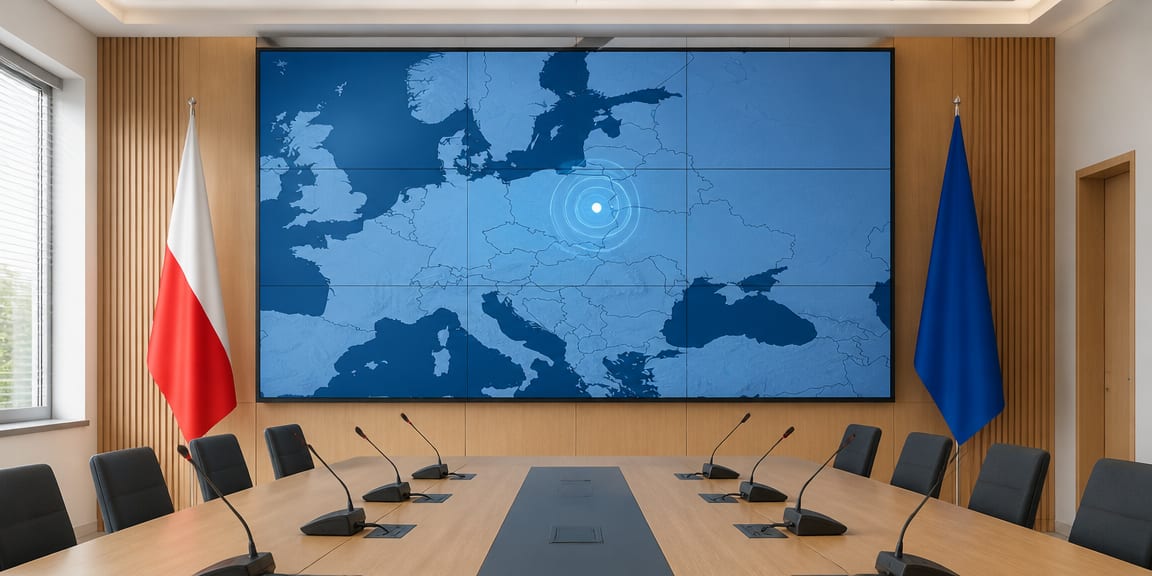
Poland says Russian missiles and a drone crashed on its territory during attack on Ukraine; investigation under way
Narrative Snapshot
Across outlets, there is broad agreement that Polish territory was struck by projectiles during a large-scale Russian attack on Ukraine, with no injuries reported in Poland. Where coverage diverges is in the characterization of intent and the certainty of the incident’s contours. Polish leaders quoted by European and international media emphasize the timing alongside major allied exercises, elevating the political salience of the episode.
Ukrainian and Polish sources concentrate on operational details and investigative cooperation. Kyiv-based outlets highlight Poland’s early-hours air defense activation and ongoing joint fact-finding with Ukraine, while Polish officials cited by multiple outlets specify two missiles and a jet-powered drone. Western and global outlets foreground the prime minister’s charge of “intentional provocation” and the proximity to extensive European drills, placing the incident within an alliance-readiness frame.
Several reports add context on the wider war environment and diplomatic backdrop. The Guardian relays President Zelenskyy’s description of one of the largest Russian attacks since 2022 with casualties in Ukraine, while the South China Morning Post notes the episode coincided with US efforts to add momentum to talks it is mediating on ending the war. Italian coverage also draws attention to the regional alert posture and calls to bolster the eastern flank, signaling how local authorities are translating a cross-border incident into preparedness measures.
What Happened
Poland’s Armed Forces Operational Command said its air defenses were activated around 3:30 a.m. local time during a Russian strike on Ukraine, and authorities opened an investigation into debris reported near the border (Kyiv Independent; France24). By day’s end, Poland’s defense minister stated that two Russian missiles and a jet‑powered drone crashed on Polish territory overnight into Friday, 20 November, with no injuries reported (Ukrinform; France24). Prime Minister Donald Tusk told reporters the episode appeared timed with Western military exercises under way in Poland, not an accident, and called it an intentional provocation (Toronto Star/AP; BBC; The Guardian). Multiple outlets placed the incident in southeast Poland, in the Lublin region, where the provincial governor announced heightened readiness and urged NATO and the EU to reinforce the eastern flank (Corriere della Sera). Ukraine’s foreign ministry said Kyiv is cooperating with Warsaw in the probe (Ukrinform).
Why It Matters
The incident tests crisis-management mechanisms on NATO’s eastern flank and the capacity to contain spillover from Russia’s war on Ukraine. Polish leaders’ framing of an “intentional provocation” during allied drills makes this not only an air-defense and forensics issue but a signaling contest with direct implications for alliance posture and deterrence (Toronto Star/AP; BBC; The Guardian; Bangkok Post). The Lublin region’s alert measures and the call to strengthen NATO/EU defenses illustrate how a border incident can accelerate demands for tangible reinforcement, resource allocations, and contingency planning (Corriere della Sera).
It also intersects with ongoing efforts to shape the endgame of the war. The South China Morning Post reports the timing coincided with US attempts to add momentum to talks it is mediating, while Al Jazeera underscores that European troops in Poland were engaged in a “post-war” exercise scenario. How allies characterize and respond to the breach will inform norms around cross-border incidents originating from Russia’s campaign against Ukraine.
Diverging Narratives
Polish leadership’s public stance is that the crash was likely a deliberate provocation synchronized with allied exercises, signaling intent by Moscow (Toronto Star/AP; BBC; The Guardian; Bangkok Post). In contrast, US President Donald Trump is quoted by Ukrinform asserting the incursion was “by mistake,” introducing an alternative interpretation of intent. This gap in attribution matters for downstream policy choices: a provocation frames the response in deterrence and signaling terms, while a mistake emphasizes de-escalation and technical remediation.
Outlets also differ in definitional precision. Early accounts referenced “unknown objects” and airspace violations under investigation (France24; Kyiv Independent), while subsequent Polish statements cited by Ukrainian and international media specify two Russian missiles and a jet-powered drone crashing on Polish soil (Ukrinform; The Guardian; Bangkok Post). Most reports agree no one was hurt in Poland (France24), and several link the episode to concurrent European drills in Poland (BBC; The Guardian; Al Jazeera; Bangkok Post). The Guardian adds wartime context inside Ukraine, noting Zelenskyy’s claim of one of the largest Russian attacks since 2022 with multiple casualties, underscoring the scale of operations from which the cross-border incident derived.
What Happens Next
Key decisions hinge on investigative findings. Warsaw’s probe, conducted with Ukrainian cooperation, will need to confirm trajectories, types, and launch vectors; firm attribution will determine whether Poland formalizes the “intentional provocation” characterization or adjusts its public framing (Ukrinform; Toronto Star/AP; BBC). Analysts should watch for technical disclosures from Poland’s defense ministry that either validate or complicate the reported count of two missiles and one drone (Ukrinform).
A second decision point concerns allied posture. The Lublin governor’s call for NATO and EU reinforcement positions Poland to seek additional eastern flank measures; movement on this would signal whether allies treat the incident as necessitating visible deterrent steps (Corriere della Sera). Finally, the intersection with ongoing European exercises and reported US-mediated talks on ending the war creates a diplomatic test: responses calibrated to Tusk’s provocation framing versus Trump’s “mistake” claim could influence both alliance messaging and the perceived viability of mediation tracks (SCMP; Ukrinform).