
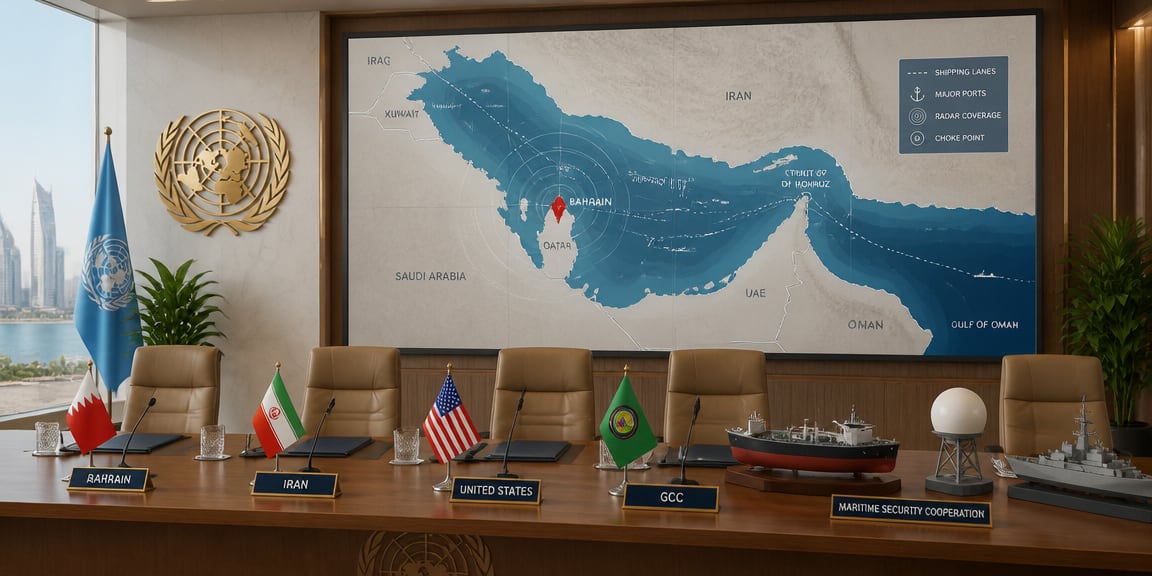
Bahrain says Iranian strike hit civilian industrial site; Tehran says it targeted US bases
Narrative Snapshot
Outlets converge that Bahrain reported an attack inside its territory and that Iran’s Islamic Revolutionary Guard Corps publicly framed recent operations as strikes on US military infrastructure in the kingdom. Where they diverge is over target characterization and immediate human impact. Iranian and several regional outlets emphasize claimed hits on US air-defense and radar assets, while Bahraini statements carried by international media stress damage to a “civilian industrial site,” with initial reports of no injuries later revised to two wounded.
Coverage outside the Gulf situates the Bahrain incident within a wider, maritime-centered escalation. Multiple reports link the strikes to tanker incidents in or near the Strait of Hormuz and to Iran’s concurrent assertions of downing or intercepting US drones. Reporting also reflects competing narratives about the war’s origins and trajectory: some frame renewed Gulf strikes as following US or US-Israeli actions earlier in the year, while others emphasize a resumption of Iranian attacks after a lull connected to talks.
Regionally, condemnation from Saudi Arabia, Qatar, and the UAE is prominent, with statements explicitly rejecting attacks on economic facilities and underscoring solidarity with Manama. Parallel references to Houthi activity against Saudi Arabia and to Oman-facilitated maritime corridor talks place the Bahrain episode within a multi-theater pressure campaign and a strained diplomatic track.
What Happened
Bahrain reported that an Iranian strike on Saturday sparked a fire at a “civilian industrial site,” later saying two people were wounded, one critically, and identifying the location as Sitra Island, which hosts major industrial facilities (Al Jazeera English; Middle East Eye; Bangkok Post). Iran’s Revolutionary Guard said its operations targeted US military positions in Bahrain, specifying Patriot air-defense assets at bases in al-Riffa and Awali, framing the action as a response to airspace violations and prior incidents around Qeshm Island (Al Jazeera English; Middle East Eye; Le Monde). Earlier in the week, Iran claimed a drone attack on a US radar system at Sheikh Isa Air Base; Bahrain said it intercepted that attempt after issuing an air-raid alert (South China Morning Post). The episode coincided with reports of two tankers being hit in the Strait of Hormuz and Iranian claims of downing a US drone, amid stalled efforts to end the war that began in late February (France24; Japan Times).
Why It Matters
The strikes test the security architecture anchoring US and Gulf cooperation, particularly in Bahrain, home to the US Fifth Fleet. Bahrain’s portrayal of a civilian site being hit pulls critical economic infrastructure into the line of fire, raising costs for regional energy and industrial operations, while Iran’s framing of US bases as legitimate targets underscores persistent contestation over American force posture in the Gulf (Haaretz; Al Jazeera English). Regional statements from Saudi Arabia, Qatar, and the UAE point to tightening Gulf coordination against cross-border strikes on “economic facilities,” even as earlier reporting noted a lull linked to ceasefire or de-escalation talks (Middle East Eye).
Maritime security is a parallel pressure point. Reports of tankers hit and of Iranian claims to have downed US drones intersect with ongoing talks involving Oman on safeguarding transit through the Strait of Hormuz, where shipping risks directly implicate global energy markets (France24; South China Morning Post). Separate reporting of additional US carrier deployments indicates Washington’s effort to underwrite deterrence, a signal that influences both adversary calculus and ally expectations (RT).
Diverging Narratives
Two incompatible framings dominate. Bahraini and several international outlets report a strike on a civilian industrial site, initially with no injuries but subsequently updated to two wounded, while Iran’s statements, echoed by some regional coverage, insist the targets were US military installations and air-defense assets at al-Riffa and Awali, and a US radar at Sheikh Isa (Al Jazeera English; Middle East Eye; South China Morning Post). This extends to battle-damage claims: Iranian media assert the “destruction” of a US radar and successful attacks in Kuwait as well as Bahrain, whereas Bahrain and other outlets emphasize interceptions, damage without casualties in earlier incidents, and investigation of a facility fire before casualty updates (Tehran Times; South China Morning Post; Middle East Eye, 18 Nov).
Attribution and sequencing are also framed differently. Some coverage ties Iran’s escalations to preceding US or US-Israeli actions, including strikes earlier in the year and an incident over Qeshm Island, alongside tanker attacks, suggesting a tit-for-tat dynamic (Le Monde; Japan Times; France24). Other reporting centers Iran’s intent to pressure or expel US forces and highlights direct threats against Bahrain’s monarchy, placing the episode within a longer-running contest over basing and regional influence (Fox News). Finally, while multiple sources note a lull since April linked to negotiations, the weekend’s events are presented as a break from that pattern, with regional condemnations underscoring renewed risk (Middle East Eye).
What Happens Next
Three decision points emerge from reported positions. First, the security posture in Bahrain: Manama’s claim of a civilian site being struck and Saudi statements of full solidarity set conditions for possible tightening of air and missile defenses and closer operational coordination with the US Fifth Fleet; indicators include new interception announcements, visible upgrades near Sitra, and US-Bahrain statements on base protection (Haaretz; Middle East Eye; Al Jazeera English). Second, the diplomatic track: references to stalled war-ending efforts and Oman-facilitated maritime corridor talks suggest a hinge between renewed escalation and containment; watch for public readouts from Tehran and Muscat, and whether regional condemnations translate into a coordinated GCC diplomatic initiative (France24; South China Morning Post; Middle East Eye).
Third, the maritime domain: incidents involving two tankers and Iranian drone claims elevate shipping risk; analysts should monitor navigational advisories, changes in naval escort patterns, and any CENTCOM or Fifth Fleet guidance that would signal recalibration of rules of engagement at sea (France24; Japan Times; South China Morning Post).