
South Korea’s education minister quits after AI-linked exam cheating prompts extraordinary security and 111 student violations
Narrative Snapshot
Across outlets, there is broad agreement that a single high-profile confession before the Suneung catalyzed a sweeping security response and, days later, the education minister’s resignation. UK and Hong Kong coverage emphasizes administrative turbulence around last‑minute measures and public backlash, with BBC and the South China Morning Post describing “chaos” or “backlash” tied to the anti-cheating checks. French coverage adds a societal lens: Le Monde characterizes an atmosphere of paranoia and a government‑led hunt for fraudsters, noting multiplying searches and public confessions.
What’s most contested is how the exam day itself unfolded. France24 reports the Suneung concluded “without any major incidents,” while BBC and RT highlight confusion created by emergency steps. There are also differences in emphasis on scale and instruments: France24 details intrusive protocols such as clothing stickers and a nationwide alert to expose phones; Clarin underscores a bounty program of up to $75,000 and public Wi‑Fi blocks; BBC reports 111 students caught with banned smart devices.
What Happened
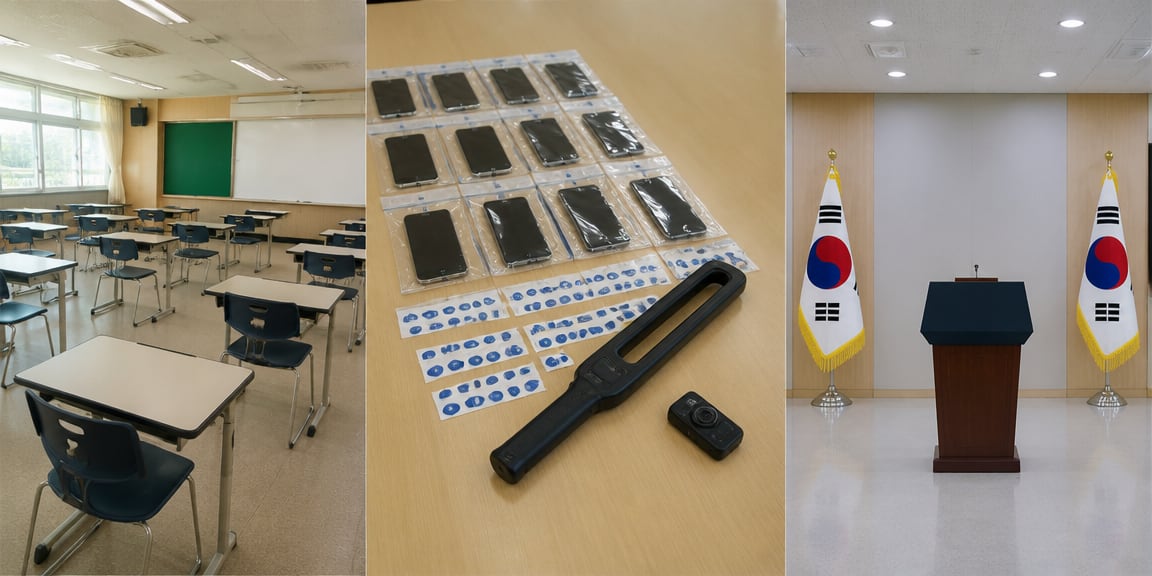
Days before South Korea’s nationwide Suneung university entrance exam, the top scorer in a national tax accountant test admitted to using a miniature camera to capture questions, relaying them to generative AI and retrieving answers on a smartphone. The confession, reported across outlets, prompted the prime minister to vow a crackdown and “mobilise all national capabilities,” including an emergency response team, bans on smart devices, expanded personnel, and intensified inspections of items such as glasses and clothing. On exam day, authorities deployed thousands of extra supervisors, placed stickers over clothing buttons, and sent a nationwide disaster alert to make even muted phones buzz. BBC reported that 111 students were caught with banned smart devices under the new regime. On November 22, Education Minister Choi Kyo‑jin resigned, acknowledging inadequate preparation; accounts differ on whether the heightened security caused disruptive confusion or delivered a largely incident‑free test.
Why It Matters
The episode exposes stress points in high‑stakes credentialing when consumer AI and covert hardware outpace established invigilation. For a system that channels more than 550,000 candidates through a single exam day, South Korea’s rapid escalation—from emergency teams to clothing inspections and a nationwide alert—signals the securitization of academic integrity and the administrative costs of acting on compressed timelines. Labeling AI‑assisted cheating a “social evil” and pledging “all national capabilities” shifts education oversight toward public‑safety style responses, raising durability questions about privacy‑intrusive tactics such as button stickers, device bans, Wi‑Fi blocking, and citizen bounties. Ministerial resignation reflects political accountability for preparedness gaps, and it sets a precedent for how governments may be judged when AI undermines core selection mechanisms. For decision‑makers, the trade‑off is between deterrence at scale and maintaining legitimacy for processes premised on fairness and proportionality.
Diverging Narratives
Outlets split on operational impact and societal framing. France24 emphasizes administrative control—“no major incidents”—despite extraordinary precautions. By contrast, BBC and RT foreground confusion from last‑minute measures, amplifying the political cost borne by the minister. Le Monde situates events within a broader clampdown ethos—“paranoïa,” multiplying searches, and public confessions—suggesting a climate of suspicion as much as enforcement.
They also diverge on what best evidences efficacy and proportionality. BBC highlights 111 students caught with banned devices, a concrete yield that can be read as either proof of necessary vigilance or as fallout from a sweeping net. France24 details novel tactics—the nationwide alert and clothing stickers—underscoring state capacity but also the novelty of measures typically seen outside educational settings. Clarin’s note on bounties up to $75,000 and Wi‑Fi blocking pushes the boundary of community‑based enforcement and network control, while RT’s granular account of the tax exam cheat—159 of 160 questions correct, 397.5/400—underscores the potency of AI‑enabled methods that existing safeguards failed to anticipate.
What Happens Next
Key decisions now revolve around institutionalizing or recalibrating emergency protocols. Authorities pledged “all national capabilities” to deter AI cheating; signals to watch include whether bans on smart devices, expanded physical inspections of clothing and accessories, disaster‑alert phone checks, Wi‑Fi blocking, and bounty incentives are retained, narrowed, or codified. Enforcement outcomes will indicate deterrence strategy: dispositions in the 111 cases and in the confessed tax exam scandal will show how violations are classified and punished. Political stewardship is another marker: after Choi Kyo‑jin’s resignation for inadequate preparation, subsequent ministerial guidance will reveal whether priority shifts toward earlier planning and targeted countermeasures over last‑minute, system‑wide sweeps. Finally, continued reports of searches or confessions, as described by Le Monde, will test whether intensified scrutiny dampens AI‑assisted attempts or drives adaptation to less detectable methods.