
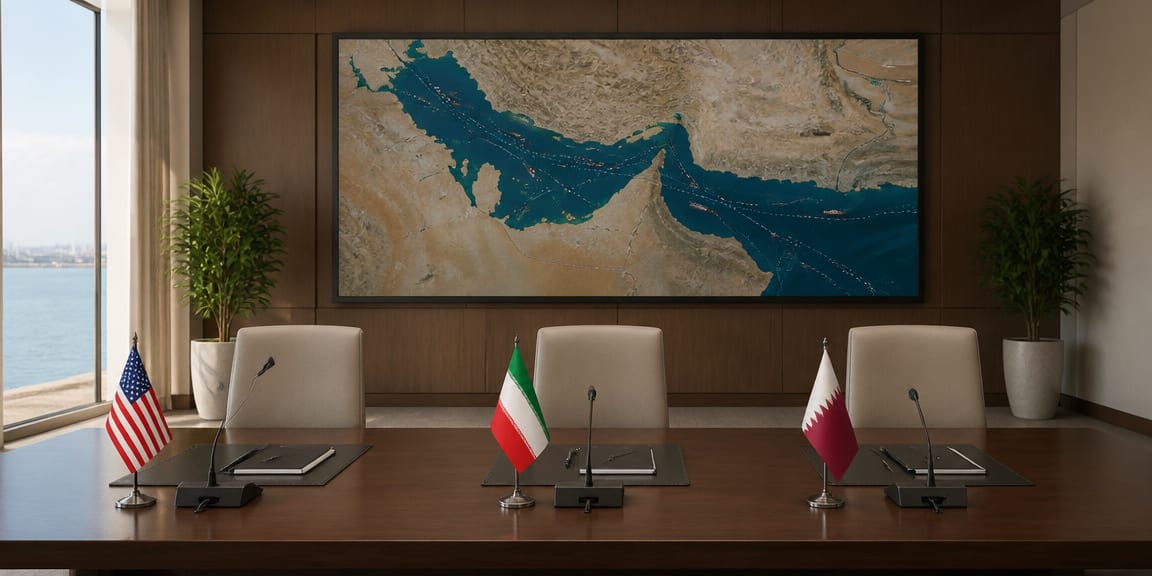
Qatar pushes to revive U.S.–Iran negotiations; Tehran confirms Qatari mediation as Washington balances talks and sanctions
Narrative Snapshot
Across the coverage, two strands are consistent: Qatar is actively mediating between Washington and Tehran, and all sides acknowledge ongoing indirect contacts. Al Jazeera and Middle East Eye foreground Doha’s effort to “revive the diplomatic track” after the Qatari prime minister’s meetings in Washington, pairing this with calls to avoid any new escalation. TASS, citing Donald Trump, reinforces the point that indirect talks are continuing, explicitly naming Qatar as the go-between.
The points of emphasis diverge on leverage and intent. Iranian Foreign Minister Abbas Araghchi publicly minimizes the singular importance of a Qatari visit by casting such mediation as routine, while separately signaling a conditional pathway to “reopening the strait.” U.S.-facing reporting splits between diplomatic messaging and coercive moves: Clarin notes Secretary of State Marco Rubio’s praise for Qatar’s mediation on the same day Washington sanctioned Iranian financial networks, while Indian and Canadian coverage highlights uncertainty over Trump’s willingness to seek any deal at all. What is most at stake, as framed by Doha, is averting another round of U.S.–Iran attacks and steering the conflict back into a negotiable channel.
What Happened
Iran’s foreign minister said Tehran had engaged Qatari mediators and argued that “reopening the strait” would be “not difficult” if the United States accepted what he called reasonable conditions, according to Al Jazeera on November 21. The next day, Middle East Eye reported Abbas Araghchi downplayed the significance of a visiting Qatari delegation, describing such intermediary contacts between Iran and the U.S. as commonplace; Qatar did not comment on the talks. Also on November 22, TASS reported that Donald Trump said U.S.–Iran indirect talks were continuing with Qatar as mediator. On November 23, Middle East Eye reported that Qatari Prime Minister Sheikh Mohammed bin Abdulrahman bin Jassim Al Thani, after meeting U.S. Secretary of State Marco Rubio, said Doha was working to revive negotiations and stressed that the region could not afford new escalation, with an aim to deepen U.S.–Qatar defense cooperation. Argentina’s Clarin the same day said Rubio thanked the Qatari premier for global mediation efforts and noted new U.S. sanctions on Iranian financial networks. On November 24, Al Jazeera again highlighted Qatar’s push to de-escalate, while The Hindu and the Toronto Star reported that Vice President JD Vance and Rubio met the Qatari premier amid uncertainty over Trump’s intentions, including a claim that Trump told Vance the administration did not need a deal with Iran.
Why It Matters
The reporting situates Qatar as a central interlocutor at a moment when diplomatic, coercive, and domestic political signals are pulling in different directions. Doha’s effort to restart talks while reinforcing defense ties with Washington underscores how U.S.–Gulf security partnerships are being leveraged to manage U.S.–Iran flashpoints, with Qatari officials explicitly linking resumed diplomacy to ending war and preventing renewed attacks. Tehran’s statement about “reopening the strait” raises the stakes around a strategic maritime chokepoint, indicating that de-escalation could hinge on U.S. acceptance of Iranian conditions.
For decision-makers, the mix of continued indirect talks, fresh U.S. sanctions on Iranian financial networks, and reporting that Trump told the vice president a deal was unnecessary collectively points to a negotiation environment in which diplomatic channels are open but policy priorities are unsettled. This affects calculations for allied governments, multilateral actors monitoring regional security, and any prospective framework that would trade de-escalatory steps for sanctions relief or other guarantees.
Diverging Narratives
Iran’s messaging couples conditional openness with normalization of mediation. Al Jazeera quotes the foreign minister’s claim that reopening the strait is feasible if the U.S. accepts “reasonable conditions,” a formulation that frames de-escalation as contingent on Washington’s moves. Middle East Eye then records Araghchi’s effort to lower the temperature around a specific Qatari visit, portraying intermediary shuttling as routine and withholding any detail on substance; Qatar itself “has not commented on the talks.”
On the U.S. side, two tracks surface. TASS relays Trump’s statement that indirect talks continue with Qatar mediating, aligning with Doha’s portrayal of an active diplomatic channel. Yet Clarin reports U.S. sanctions on Iranian financial networks alongside Rubio’s praise for Qatar’s role, and The Hindu cites a claim that Trump told JD Vance the administration did not need a deal, directing focus to domestic priorities after Republican midterm losses. Canadian coverage mirrors the uncertainty over Trump’s intentions while confirming the Vance and Rubio meetings with the Qatari premier. The combined effect is a live channel mediated by Qatar, paired with coercive measures and ambiguous end goals from Washington.
What Happens Next
Key decision points turn on whether the United States engages with any Iranian “reasonable conditions” tied to reopening the strait and whether indirect contacts mature into a defined negotiating track. Acceptance or rejection of such conditions, as flagged by Iran, would directly affect prospects for maritime de-escalation. Analysts should watch for explicit U.S. responses to Iran’s linkage and any Qatari statements that move beyond process to substance.
A second pivot is how Washington balances sanctions and diplomacy. Clarin’s report of new sanctions amid praise for mediation suggests parallel tracks; additional designations or, conversely, signals of restraint will shape Tehran’s incentives. Finally, U.S. political signaling matters: TASS’s account of continuing talks contrasts with The Hindu’s report that Trump told the vice president a deal was unnecessary. Public statements from Trump, Vice President JD Vance, or Secretary Rubio, and any Qatar–U.S. defense announcements referenced by Doha, will indicate whether mediation gains structure or remains limited to indirect exchanges.