
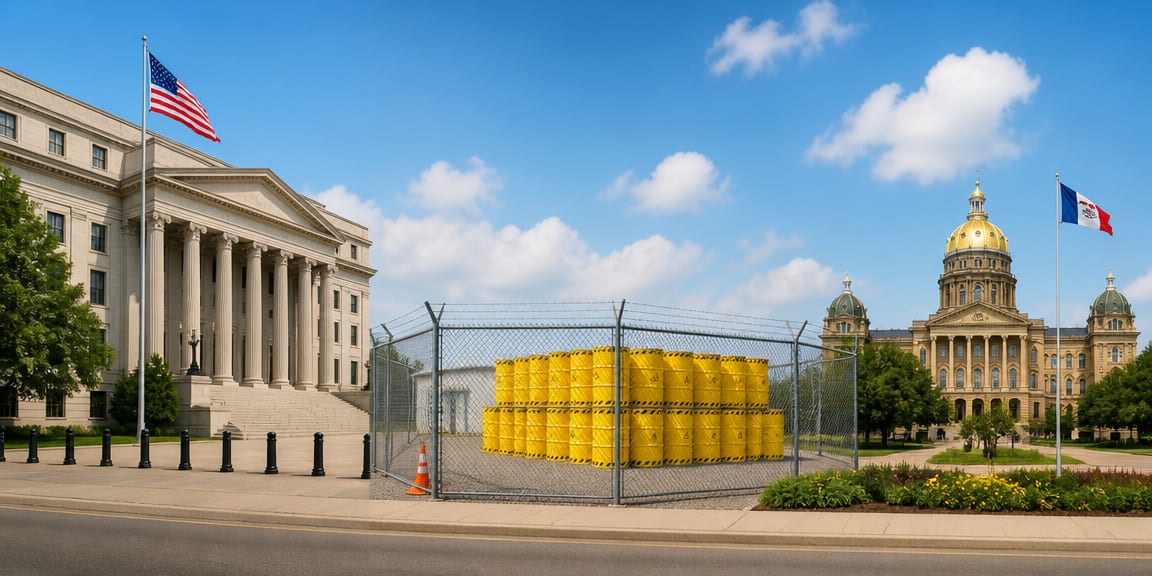
Trump pauses Iowa Army detonation of lead azide pending court outcome and governor-elect’s assent
Narrative Snapshot
Across U.S. coverage, the fulcrum is presidential restraint after an initial move toward expedited action. The New York Times distilled the message to a wait for the legal challenge, while Fox News detailed conditions President Donald Trump attached to any detonation: a green light from the Eighth Circuit and explicit agreement from Iowa’s Democratic governor-elect, Rob Sand. The Toronto Star likewise emphasized deference to the federal appeals court, and Al Jazeera focused on the fact of further postponement.
International outlets sharpen different edges of the story. TASS framed the decision as left entirely to the governor-elect, a stronger claim than U.S. sources’ dual-caveat framing. Indian daily The Hindu and Argentina’s Clarín instead emphasized the legal pivot: an appeals court’s removal of a prior barrier and a federal court’s authorization to proceed, even as opposition coalesced around toxic exposure risks. Clarín also reported the Army’s view that a controlled blast is safer, a potential dispersion radius of up to 160 km, and the cancellation of an alternative neutralization plan. What is most at stake is less the basic chronology than the balance among emergency executive authority, judicial oversight, state-level consent, and risk management for an unusual hazardous disposal problem.
What Happened
Over the weekend, the administration told a court it would detonate 68 barrels of lead azide at the Iowa Army Ammunition Plant using emergency legal powers that could bypass a blocking order, according to CBC News. By Monday, President Trump publicly said the Army should wait until the legal challenge is resolved, the New York Times reported, and he ordered a hold unless both the Eighth Circuit and Iowa governor-elect Rob Sand approve, Fox News and the Toronto Star noted. Fox added that the Army pushed its target date to Wednesday after successive postponements. The Hindu reported that an appeals court lifted a prior stay that had blocked detonation, while Clarín said a federal court authorized the operation despite opposition and presidential intervention. Al Jazeera said Trump further postponed the plan. Opponents warn of toxic lead dust, and Fox reported the Army expects lead-containing particles in the air.
Why It Matters
The episode tests the interplay of emergency executive authority, judicial oversight, and state-level consent in environmental risk decisions at federal defense sites. CBC News’ account of planned use of emergency powers, followed by a presidential pause tied to both a federal appeals court and a governor-elect’s assent reported by Fox News and the Toronto Star, highlights an atypical sequencing of authority that could shape how similar hazardous disposals are governed. The Hindu and Clarín’s reporting that courts cleared the path underscores the judiciary’s central role in arbitrating contested mitigation methods. For decision-makers, the case concentrates questions around process legitimacy, federal–state coordination, and risk communication when immediate disposal is argued by the Army to be safer, yet local stakeholders fear toxic exposure. It also surfaces a precedent for conditioning federal action on state leadership’s agreement, as emphasized by Fox News and TASS.
Diverging Narratives
Coverage diverges on who effectively holds a veto. Fox News quotes President Trump conditioning any detonation on both an appeals court ruling and governor-elect Rob Sand’s approval, whereas TASS asserts the president “left the decision entirely” to Sand. U.S. outlets also vary in emphasis: the New York Times stresses awaiting a legal decision, while Al Jazeera underscores continuing postponement. In contrast, The Hindu and Clarín foreground the legal green light—lifting of a stay and federal authorization—suggesting the main barrier is now political and executive rather than judicial. On risk and method, Clarín reports the Army views a controlled blast as the safer course, potential lead dispersion up to 160 km, and cancellation of an alternative neutralization plan; other outlets focus on anticipated “lead-containing particles” or a toxic lead dust cloud without those additional specifics (Fox News; The Hindu). Finally, CBC News highlights the initial intent to proceed under emergency powers despite a court order, setting up a tension with subsequent reports of a presidential pause and conditionality.
What Happens Next
Two decision points emerge from the sources. First is state assent: Fox News reports the president conditioned any detonation on governor-elect Rob Sand’s approval, and TASS portrays the choice as his to make. If Sand agrees—and with The Hindu and Clarín reporting that courts have removed earlier legal barriers—the Army could proceed; without his assent, Fox quotes the president saying the operation will not go forward. Second is operational timing and method: Fox notes rolling postponements as the Army re-sets schedules, while Clarín says a federal court has authorized detonation and that an alternative neutralization plan was canceled, narrowing options if that remains the case. Analysts should watch for explicit statements from Sand, any additional court directives clarifying the scope of authorization, and whether the Army issues a definitive schedule or pursues further delays.