
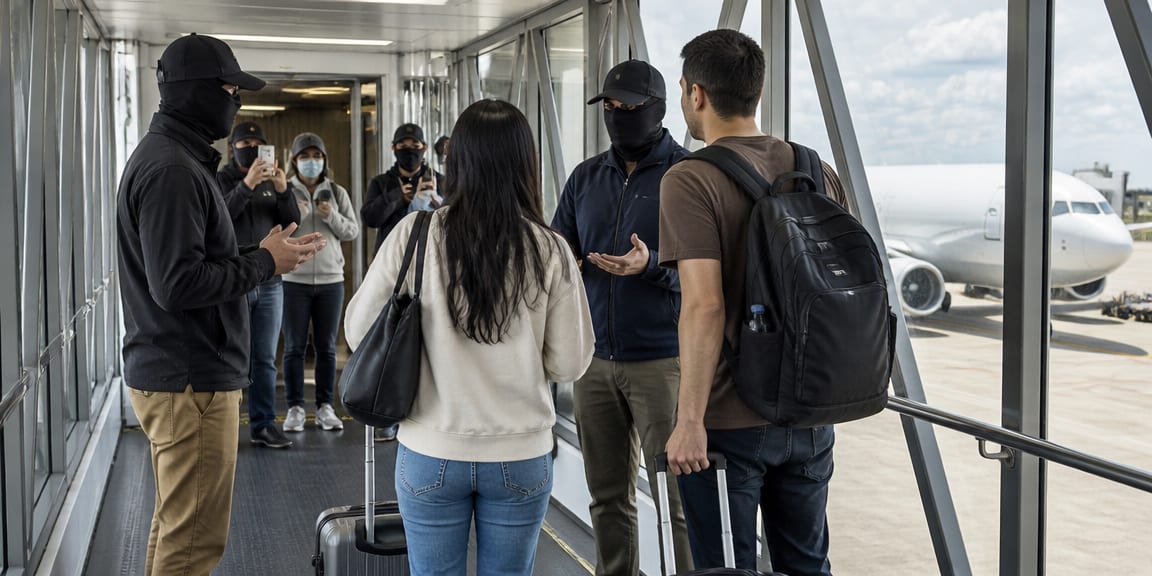
ICE detains two passengers on Seattle jet bridge; officials condemn tactics as DHS cites visa overstays
Narrative Snapshot
Across outlets, there is broad agreement on core facts: masked, unmarked immigration agents detained two passengers on a Seattle-Tacoma jet bridge as an Alaska Airlines flight boarded, with bystander video capturing a chaotic, distressing scene. International and U.S. coverage consistently foregrounds the human impact and optics. Italian media described an “angosciante” and “shocking” episode, echoing Alaska Airlines staff who called it “agony-inducing” and “distressing” (ANSA; Corriere della Sera; South China Morning Post). Al Jazeera, France24, the BBC, CBC, and The Guardian frame the footage itself as central to the public reaction and official condemnation.
Where outlets diverge is in emphasis and causal framing. State and local officials in Washington denounced ICE’s tactics as “un-American” and “out of control,” and the governor raised the prospect of a state law on law enforcement face coverings being breached (The Guardian; CGTN; France24). By contrast, DHS/ICE communications and sympathetic coverage stressed the underlying immigration violations and an alleged assault on officers, naming the two as Mexican nationals and asserting both had overstayed visas (Fox News; Telesur; Clarín). Canadian and Indian reporting foregrounds defense counsel claims that the pair were en route to a family baptism and seeking asylum, locating the incident in the protection context rather than solely enforcement (Toronto Star; The Hindu).
A parallel strand in the news cycle anchors the Seattle events in a broader pattern of airport enforcement. Days earlier, ICE detained a Chinese Princeton neuroscience PhD student at Washington’s Reagan National Airport; DHS said she overstayed in 2016 (South China Morning Post; The Guardian; Toronto Star). That case situates airports as active venues for “targeted” immigration operations and extends the debate beyond Seattle to academic mobility and due process implications.
What Happened
During boarding of an Alaska Airlines flight to Los Angeles on Saturday, masked immigration agents in unmarked attire detained two passengers on the Seattle-Tacoma International Airport jet bridge, prompting screams, delays, and widespread bystander filming (South China Morning Post; Corriere della Sera). Washington Governor Bob Ferguson and Seattle’s mayor condemned the tactics; Ferguson called ICE “out of control” and suggested agents may have violated a state limit on law enforcement face coverings (CGTN; The Guardian). DHS/ICE said both detainees had overstayed visas, identified one as Ricardo Larrondo Mendoza, and alleged the second, Sofia Hernández Mejía, also a visa overstay, threw hot coffee at officers and would face an assault charge (Fox News; Telesur; Clarín). A lawyer representing the pair said they are a father and daughter traveling to a family baptism and seeking U.S. asylum (Toronto Star; The Hindu). Protests at Sea-Tac followed on Sunday amid heightened security (The Guardian; Fox News).
Why It Matters
The episode tests fault lines between federal immigration authority and state-local oversight in critical infrastructure spaces. Washington’s governor raised potential conflict with a state law on law enforcement face coverings, putting state legal constraints on federal operations into focus (CGTN). The clash extends to airport governance, as bystander video and airline statements about passenger distress draw carriers and airport authorities into the operational fallout of immigration enforcement at the gate (South China Morning Post; Corriere della Sera). Nationally, CGTN situates the arrests within a continued Trump-era crackdown post-midterms, while Fox News references a congressional push to restrict airport arrests, signaling prospective oversight and legislative activity around TSA-ICE coordination (CGTN; Fox News). The Princeton case underscores implications for international students and researchers transiting U.S. airports, raising questions for universities and foreign governments about exposure to enforcement tied to historical status issues (South China Morning Post; The Guardian; Toronto Star).
Diverging Narratives
Two frames dominate. One centers on tactics and civil norms: multiple outlets highlight masked, unmarked agents removing a family on a jet bridge and quote state and local leaders labeling the conduct “un-American,” “out of control,” and traumatizing for passengers and staff (The Guardian; CGTN; France24; ANSA; Corriere della Sera; South China Morning Post). The other centers on statutory violations and officer safety: DHS and aligned coverage emphasize that both individuals allegedly overstayed visas, identify them as Mexican nationals, and report an alleged coffee-throwing assault that triggered a second arrest and expected federal charges (Fox News; Telesur; Clarín).
There is also a contest over public order implications. The Guardian reports protests through the airport after the video went viral, whereas Fox News characterizes demonstrators as agitators who disrupted security lines and taunted police during peak travel (The Guardian; Fox News). Finally, accounts diverge on legal posture: defense counsel places the Seattle detainees within the asylum process and a family religious trip, while DHS frames the matter as targeted enforcement for prior status violations (Toronto Star; The Hindu; Fox News). The Princeton detention broadens the lens to targeted airport operations against long-standing overstays, drawing coverage that spotlights academic vulnerability rather than street-level disorder (South China Morning Post; The Guardian; Toronto Star).
What Happens Next
Several decision points emerge. In Washington state, officials signaled potential legal scrutiny of ICE’s masking and identification practices; any state review or litigation would test the reach of state constraints over federal conduct at airports (CGTN). Federally, DHS indicated an assault case would be pursued against Sofia Hernández Mejía; charging documents and court proceedings will clarify the criminal track alongside immigration adjudication for both detainees (Fox News; Telesur). Defense claims of asylum-seeker status introduce parallel protection processes; watch for filings or credible-fear interviews that could shift the legal framing reported by Canadian and Indian outlets (Toronto Star; The Hindu).
Operationally, airport and airline responses bear watching: Alaska Airlines’ description of passenger distress and Fox-reported escalated security posture during protests could precipitate revised coordination protocols between Port of Seattle police, TSA, and ICE. On Capitol Hill, reporting of efforts to curb airport arrests signals prospective oversight that may influence future enforcement at transportation hubs (Fox News). The Princeton case remains a barometer for how ICE communicates and prioritizes airport “targeted” operations involving students and researchers (South China Morning Post; The Guardian; Toronto Star).