
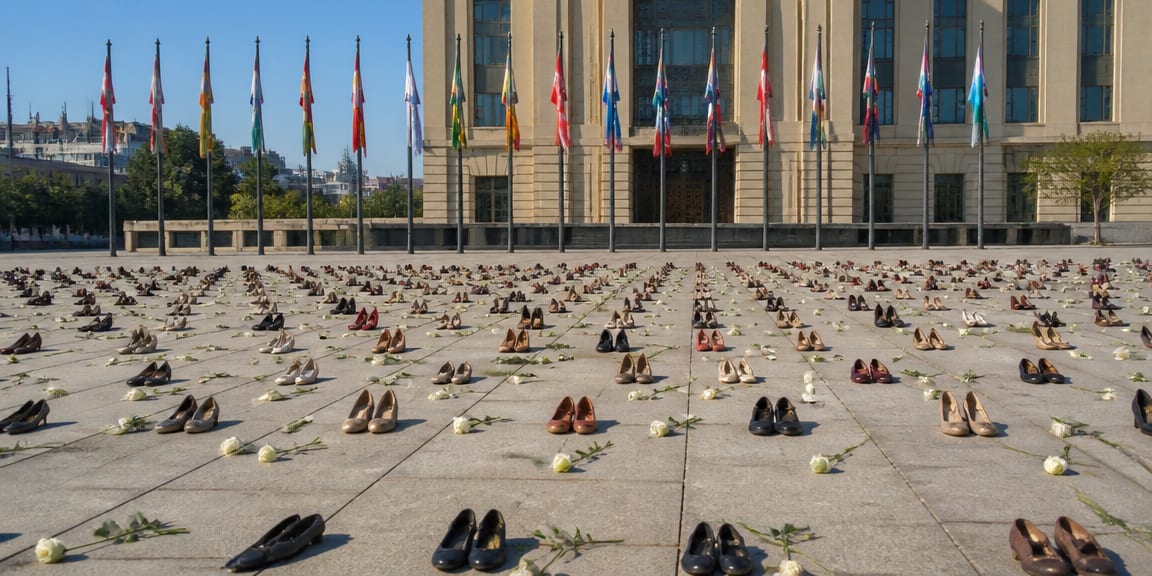
UN data show about five women killed hourly by partners or relatives in 2025, amid low reporting and stalled progress
Narrative Snapshot
International outlets converge on the UN’s core finding that killings of women by partners or family members remain persistently high, with Deutsche Welle and Al Jazeera anchoring their coverage in the “five per hour” rate and the characterization of home as the most dangerous place for women and girls. Le Monde emphasizes structure over cadence, highlighting that women comprised 19% of homicide victims globally in 2025 but that 60% of these killings occurred in the private sphere, a context that accounts for only 11% of male homicides, and notes the lack of progress year to year.
CGTN integrates the UN Women Access to Justice report with the Femicide Brief produced with UNODC, linking lethal violence to systemic barriers: nearly one in three women experience physical or sexual violence; only 23% seek help and just 7% report to police. Clarin localizes these dynamics in Argentina, reporting that half of adult women experienced partner violence and that most femicide victims had not previously filed complaints, framing a criminal justice system shortfall alongside underreporting. The Times of Israel introduces a policy response lens, reporting a 165% spike in domestic abuse cases referred for electronic monitoring and nearly doubled tagging orders, while a nonprofit counts 166 women murdered over five years—illustrating a judicial tool being scaled amid ongoing lethality.
A smaller divergence sits in how stagnation is framed. Le Monde and Al Jazeera stress that the pattern has barely shifted, and Folha de S.Paulo situates this stasis against declining overall homicide in several regions. Folha’s article also prints “more than 47 million” women and girls killed by partners or family in 2025; all other outlets cite about 47,000 and 129 per day from the UN Women–UNODC brief.
What Happened
UN Women, alongside UNODC, reported that an estimated 78,000 women and girls were intentionally killed worldwide in 2025, of whom approximately 47,000—around 60%—were killed by intimate partners or family members, averaging 129 victims per day, or about five per hour, according to CGTN and Deutsche Welle. Le Monde adds that women constituted 19% of homicide victims globally, yet most women killed were murdered in the private sphere, a profile far less common among male homicide victims. Al Jazeera underscores UN Women’s assessment that the home remains the most dangerous place for women and girls and that this pattern has barely shifted. Complementing the lethal-violence brief, CGTN reports UN Women findings that nearly one in three women experience physical or sexual violence, only 23% seek help, and just 7% report to police. Clarin cites similar help-seeking constraints in Argentina and notes that most femicide victims there had not made prior complaints. The Times of Israel reports a national policy response: a 165% surge in domestic abuse cases referred for electronic monitoring and nearly doubled court-ordered tags.
Why It Matters
The UN figures indicate that overall homicide reductions in some regions have not translated into fewer killings of women by partners or relatives, as Folha de S.Paulo notes, suggesting that generalized anti-violence strategies are insufficient without measures tailored to private-sphere risk. Le Monde’s comparison of homicide contexts by sex underscores the specificity of femicide’s setting, with implications for policing, judicial protection, and social services that operate at the household level. UN Women’s access-to-justice findings—only 23% seeking help and 7% reporting to police—point to systemic barriers that limit the reach of criminal justice and welfare interventions.
National responses, such as Israel’s sharp increase in electronic monitoring orders reported by The Times of Israel, illustrate one preventive tool courts can scale, but Clarin’s account that most femicide victims in Argentina had not previously complained signals the limits of complaint-led systems. For governments and multilateral bodies, the persistence highlighted by Al Jazeera and Le Monde raises questions about institutional capacity to intervene before escalation and the need to integrate survivor access pathways with enforceable protective measures.
Diverging Narratives
Outlets differ in framing the same underlying dataset. Deutsche Welle and Al Jazeera lead with the per-hour cadence to convey urgency, while Le Monde stresses structural asymmetries—women’s homicides concentrated in private settings—and the lack of progress over time. CGTN binds the femicide brief to UN Women’s access-to-justice evidence, shifting the emphasis from enumeration to systemic obstacles: widespread prevalence, low help-seeking, and very low police reporting.
Regional reporting introduces varied accountability lenses. Clarin foregrounds Argentina’s prevalence of partner violence and the fact that most femicide victims had not filed prior complaints, presenting underreporting and judicial failures as twin constraints. The Times of Israel highlights court practice, noting a 165% spike in domestic abuse cases referred for electronic monitoring and nearly doubled tagging orders, pointing to expanded use of a specific judicial control even as a nonprofit records 166 women murdered over five years. Quantitatively, most outlets cite approximately 47,000 women and girls killed by partners or relatives in 2025, or 129 per day, aligning with the UN Women–UNODC brief reported by CGTN. Folha de S.Paulo departs by printing “more than 47 million,” while still describing the figure as nearly five per hour and largely unchanged year to year, and noting that declines in overall homicide have not reduced these killings.
What Happens Next
Two decision points emerge from the reporting. First is whether judicial systems expand preventive controls. The Times of Israel documents rapid growth in electronic monitoring orders; further increases, changes in criteria, or evaluations of their use will signal whether such tools are institutionalizing as standard practice. Second is how authorities address access barriers identified by UN Women and CGTN: with only 23% of survivors seeking help and 7% reporting to police, choices about proactive outreach, survivor services, and alternative reporting pathways will shape the system’s reach in contexts where Clarin notes victims often have not complained before being killed.
Analysts should watch whether future UN Women–UNODC briefs move the 129-per-day metric, whether outlets continue to report stagnation as Le Monde and Al Jazeera do, and whether countries where overall homicide is falling, as described by Folha de S.Paulo, adopt targeted domestic-violence measures that register in help-seeking and protective-order data.