
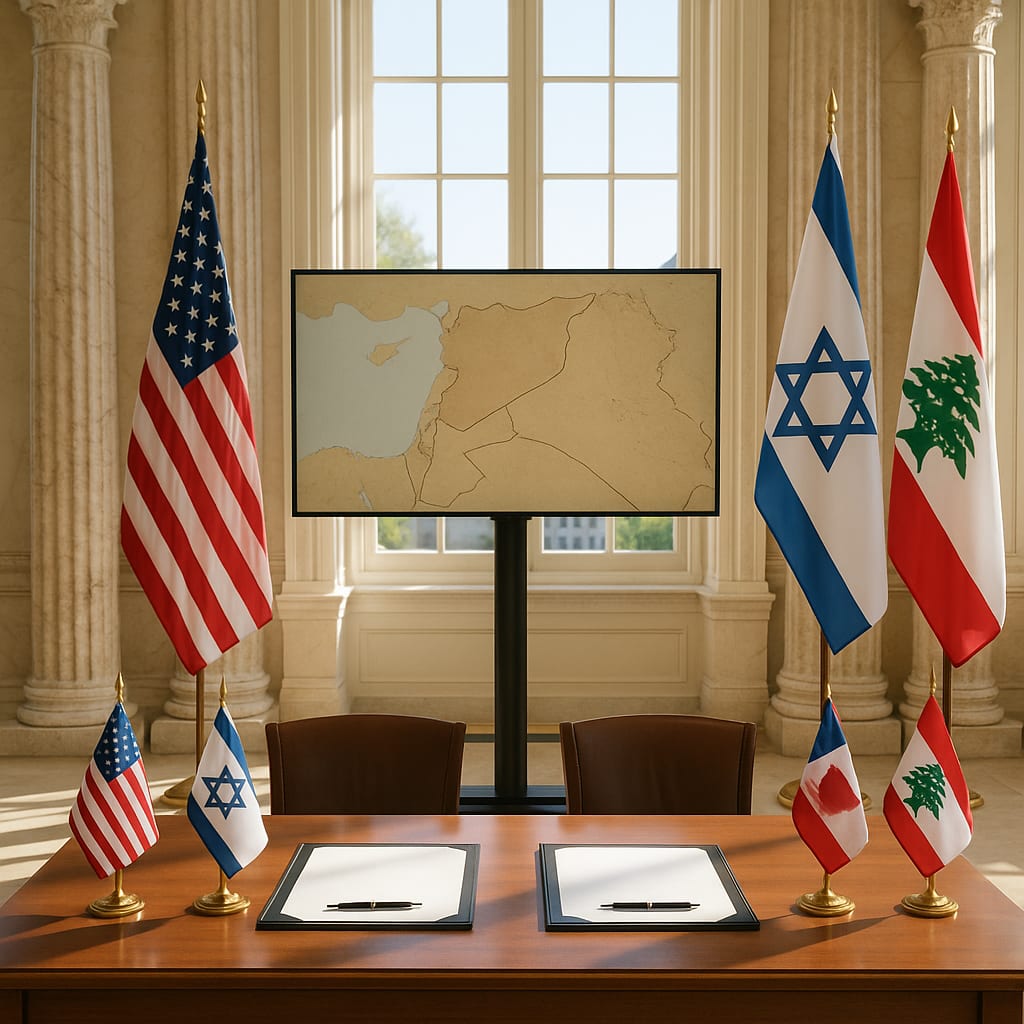
US-brokered Israel–Lebanon framework agreement signed in Washington
Narrative Snapshot
- Broad alignment: All outlets cite a US-mediated, State Department-hosted signing announced by Secretary of State Marco Rubio; most frame it as an initial, limited step rather than a final settlement.
- Substance framed differently: The Times of Israel and the New York Times highlight a “minor” Israel Defense Forces pullback from two areas in Lebanon, while the Japan Times reports Israel will maintain a “security zone” along the “yellow line” about 10 km inside Lebanon. Middle East Eye emphasizes a 14‑point text and casts the deal as aiming to end the war.
- Transparency gap: The Hindu reports that officials withheld details at the signing, even as Middle East Eye the next day published elements of the 14‑point framework.
- Political constraints surface unevenly: The Times of Israel links turbulence to a US‑Iran MOU that “almost derailed” talks; Middle East Eye cites Hezbollah lawmaker Hassan Fadlallah’s sharp criticism of the agreement’s enforceability in Lebanon.
What Happened
US Secretary of State Marco Rubio announced a trilateral framework agreement among the United States, Israel, and Lebanon signed at the State Department on June 26, 2026 (Deutsche Welle; TASS; Al Jazeera English). The Hindu notes the signatories were Israel’s ambassador to Washington, Yechiel Leiter, and Lebanon’s ambassador, Nada Hamadeh, with officials withholding detailed terms. Reporting diverges on substance: the New York Times and the Times of Israel describe Israeli agreement to withdraw from two areas in Lebanon after four days of Washington talks, while the Japan Times says Israel will maintain a “security zone” along the “yellow line” extending roughly 10 km into Lebanon. Middle East Eye reports the document comprises 14 points and follows five rounds of US-hosted talks, set against a conflict that has killed more than 4,000 and displaced over a million since October 2023.
Why It Matters
The agreement formalizes a US-brokered channel between Israel and Lebanon after months of direct talks, signaling renewed American capacity to orchestrate incremental de-escalation steps in a crowded regional diplomacy space (Deutsche Welle; Al Jazeera English; TASS). It introduces an agreed framework that, according to multiple reports, pairs limited Israeli withdrawals with continued border security arrangements, potentially shaping military postures and rules of engagement along the frontier (New York Times; Times of Israel; Japan Times). The optics—ambassadors as signatories and restrained detail disclosure—suggest a deliberately cautious approach to domestic constituencies and armed actors whose buy-in remains uncertain (The Hindu; Middle East Eye). For policymakers, the deal’s durability will hinge on implementation credibility in Lebanon, where enforceability is already questioned by Hezbollah figures, and on whether Washington can manage external linkages that, per the Times of Israel, have already stressed the talks.
Diverging Narratives
Outlets differ on the agreement’s weight and direction of travel. The New York Times and the Times of Israel emphasize modest, discrete steps—a “small” Israeli pullback from two areas—underscored by Rubio’s “beginning of the beginning” characterization. Middle East Eye instead centers the document’s breadth (a 14-point framework) and frames it as aimed at ending the war, while also highlighting domestic pushback via Hezbollah MP Hassan Fadlallah’s criticism of enforceability. The Hindu underscores opacity—no details at the signing—contrasting with Middle East Eye’s subsequent publication of elements, suggesting a managed rollout. On the security architecture, the Japan Times’ report that Israel will maintain a “security zone” along the “yellow line” sits in tension with narratives of withdrawal, implying a partial repositioning rather than a wholesale pullout. Process narratives also diverge: the Times of Israel introduces a US‑Iran MOU as a near-derailment factor not mentioned elsewhere, while Deutsche Welle and Middle East Eye stress the extended, US-hosted negotiation track since April with multiple rounds.
What Happens Next
- Implementing territorial steps: Watch for verifiable movement related to the reported Israeli withdrawal from two areas and how this coexists with the Japan Times’ “security zone” along the “yellow line.” Concrete indicators include official communiqués, mapped adjustments, and on-the-ground posture changes (New York Times; Times of Israel; Japan Times).
- Clarifying the framework: The gap between withheld details at the signing (The Hindu) and Middle East Eye’s 14‑point outline makes subsequent State Department or party briefings key signals of scope, sequencing, and monitoring arrangements.
- Domestic enforcement in Lebanon: Hezbollah lawmaker Hassan Fadlallah’s critique spotlights a decision point for Lebanese authorities on how, and whether, they can operationalize commitments. Monitor statements from Lebanese institutions and armed actors for acceptance, conditionality, or rejection (Middle East Eye).
- Sustaining the channel: Rubio’s “beginning of the beginning” implies further rounds. Analysts should watch scheduling and venue of follow-on talks, and any resurfacing of external linkages—such as the US‑Iran MOU issue flagged by the Times of Israel—that could again test the negotiations’ stability.