
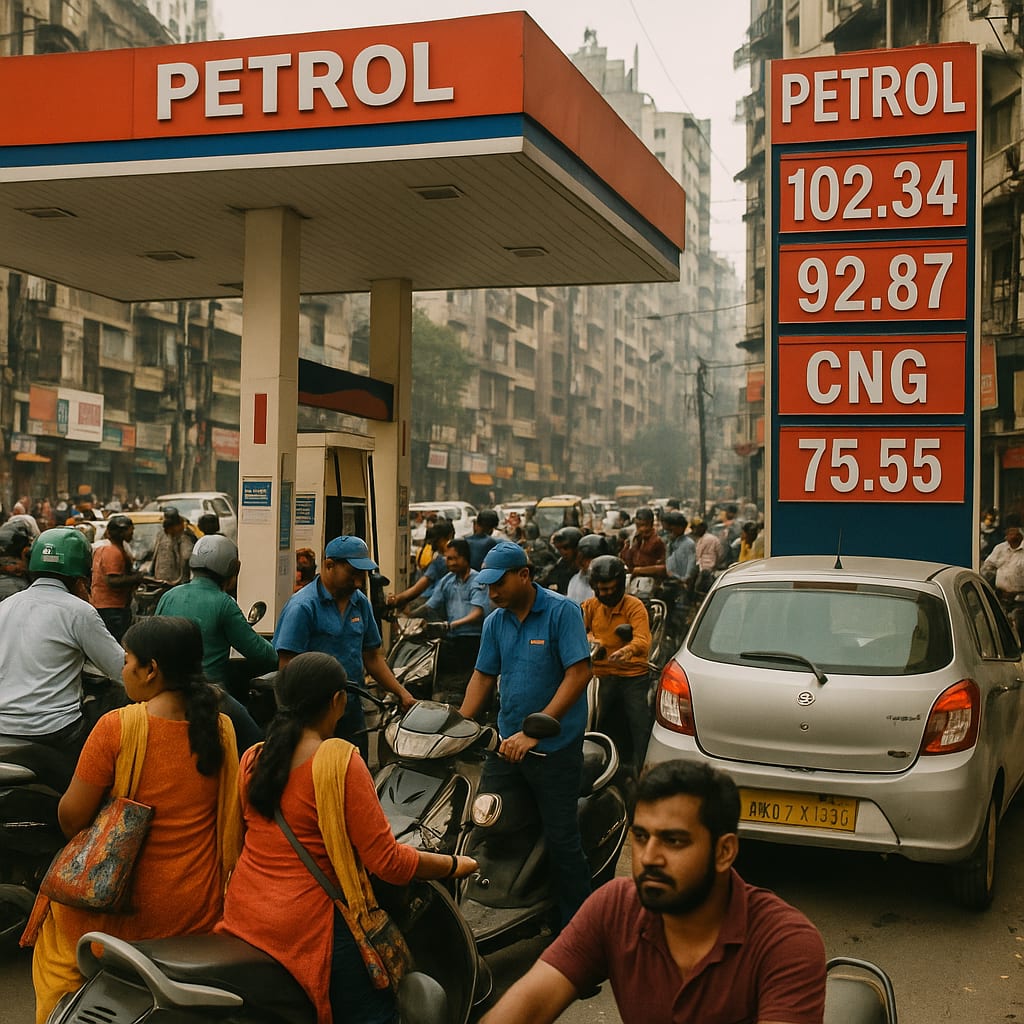
India Raises Fuel Prices Amid Global Oil Market Instability
In the midst of escalating tension in the Strait of Hormuz and fluctuating global oil prices, India's state-run refiners have raised the prices of diesel and petrol for the third time in eight days. This move is an attempt to mitigate losses from discounted sales and control a surge in demand, according to the South China Morning Post and Middle East Eye.
Context: Global Oil Market in Flux
The global oil market has been on a rollercoaster ride, with prices nearing a danger point that could trigger inflation, shortages, and eventually a recession, The Guardian suggests. The cost of crude oil for immediate purchase has hovered around $100 a barrel since Iran responded to the US-Israeli onslaught by closing the Strait of Hormuz, a vital passageway for global oil shipments.
However, recent developments suggest a potential easing of tensions. Hopes of a US-Iran peace deal have led to a significant decline in oil prices, with Brent crude futures dropping below $100 a barrel, as reported by the Middle East Eye, The Guardian, and ANSA. The US and Iran appear to be inching towards an agreement, although President Donald Trump has declared that the US blockade of the Strait of Hormuz will persist until an agreement is finalized.
Impact on India's Fuel Prices
As the world's third-largest oil importer and consumer, India has been hit hard by these global market fluctuations. The South China Morning Post and Middle East Eye report that India's state-owned fuel retailers have raised petrol and diesel prices multiple times this month in an effort to recover losses caused by escalating crude oil costs linked to the US-Israeli conflict with Iran and the accompanying disruptions to energy supplies.
In New Delhi, petrol now costs 102.12 rupees per litre, and diesel 95.20 rupees per litre, marking a cumulative increase of nearly 7.5 rupees per litre over the past two weeks.
Reactions and Implications
The ongoing volatility in the global oil market and the consequent impact on domestic fuel prices have significant implications for economies worldwide. As noted by Deutsche Welle, Iran's economic endurance in the face of sanctions and the US's struggle with elevated oil prices, renewed inflation pressure, and rising global recession risks are contributing to the heightened tension in the Strait of Hormuz.
Meanwhile, the United Arab Emirates (UAE) is fast-tracking an oil pipeline expansion to bypass the strait, as reported by the Mail & Guardian. This move indicates the extent of regional strategic shifts triggered by the current crisis.
Conclusion
Despite the turbulence, there seems to be a glimmer of hope for a resolution to the ongoing crisis. As per Middle East Eye, Iran has agreed in principle to reopen the Strait of Hormuz in exchange for the US lifting its naval blockade and addressing issues related to Tehran's stockpile of highly enriched uranium. While this agreement is yet to be finalized, it signals a potential end to the current standoff in the near future. However, the repercussions of the crisis on the global economy, particularly on countries like India, are likely to be felt for some time.