
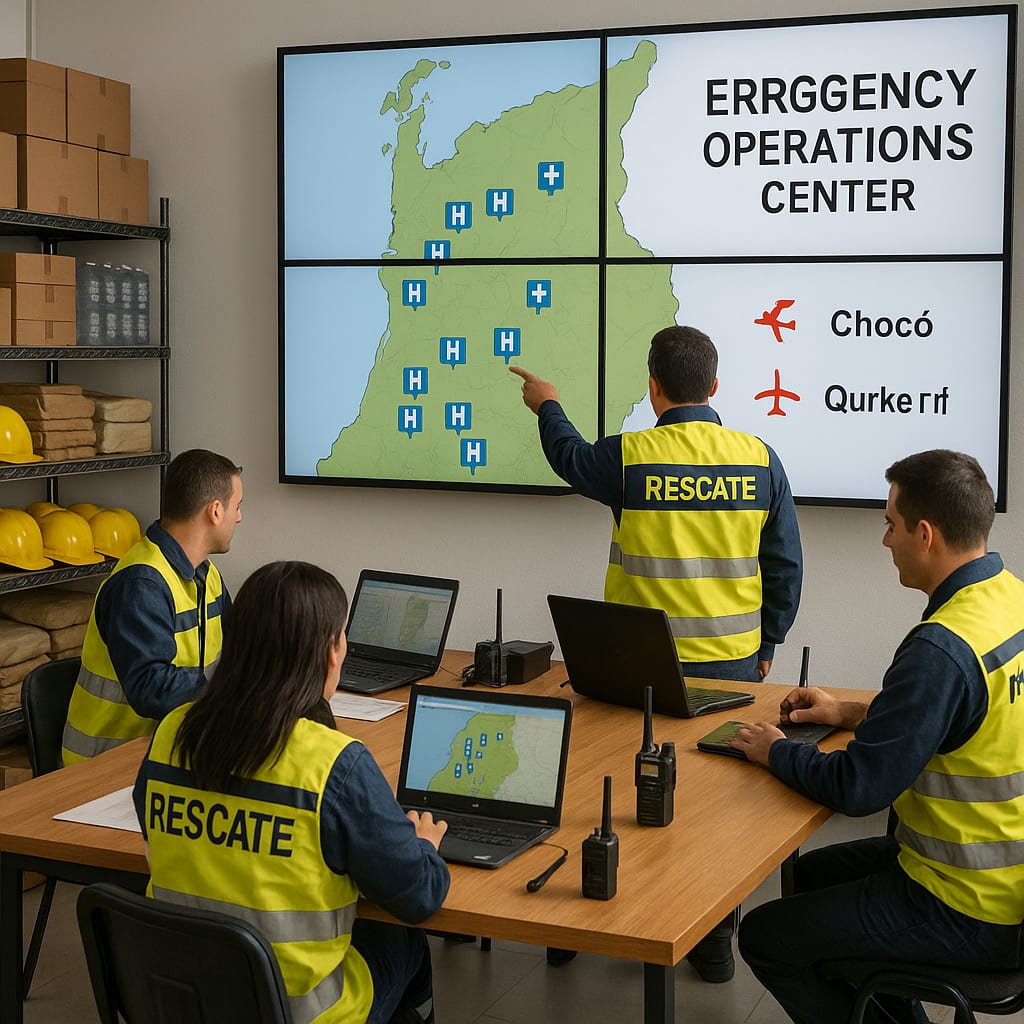
Colombia declares emergency after 7.4-magnitude earthquake in Chocó
Narrative Snapshot
Across outlets, there is broad alignment on core parameters and notable variation on scope, impact, and official framing. Multiple sources identify a magnitude-7.4 event with an epicenter near San José del Palmar in Chocó (The Hindu, South China Morning Post, NBC News, TASS), and they converge on the government’s decision to invoke extraordinary powers. Yet they describe that decision differently: a “national disaster” in Telesur English and Clarín versus a “state of emergency” in Le Monde, Bangkok Post, and TASS. Coverage also coalesces around western departments as the most affected, with Telesur English and Clarín highlighting Risaralda, Valle del Cauca and Chocó, and naming Pereira, Cali, Manizales, Quibdó, and Armenia among the hardest hit.
Casualty reporting diverges with the news cycle. Initial tallies put fatalities at “at least 71” (Telesur English) and 73 (Clarín), before rising to 111 in Le Monde and Bangkok Post. Telesur English later cites an “official” total of 111 and “dozens of collapsed buildings.” RT publishes the highest figures—138 dead, 570 injured—and uniquely reports a curfew in Cali, accompanied by graphic videos. Internationally, The Hindu, SCMP and NBC emphasize that the quake was felt in Ecuador and prompted evacuations, broadening the frame beyond Colombia. TASS adds institutional detail, citing the UNGRD and a unanimous emergency decision by the government. Clarín foregrounds cascading systems impacts—hospital infrastructure, airports, public services and transport—shifting attention from headline figures to operational strain.
What Happened
A powerful earthquake struck western Colombia on Monday, measured at magnitude 7.4 and centered near San José del Palmar in Chocó, according to national and US Geological Survey reporting carried by The Hindu, SCMP, NBC News, and TASS. Clarín places the event at 7:34 a.m. local time and cites an 82 km depth, while SCMP relays a USGS depth estimate of 107 km. The shock triggered evacuations in Colombia and neighboring Ecuador (The Hindu, SCMP, NBC). President Abelardo de la Espriella activated extraordinary measures—described as a national disaster by Telesur English and Clarín, and as a state of emergency by Le Monde, TASS and Bangkok Post—following an emergency government meeting referenced by TASS. Reports identify severe impacts across Chocó, Valle del Cauca and Risaralda, with cities including Pereira, Cali, Manizales, Quibdó and Armenia experiencing collapsed structures and trapped residents (Telesur English, Clarín). Fatality counts vary by outlet and update, ranging from at least 71 (Telesur English) to 111 (Le Monde, Bangkok Post; later Telesur English) and 138 (RT).
Why It Matters
The move to an emergency footing signals a test of Colombia’s disaster governance architecture and the National Unit for Disaster Risk Management’s coordinating capacity under acute, multi-city stress. TASS underscores the centralized decision process, while Clarín details disruptions to hospitals, airports, public services and transport, highlighting the cross-sector logistics challenge that follows a deep, region-wide seismic event. With evacuations reported in Ecuador by The Hindu, SCMP and NBC, the episode underscores the cross-border dimensions of Andean seismic risk and the case for interoperable protocols. Telesur English reports regional aid offers, indicating near-term pathways for Latin American support and the need to integrate external assistance with national response priorities. The choice and scope of legal instruments—variously described as a national disaster or state of emergency—matter for unlocking resources, streamlining procurement, and imposing public-order measures, all of which will shape immediate life-saving operations and medium-term recovery.
Diverging Narratives
Discrepancies center on impact and framing. Fatalities span multiple reported figures: at least 71 (Telesur English), 73 (Clarín), 111 (Le Monde, Bangkok Post; also Telesur English’s subsequent article), and 138 (RT), reflecting an evolving count and heterogeneous sourcing. Depth estimates also differ—82 km in Clarín versus 107 km via USGS reporting cited by SCMP—producing varied interpretations of shaking intensity and damage patterns. Most outlets identify the epicenter in San José del Palmar (The Hindu, SCMP, NBC, TASS), while RT’s presentation emphasizes Cali, including a reported curfew and videos of building failures; no other source in this set corroborates the curfew. On legal framing, Spanish- and French/English-language coverage splits between “desastre nacional”/“national disaster” (Telesur English, Clarín) and “state of emergency” (Le Monde, Bangkok Post, TASS). TASS adds procedural legitimacy—unanimous cabinet backing and the UNGRD’s role—whereas Clarín emphasizes cascading infrastructure failures. The Hindu, SCMP and NBC widen the aperture to include Ecuadorian evacuations, whereas others concentrate on Colombia’s internal toll and governance response.
What Happens Next
Key decision points will determine response trajectories. First, the scope and operationalization of emergency authorities—described variously across outlets—will shape resource allocation and public-order tools; official communiqués from the presidency and UNGRD, cited by TASS as leading coordination, will be the primary indicators. Second, casualty and damage assessments will likely continue to update; watch for reconciled figures from national authorities relative to the current range reported by Telesur English, Le Monde, Bangkok Post and RT. Third, external assistance: Telesur English reports Latin American aid offers, so formal acceptance, activation of bilateral mechanisms, and integration into logistics for hospitals, airports and transport—sectors flagged by Clarín—will signal the scale of international engagement. Finally, city-level measures, including any curfews or movement controls like the one reported by RT in Cali, and the status of collapsed structures and trapped persons, will indicate whether the response pivots from rescue to stabilization and recovery.