
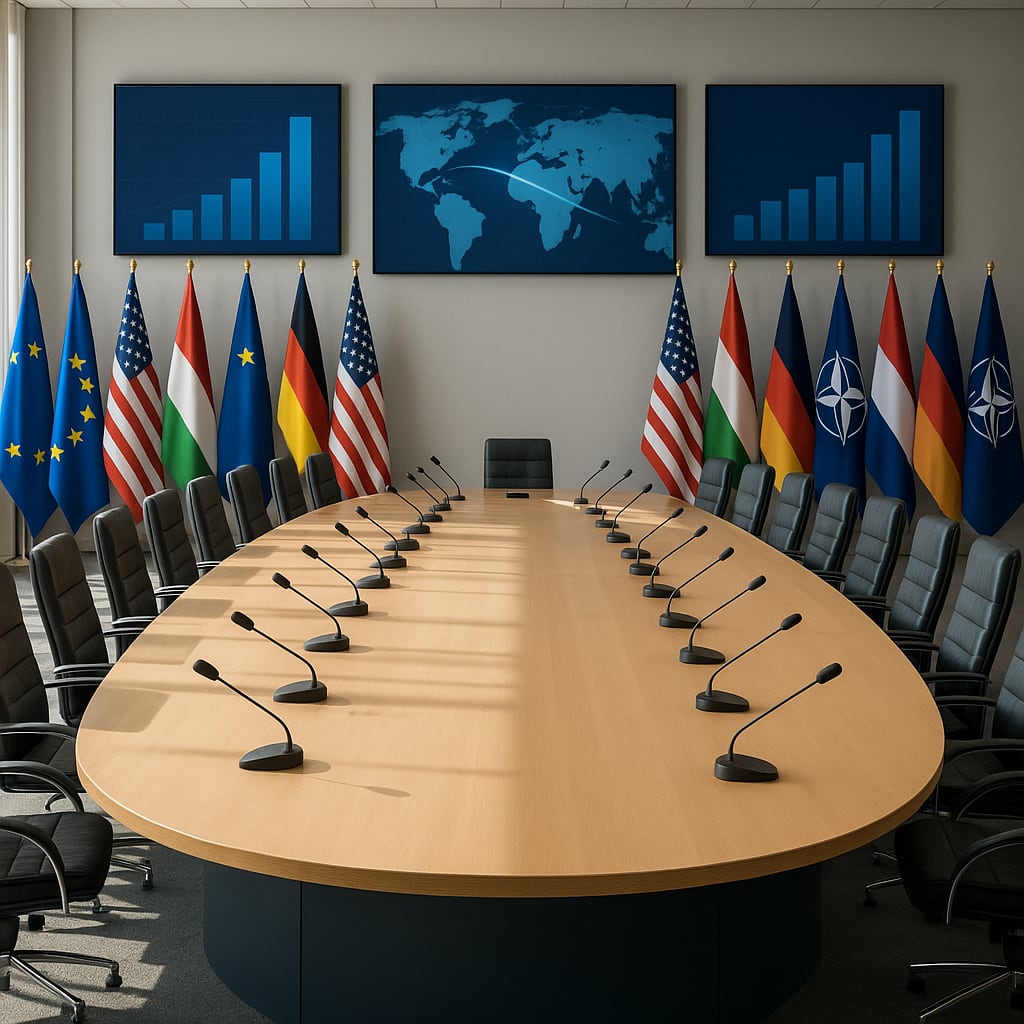
Ankara NATO summit forces concrete defense plans amid budget strain and procurement politics
Narrative Snapshot
- Broad agreement that European allies must table “clear, concrete and credible” roadmaps to meet the 5% of GDP target, with leaders highlighting recent spending increases but emphasizing delivery over declarations (DW; Guardian).
- Coverage splits on feasibility and instruments: some frame the push as a Trump-driven correction that must translate into real capabilities (Fox), while others foreground budget strain and industrial bottlenecks that could slow or distort rearmament (Japan Times; Guardian).
- Procurement direction is contested: Washington’s pressure intersects with a declared US interest in allies buying American systems (TASS), even as Europeans weigh alternative sources amid concerns about depleted US stockpiles (Guardian) and persistent intra-European fragmentation (Le Monde).
- Strategic framing diverges: calls for European self-reliance given a persistent Russian threat (La Repubblica) contrast with Russian state media portraying NATO’s course as an offensive bid to “defeat” Russia (RT). Middle East Eye centers Turkey’s agenda-setting role as host.
What Happened
On the eve of the Ankara summit (7–8 July), NATO Secretary General Mark Rutte urged allies to submit detailed national plans to meet the alliance’s new spending benchmark, set at 5% of GDP by 2035 at last year’s Hague meeting (Guardian; Japan Times; Fox). Washington’s pressure is explicit: US officials warned of “consequences” for members lacking credible pathways (Al Jazeera). Rutte said leaders intend to “show how they are investing in defense,” including signing defense contracts worth “tens of billions of dollars” at the summit (TASS). A US envoy to NATO stated Washington wants allies to purchase American weapons, arguing this would contribute to peace (TASS). Parallel reporting highlights recent European spending gains (DW) alongside concerns that US stockpile depletion from conflicts in Ukraine and Iran is constraining US arms deliveries to partners (Guardian).
Why It Matters
The summit tests whether NATO’s burden-sharing shift can be institutionalized into planning, procurement, and production — not only budgets. The push toward 5% by 2035 reframes alliance expectations and, per the New York Times, accelerates a model in which Europe leads more of NATO’s operational load as a US administration pushes to “do less” while others “do more.” That shift collides with practical constraints: fiscal trade-offs (Japan Times), US industrial shortfalls (Guardian), and fragmented European buildup that, as Le Monde notes, remains powerful but dispersed. Procurement politics are central: US calls for allies to “buy American” (TASS) run up against European incentives to onshore capability and reduce single-source risk. Outcomes will shape transatlantic defense market integration, industrial policy, and NATO’s ability to translate spending into interoperable force structures.
Diverging Narratives
Sources agree that allied spending is rising and must be paired with executable plans, but differ on attribution, feasibility, and intent. Fox frames the surge as a product of Trump’s “historic leadership” and stresses that commitments must become capabilities. The Guardian quotes Rutte channeling Trump’s expectation for urgent progress to 5%, while DW emphasizes Europeans’ need to demonstrate delivery. The Japan Times underscores fiscal strain from the 5% path, contrasting with TASS’s projection of “tens of billions” in new contracts as evidence of momentum.
Procurement narratives clash. TASS quotes a US envoy urging allies to buy American, implying an industrial policy vector within the burden-sharing debate. The Guardian, by contrast, highlights concerns that US stockpile depletion limits Washington’s ability to arm allies, pushing Europeans to consider other supply routes. Le Monde reports European militaries gaining strength “de façon dispersée,” spotlighting coordination deficits even as leaders seek to reweight NATO’s model (NYT).
Threat framing also diverges. La Repubblica’s interview with ex–NATO deputy commander Richard Shirreff warns Europe must prepare to defend itself “without external aid” against a potential Russian attack. RT characterizes NATO’s “new mission” as seeking Russia’s defeat, recasting allied modernization as offensive — a starkly different interpretation of intent than the deterrence and capability-building emphasis elsewhere.
What Happens Next
- Credible national plans: Watch whether allies publish timelines, capability targets, and budget baselines consistent with the 5% by 2035 commitment (Guardian; Japan Times). Al Jazeera’s reporting on unspecified US “consequences” makes subsequent US statements a key indicator of enforcement mechanisms.
- Contracting and suppliers: Track the scale and composition of contracts Rutte said would be signed at Ankara (TASS). Supplier mix will signal whether Washington’s push for American systems (TASS) prevails or if Europeans diversify to address US stockpile constraints (Guardian).
- Industrial capacity and coordination: Evidence of joint procurement, standardization, and production ramp-ups will test Le Monde’s observation of dispersed European efforts. Indicators include multinational frameworks and production expansion announcements.
- Alliance model and host-state leverage: The NYT’s “Europe-leading” model will be reflected in communique language on roles and capabilities. Middle East Eye’s focus on Turkey suggests attention to Ankara’s priorities shaping agenda items and deliverables.